Is the Tarantula Nebula bigger than a galaxy?
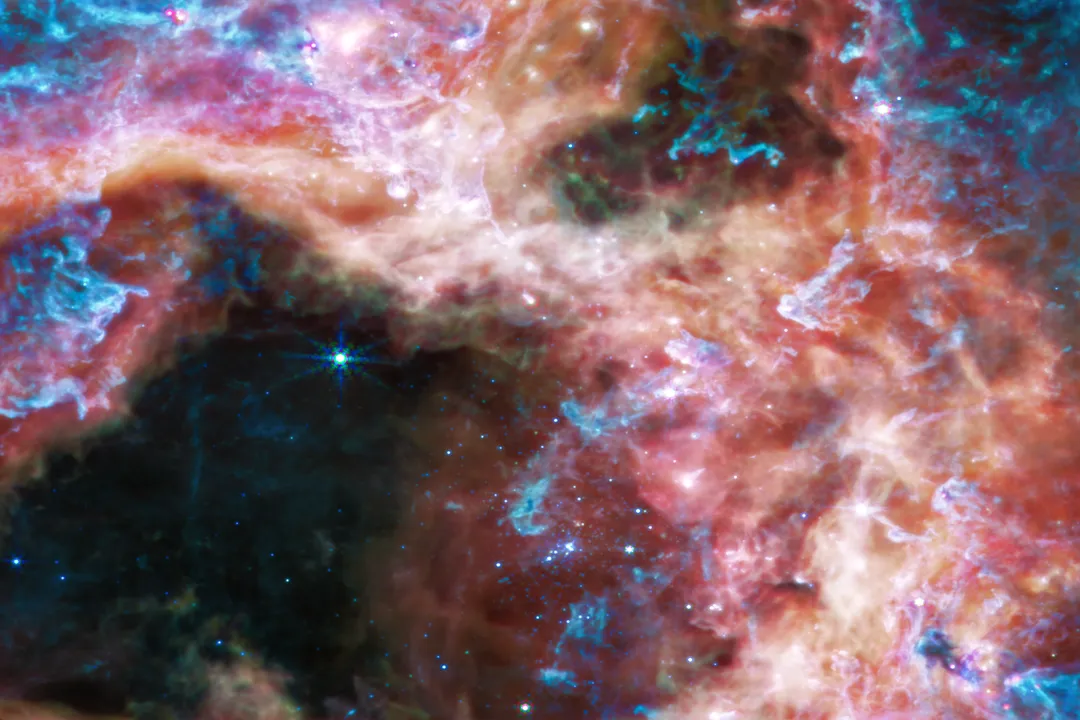
The Tarantula Nebula, often referred to by astronomers as 30 Doradus, captures the imagination due to its immense size and complex, glowing filaments that resemble the legs of a spider. [1][6] It stands out as one of the most active star-forming regions within our local cosmic neighborhood. [4][5] Because of its striking appearance and sheer luminosity, observers often wonder how it ranks in size when compared to a galaxy. It is easy to see why confusion exists, as the object occupies a massive span of space, yet it is a constituent part of a much larger structure rather than an independent entity. [3][7]
# Defining Nebulae
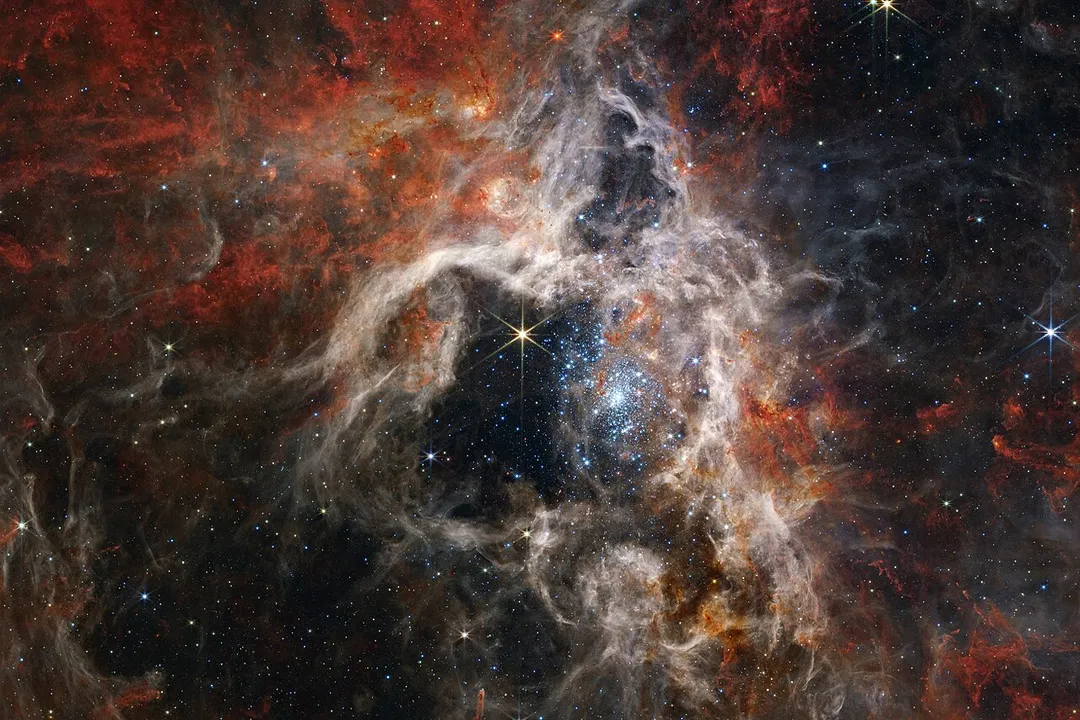
To understand the scale of the Tarantula Nebula, one must first distinguish between what a nebula is and what a galaxy is. In simple terms, a nebula is an interstellar cloud of dust, hydrogen, helium, and other ionized gases. [4] The Tarantula Nebula specifically is classified as an H II region, which is a massive cloud of ionized gas where star formation happens at an intense rate. [9] These regions are nurseries where gravity collapses dust and gas to create new stars. They are not structural units like galaxies; instead, they are features contained inside galaxies. [8]
A galaxy, by contrast, is a vast gravitational system composed of stars, stellar remnants, interstellar gas, dust, and dark matter. [8] Galaxies are the containers for the nebulae within them. The Tarantula Nebula sits inside the Large Magellanic Cloud (LMC), which is a dwarf galaxy orbiting our own Milky Way. [3][9] Asking if a nebula is bigger than a galaxy is similar to asking if a single room is larger than the entire house it occupies. The room might be very large, but it remains a single part of the larger architectural whole.
# Scale Comparison
The physical dimensions reveal the significant gap between a nebula and a galaxy. The Tarantula Nebula spans approximately 1,000 light-years in diameter. [7][9] While that number is staggering—representing a distance so vast that even light takes a millennium to travel across it—it is still physically smaller than the galaxy that hosts it.
The Large Magellanic Cloud, the galaxy home to the Tarantula, spans about 14,000 light-years across. [9] If we look at the Milky Way, the galaxy we reside in, the scale grows even larger, with a diameter of roughly 100,000 light-years. The following table helps visualize these differences in scale:
| Object | Type | Approximate Diameter |
|---|---|---|
| Tarantula Nebula | H II Region | 1,000 Light-Years |
| Large Magellanic Cloud | Dwarf Galaxy | 14,000 Light-Years |
| Milky Way | Spiral Galaxy | 100,000 Light-Years |
This comparison highlights that while the Tarantula Nebula is an enormous structure, it remains a smaller component of a galactic system. [3][7] Even a dwarf galaxy, which is smaller than a spiral galaxy like the Milky Way, is significantly more massive and wider in scope than the nebula.
# Visual Misconceptions
The misconception that the Tarantula Nebula might be a galaxy often stems from its brightness and appearance in deep-space photographs. Because it is so luminous, it creates a visual dominance in images, leading some to assume it is a standalone galactic object. [2] If the Tarantula Nebula were located within the Milky Way at the same distance as the famous Orion Nebula, it would be so bright that it would cast visible shadows on the ground on Earth at night. [2][7]
This intensity of light gives the impression of a massive, singular object. However, this brightness is a product of high-energy radiation from the massive, young stars clustered within it, not because it contains the number of stars a galaxy possesses. [4][5] A galaxy consists of billions of stars held together by its own gravity and dark matter, whereas the Tarantula Nebula is primarily a concentration of gas and newborn stars. [8][9]
# Nested Relationships
An interesting way to view this is through the concept of cosmic hierarchy. Consider the "nesting" of these structures. The Tarantula Nebula resides in the Large Magellanic Cloud, which is a satellite galaxy to the Milky Way, and the Milky Way is part of the Local Group of galaxies.
If we calculate the volume of space occupied, the disparity becomes even clearer. A sphere 1,000 light-years across (the nebula) has a significantly smaller volume than a disc 14,000 light-years across (the dwarf galaxy). The density of mass within the galaxy is also distributed differently. While the nebula is dense with gas and star-forming activity, the galaxy is a much more spread-out collection of billions of stars, planets, and dark matter halos that extend far past the visible gas clouds. [8]
# Star Formation
The primary reason this nebula is so often discussed is not its size relative to a galaxy, but its activity. Astronomers study 30 Doradus because it is the most active star-forming region in the entire Local Group of galaxies. [4] It serves as a laboratory for understanding how stars are born. The nebula is currently churning out stars at a rate that is rare in the modern universe.
If the Tarantula Nebula were a galaxy, it would have to be self-sustaining, maintaining a consistent shape and structure over billions of years. Instead, it is a transient phenomenon. In cosmic timeframes, it is relatively short-lived. Eventually, the radiation from the stars being born within it will disperse the gas, ending the nebula phase. A galaxy, however, persists for billions of years, cycling through different stages of star formation, consumption, and evolution, even after the specific star-forming regions within it have faded away.
Understanding that this object is a region within a galaxy changes the perspective on its importance. It is not an entire galactic system, but it acts as a power plant, generating the next generation of stars that will inhabit its host galaxy. This clarifies that while the Tarantula Nebula is among the largest and brightest objects of its kind, it does not challenge the structural dominance of the galaxies that contain it. [2][9]
#Videos
Most Massive Star and the Tarantula Nebula | Hubble Images 4K
Related Questions
#Citations
Tarantula Nebula - Wikipedia
The Tarantula nebula is so large and bright that if it was in our ...
The Tarantula Nebula in nearby Large Magellanic Cloud Galaxy
Untangling the Tarantula Nebula, the sky's largest stellar nursery
A Cosmic Tarantula, Caught by NASA's Webb
The Tarantula Nebula is very, very big - SYFY
Is a nebula bigger than a galaxy? - Quora
Tarantula Nebula | Star Cluster, Supernova & Nebulae | Britannica
Most Massive Star and the Tarantula Nebula | Hubble Images 4K