Is the Earth on the ecliptic?
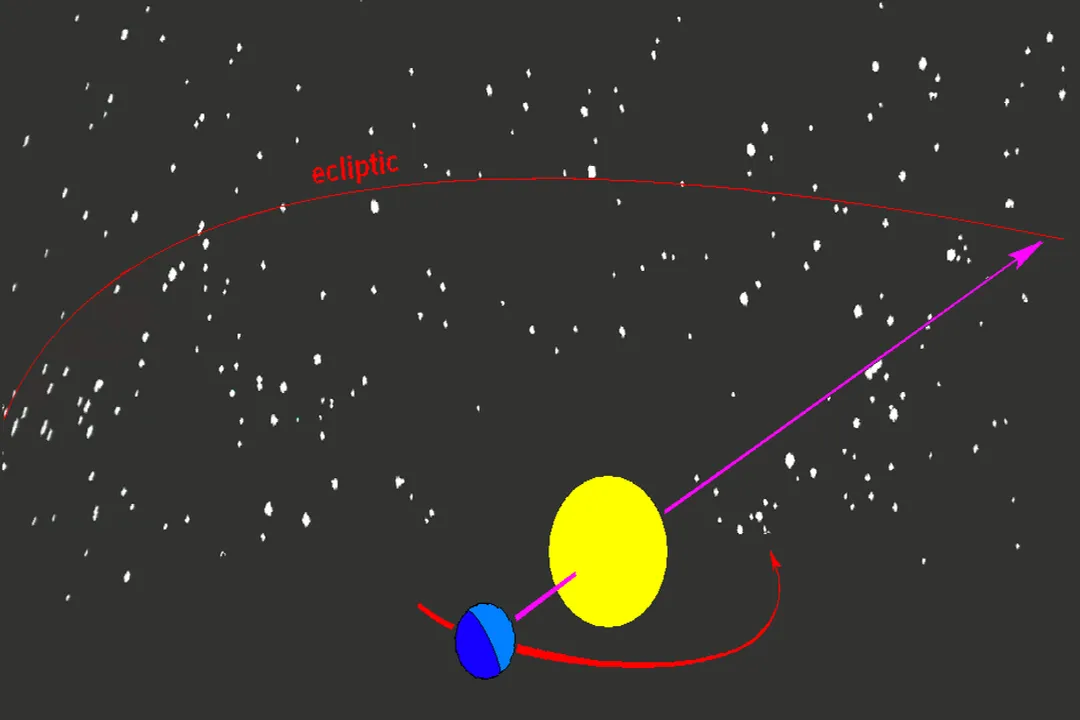
The plane we call the ecliptic is fundamentally linked to Earth's movement, which can make the question of whether the Earth is "on" it sound like a trick of language, but the answer hinges entirely on geometry and definition. In the simplest sense, the Earth’s orbit defines the ecliptic plane itself. [1] As our planet circles the Sun, every position it occupies lies within this single, vast, imaginary plane extending outward through space. [1] The concept is less about the Earth sitting on a pre-existing surface and more about the orbit creating the surface upon which it travels. [7]
# Orbital Plane

The ecliptic plane is formally defined as the plane containing the Earth’s orbit around the Sun. [1] If you could view our solar system edge-on, the Sun, Earth, and the path the Earth traces would all appear as a single, flat line—that line represents the ecliptic plane. [2] This specific geometric reference is incredibly important in astronomy because it serves as the baseline for measuring the positions of other objects in our solar system. For instance, the inclination or tilt of the orbit of other planets, moons, or asteroids is almost always measured relative to the plane of the ecliptic. [1]
It is useful to think of the Earth as a coin spinning on a perfectly flat table. The table surface is the ecliptic plane. The coin is always on the table, but its own rotational axis is tilted relative to the table's surface, which brings us to the most common point of confusion regarding the Earth and the ecliptic. The Earth is always in the plane, but its rotation is not aligned with it. [5]
# Axis Tilt

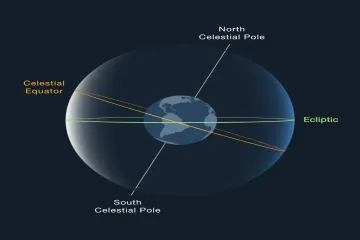
While the Earth defines the ecliptic through its orbit, its day-to-day experience is governed by the fact that its axis of rotation is tilted relative to that orbital plane. [2][5] This angle of tilt, known officially as the obliquity of the ecliptic, is currently about . [2] The equator of the Earth is the projection of its rotation axis onto the orbital plane; therefore, the Earth’s equator is tilted away from the ecliptic plane. [5]
This persistent, fixed tilt is the direct cause of our seasons. As the Earth orbits the Sun along the ecliptic, the tilt means that one hemisphere spends part of the year leaning more directly toward the Sun (summer) while the other leans away (winter). [2] If the Earth had zero tilt—if its rotational axis were perpendicular to the ecliptic plane—we would not experience significant seasonal variation based on orbital position, as every location on Earth would receive roughly the same amount of direct sunlight year-round. [9]
A common analogy helps distinguish these two planes: the ecliptic describes where we go over the course of a year, whereas the axial tilt describes how we spin while we are going there. [5] When we discuss the path of the Sun across our sky over the year, we are tracking the Sun’s apparent motion along the ecliptic plane as projected onto our celestial sphere. [1]
# Reference Systems

The choice of the ecliptic plane as a fundamental reference is not arbitrary, though it often prompts questions about why we don't use a different baseline, such as the Sun's equator. One might logically suggest that since the Sun is the gravitational center, perhaps the plane of the Sun's equator should define the main reference plane for the solar system. [7]
However, the Earth's orbit is the most established and historically reliable reference for defining celestial coordinates, making the ecliptic the standard against which nearly everything else is measured. [1] While the orbital planes of the major planets are close to the ecliptic plane—Venus is tilted by about , and Mars by [1]—the Earth's path remains the primary reference plane for defining terms like longitude and latitude in the celestial coordinate system known as the ecliptic coordinate system. [1]
If we were to define a coordinate system based on the Sun's equator, it would be cumbersome because the Sun is not a perfectly rigid sphere, and its rotation is not the primary driver of planetary motion; the orbit is the defining kinematic feature. [7] The Earth's orbital plane has remained remarkably consistent over astronomical timescales, providing an excellent, unchanging reference frame for tracking solar system objects. [4]
Here is a simple comparison of the key planes involved in understanding Earth's position:
| Plane | Definition | Angle Relative to Ecliptic | Primary Cause |
|---|---|---|---|
| Ecliptic | The plane of Earth's orbit around the Sun. [1] | (The baseline) | Earth's orbital motion |
| Equator | The projection of Earth's rotation axis onto space. [5] | Earth's axial spin | |
| Equinoxes | The two points where the Equator and Ecliptic intersect. [1] | N/A (Intersection) | Result of tilt and orbit |
# Celestial View

The ecliptic plane dictates where we look to see the major players in our solar system. Anything traveling near the plane of the ecliptic is considered to be traveling along the Zodiac. [1] The term "Zodiac" refers to the belt of constellations through which the Sun, Moon, and visible planets appear to pass across the sky. [1] If an object's orbit is highly inclined relative to the ecliptic, it will spend much of its time far above or below the path the Sun appears to take. [6]
For an observer on Earth, the Sun appears to cross the celestial sphere along the ecliptic path over the course of a year. [1] The celestial poles—the points in the sky directly above the Earth’s geographic North and South Poles—are tilted away from the Earth's orbital poles, which are the poles of the ecliptic plane. [5] This offset means that the North Celestial Pole is not directly aligned with the pole of the ecliptic.
It can be fascinating to consider how our perception changes depending on the reference system we use. If we primarily referenced the celestial sphere based on the Earth's Equator (the equatorial coordinate system), we would see the Sun moving north and south relative to the celestial equator, crossing it twice a year at the equinoxes. This movement north and south is the manifestation of the tilt relative to the ecliptic. [2] If, hypothetically, an advanced space station were positioned exactly on the ecliptic plane outside of Earth's orbit, the apparent path of the Sun across its local sky would always be a straight line, but the Earth itself would appear to rise and set at an angle dictated by its tilt, appearing to move "above" and "below" the station's equatorial plane as it orbited. [5]
# Geometry Application
Understanding this geometry allows for more nuanced observations. For example, when astronomers discuss the transit of Mercury or Venus across the face of the Sun, they are tracking those planets' orbits intersecting the Earth's orbital plane—the ecliptic. [1] If a planet’s orbit were perfectly aligned with the ecliptic, a transit would happen every time the planet was between the Earth and the Sun. Because the orbits are usually slightly inclined, the planet usually passes slightly above or below the Sun from our perspective. [1]
Consider the geometry from the Sun's perspective, which is often simpler for orbital mechanics calculations. If we were able to set up a fixed grid based on the Sun's equator, measuring the Earth's position would involve describing its orbital latitude and longitude relative to that solar equator. However, because the solar system coalesced from a disk of material, the dominant plane established by the largest body’s orbit—Earth’s orbit—has become the conventional zero point for our coordinate mapping of the entire system. [7] This convention saves us the trouble of constantly recalculating coordinates based on the Sun's slow rotation or the less stable orbits of smaller bodies. The Earth's orbital plane provides the stable, dominant plane of reference for the inner solar system. [1]
Ultimately, the answer to whether the Earth is on the ecliptic is an emphatic yes, because the ecliptic plane is simply the surface created by the Earth’s path as it revolves around the Sun. The Earth is forever confined to moving within this plane, even as its own internal spin keeps its surface tilted relative to the path it follows. [1][5]
#Videos
What is the Ecliptic in Astronomy? Discover Its Celestial Significance
Related Questions
#Citations
Ecliptic - Wikipedia
Orbits and the Ecliptic Plane - HyperPhysics Concepts
What is the Ecliptic in Astronomy? Discover Its Celestial Significance
Is there anything interesting in our solar system that is outside of the ...
Earth is Tilted, but in reference to What Object / relative to what?
What is the Plane of the Ecliptic? - Facebook
Wouldn't it be more logical for the 'ecliptic plane' to be based ... - Quora
Ecliptic Facts For Kids | AstroSafe Search - DIY.ORG