How does red Shift support the Big Bang GCSE?

The observable universe is not static. It is constantly changing, with galaxies moving away from each other at incredible speeds. [5][8] This movement, observed as a shift in light, serves as primary evidence for the Big Bang theory, which posits that the universe began as a tiny, dense point and has been expanding ever since. [1][7] To understand why this shift proves the universe is growing, we first need to look at how light behaves.
# Light Waves
Light travels in waves, and like any other wave, it has a frequency and a wavelength. The distance between the peaks of the waves determines the color we see. [3] Visible light exists on a spectrum, ranging from violet at one end to red at the other. Violet light has short, frequent waves, while red light has longer, stretched-out waves. [5]
When astronomers look at the light from distant stars and galaxies, they use a technique called spectroscopy. This involves looking at the specific "absorption lines" in the light spectrum—dark bands that appear because certain elements in the star's atmosphere absorb specific frequencies of light. [8] These lines act like a barcode, telling us exactly what the star is made of and, crucially, how its light has been altered by the time it reaches Earth. [5][9]
# Doppler Effect
To grasp Redshift, it helps to first think about sound. When an ambulance with its siren on drives toward you, the sound waves are compressed, making the pitch sound higher. [6] As the ambulance drives away, those same sound waves are stretched out behind it, making the pitch sound lower. This is known as the Doppler Effect. [2][4]
Light behaves in a very similar way. If a light source is moving toward an observer, the light waves are compressed, causing the light to shift toward the blue end of the spectrum. This is called Blueshift. [5][9] Conversely, if a light source is moving away, the light waves are stretched out, shifting them toward the red end of the spectrum. This is Redshift. [3][6]
# Redshift Defined
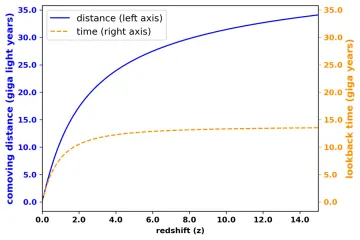
Redshift occurs because the source of the light is moving away from us. [3] When scientists observe distant galaxies, they almost always see that the absorption lines in the spectrum have shifted toward the red end. [5][8] This tells us two critical things: the galaxies are moving away from our position, and the further away the galaxy is, the faster it is moving. [7][9]
This observation is not just about local movement within a galaxy cluster; it is a universal phenomenon. If you look at the spectrum of a distant galaxy, the "barcode" of the elements is shifted to the right, toward longer wavelengths. [5] The degree of this shift allows physicists to calculate the recession velocity of these galaxies relative to Earth. [8]
| Feature | Sound (Doppler) | Light (Redshift) |
|---|---|---|
| Movement Away | Lower pitch (longer waves) | Redder light (longer wavelengths) |
| Movement Toward | Higher pitch (shorter waves) | Bluer light (shorter wavelengths) |
| Observation | Frequency change of sound | Wavelength change of EM spectrum |
| Medium Required | Needs air or other medium | Travels through a vacuum |
# Universal Expansion
The connection to the Big Bang comes from the implication of this movement. If every distant galaxy is moving away from every other galaxy, the logical conclusion is that they were closer together in the past. [1][7] By "rewinding" the expansion of the universe, scientists conclude that at some point in the distant past, all matter and energy in the universe must have been contained within a single, incredibly hot, and dense point. [1][5]
This is the central tenet of the Big Bang theory. Redshift provides the observational "proof" that the universe is currently expanding, supporting the idea that this expansion started from a singular origin event. [7][9] If the universe were static or contracting, we would see a mix of Blueshift and Redshift in distant galaxies, rather than the consistent Redshift we observe. [8]
# Conceptual Limitations
While the "balloon analogy" is frequently used to help explain this concept, it often causes confusion. In this analogy, you draw dots on a balloon and inflate it to represent the expanding universe. [6] The dots move apart as the balloon stretches. However, it is important to remember that the universe is not expanding into anything. There is no "outside" space that the universe is filling up. [5]
Another distinction to keep in mind is the difference between Doppler Redshift and Cosmological Redshift. Doppler Redshift happens because objects are physically moving through space. Cosmological Redshift happens because the fabric of space itself is stretching, carrying the galaxies along with it. [9] At the GCSE level, these are often taught together because the observable result is the same: the light is stretched, and the universe is growing. [3][8]
# Measuring Distance
The relationship between Redshift and distance is a powerful tool in modern astronomy. By measuring the amount of Redshift, astronomers can estimate how far away a galaxy is. This is known as Hubble’s Law. [9] It suggests that the velocity at which a galaxy moves away is proportional to its distance from us.
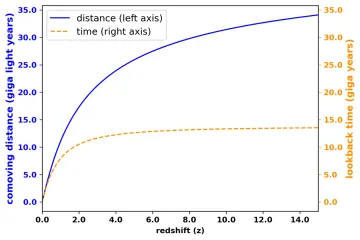
This relationship effectively turns the universe into a giant clock. Because we can measure the speed of expansion via Redshift, we can estimate how long it has taken for the universe to reach its current size. [1] This calculation points to the age of the universe being approximately 13.8 billion years. Without the evidence provided by Redshift, we would have no empirical way to determine the age or the history of the cosmos. [5][7]
Understanding that light can be "stretched" by the expansion of the universe allows us to look back in time. Because light takes time to travel, when we observe highly redshifted light from the edge of the observable universe, we are not seeing those galaxies as they are today, but as they were billions of years ago, shortly after the Big Bang occurred. [1][9] This makes Redshift one of the most critical observation tools in the history of science.
#Videos
GCSE Physics - What is Red Shift? (2026/27 exams) - YouTube
Redshift and the Big Bang - GCSE Physics - YouTube
Related Questions
#Citations
Red-shift - The expanding Universe - AQA - BBC
GCSE Physics - What is Red Shift? (2026/27 exams) - YouTube
Galactic Red-shift | Edexcel GCSE Physics Revision Notes 2016
ELI5 - what is red shift and how does it support the Big Bang Theory?
Explain how red-shift provides evidence for the Big Bang theory.
[PDF] 10.2 Red Shift and Universe Expansion - Physics & Maths Tutor
Hubble Cosmological Redshift - NASA Science