How are signals sent from Mars?
Sending information across millions of miles from the surface of Mars to Earth is not a matter of pointing a smartphone toward the sky; it is an intricate, decades-old feat of radio engineering that relies on massive infrastructure and precise orbital mechanics. [1][7] When a rover like Curiosity or Perseverance gathers a high-definition image or records the whir of its drill, that digital data must be converted into an electromagnetic wave and broadcast across the void, often requiring hours for the faint whisper to reach home. [6][8] The challenge scales with distance, as the signal strength drops off dramatically over the interplanetary gulf separating the two planets. [3]
# Radio Waves
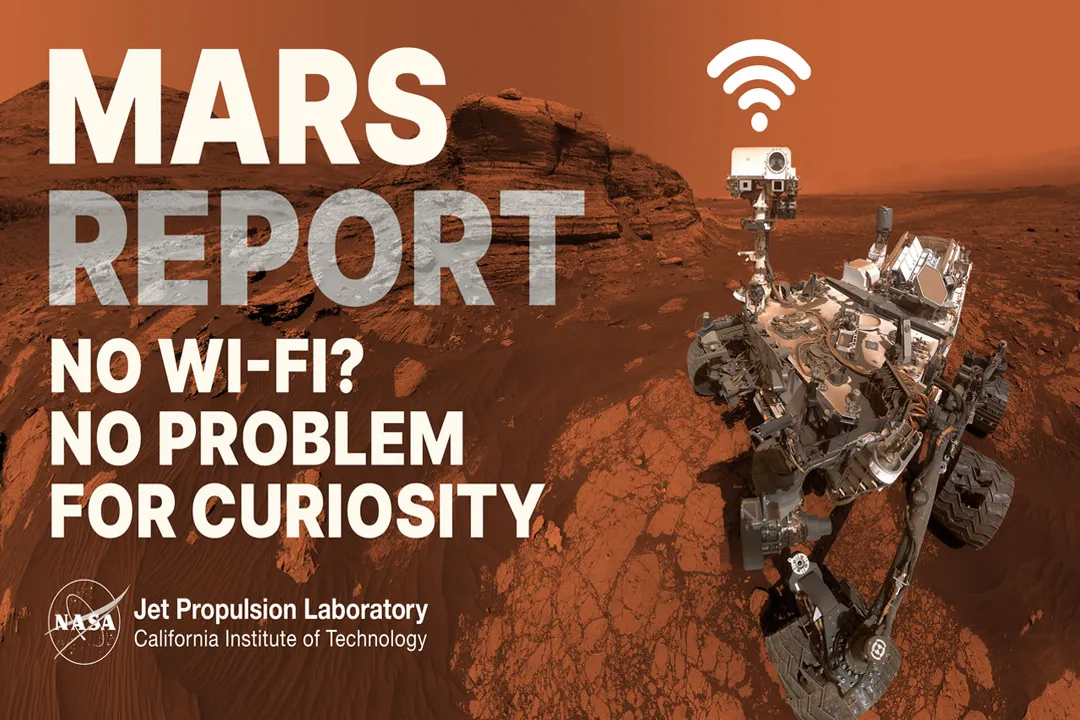
The fundamental method for communication between Earth and Mars relies on radio waves. [7] These are a form of electromagnetic radiation, similar to light waves or the signals used by your Wi-Fi router, but with much longer wavelengths and lower frequencies. [7] On the Martian surface, the rover or lander possesses transmitters—radio antennas—that encode the collected data onto these waves. [8]
The process involves converting the digital bits (ones and zeros) that make up an image or a system diagnostic into a stream of radio frequencies, a concept known in engineering as modulation. [7] The signals travel at the speed of light, which, while incredibly fast, is still finite. Because the distance between Earth and Mars is constantly changing due to their orbits around the Sun, the time it takes for a signal to cross this vast gap varies significantly. [6] At its closest approach, the one-way trip takes around three minutes; at its farthest, that lag stretches to over twenty-two minutes. [6] This inherent delay means that mission operators cannot "drive" a rover in real-time; every command must be pre-programmed and sent hours in advance, waiting for the response to return. [6][4]
# Signal Relay

While it is technically possible for a rover on Mars to transmit directly to Earth, this method is reserved for critical, low-data-rate messages or emergencies. [1] The primary way large volumes of science data—like the gigabytes of images and atmospheric readings—are sent back involves a crucial intermediary: the Mars orbiters. [1]
Surface assets, such as the Perseverance rover, are designed with low-power transmitters to conserve precious energy, which is essential for operating in the cold Martian environment and recharging solar arrays or managing RTG power sources. [1] Transmitting directly to Earth from the surface consumes a significant portion of the rover's limited power budget. [1]
Instead, the rover sends its data at a higher frequency to an orbiter passing overhead, like the Mars Reconnaissance Orbiter (MRO) or the Mars Odyssey satellite. [1] This connection is much more power-efficient for the rover. Once the orbiter has stored the data, it waits for an optimal alignment with Earth and then uses its own, much more powerful transmitter to beam the information across interplanetary space back to our home planet. [1] This relay system allows for much higher data rates—sometimes exceeding 2 megabits per second when using a high-gain antenna on an orbiter—which simply wouldn't be feasible for the surface vehicle to manage directly to Earth. [1]
Thinking about the operational trade-offs, this relay structure highlights a key engineering decision: power versus redundancy. A direct-to-Earth transmission path, even if slow, offers a single point of contact, whereas the orbiter relay introduces a second potential point of failure in the chain. Mission planners must constantly weigh the efficiency gain from using the orbiter against the risk associated with relying on that secondary communication link.

# Earth's Ears
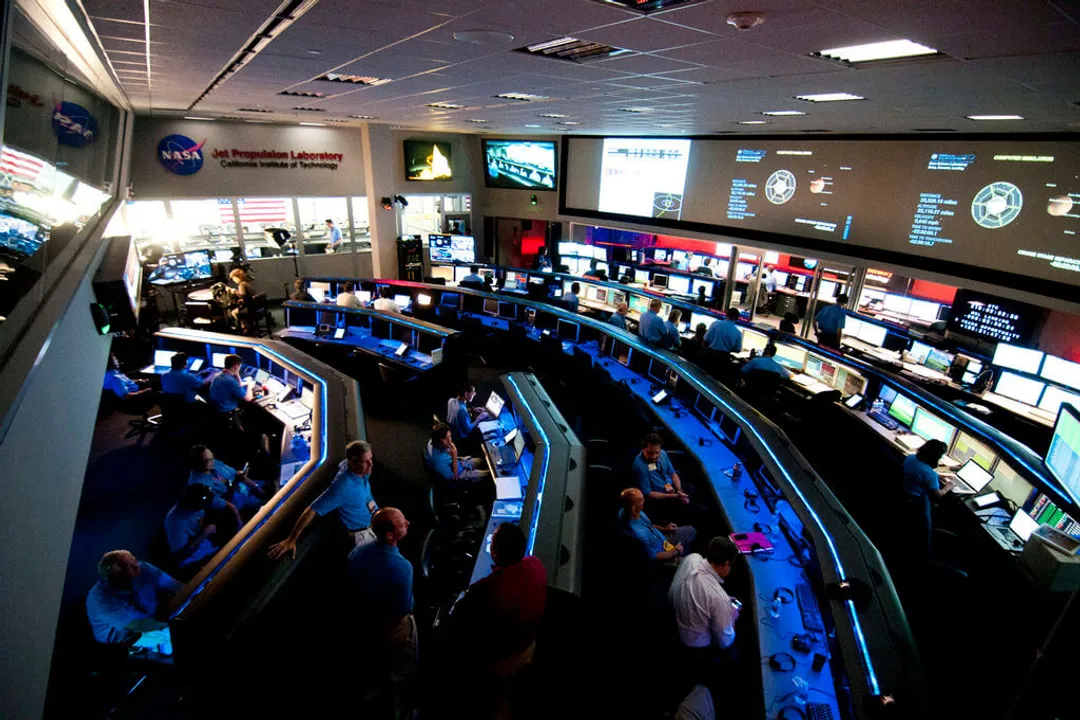
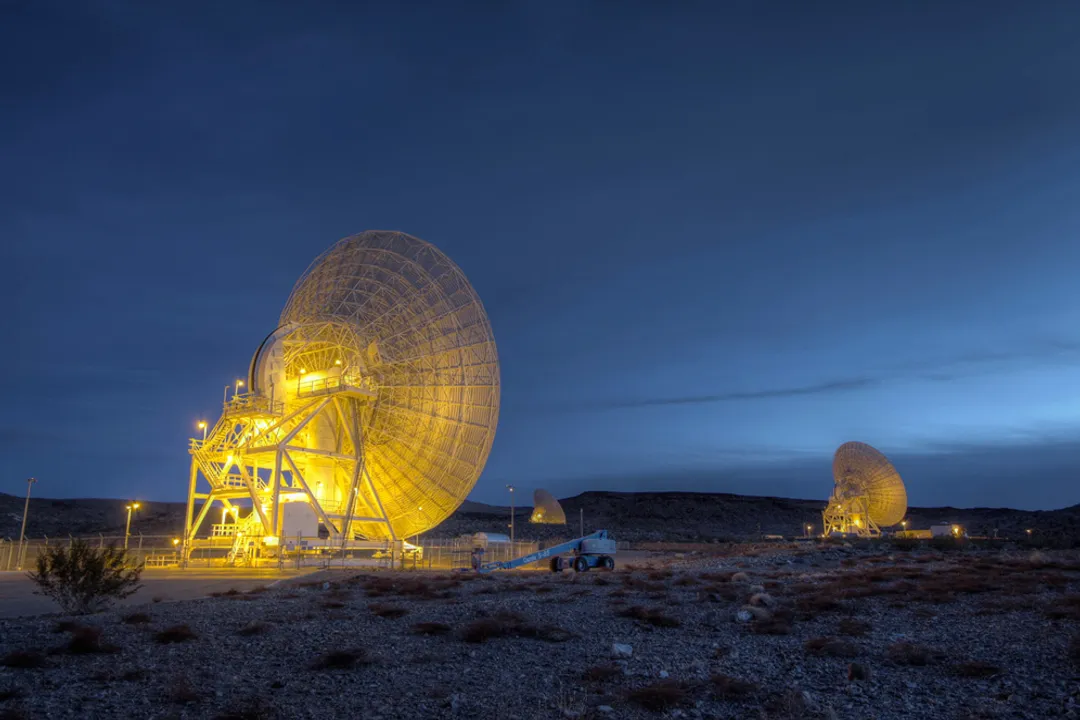
Capturing those exceedingly faint radio whispers from Mars, even when relayed by an orbiter, requires some of the most sensitive receiving equipment on our planet. This is the job of NASA’s Deep Space Network (DSN). [4][5] The DSN is a worldwide complex of three facilities strategically placed almost equidistant around the globe: one in Goldstone, California; one near Madrid, Spain; and one in Canberra, Australia. [4][5]
These sites ensure that no matter where Mars is in the sky, at least one station always has a clear line of sight to it. [4] If a rover on Mars sends a signal, Earth has to wait for the planet to rotate into the view of one of these antenna complexes.
The hardware itself is monumental. The DSN employs giant parabolic dish antennas, some measuring up to 70 meters (230 feet) across. [4] These dishes act as massive light buckets for radio waves, focusing the extremely weak incoming signal onto a receiver. The sheer physical size is necessary to gather enough energy from the distant source to be processed. [4] After the signal is received, specialized, extremely sensitive receivers cool the electronics down to near absolute zero to minimize background noise and maximize the chance of detecting the Martian transmission over the static of space. [4]
# Data Faintness
The difficulty in receiving a signal from Mars is directly related to the inverse-square law: as distance doubles, the power density of the signal drops to one-fourth of its original strength. [3] Imagine trying to hear a specific person whispering from across a football field while a jet engine is running nearby; that gives a small sense of the signal-to-noise challenge. [3]
When a rover transmits, its signal spreads out spherically. By the time it reaches Earth, that energy is distributed across an enormous sphere, making the signal incredibly weak. [3] For a small rover antenna, the signal arriving at Earth might be equivalent to a few trillionths of a watt. [3] The stack antennas used for receiving are designed not only to be physically large but also to have incredibly low-noise amplifiers to filter out terrestrial interference, like cell phones, passing aircraft, and even general cosmic background noise. [5]
A specific comparison can illustrate the required sensitivity. If a rover transmits using a small, omnidirectional antenna (one that broadcasts equally in all directions), the signal received on Earth is so weak it might be nearly impossible to distinguish from background noise. [3] This is why high-gain antennas, which focus the radio beam in a tight cone toward Earth or the relay orbiter, are essential for efficient communication. [3]
An interesting point for mission planners is how the choice of frequency impacts the link budget. Higher frequencies (like X-band or Ka-band often used for the orbiter-to-Earth link) allow for higher data rates due to greater available bandwidth. However, higher frequencies are also more susceptible to atmospheric interference, particularly heavy rain or dust storms on Earth or Mars. Therefore, mission schedules must sometimes revert to lower, more resilient frequencies during periods of predicted atmospheric interference, even if it means accepting a lower data rate for that specific day.

# Operational Timing
Communication with Mars is not a constant, two-way conversation; it is a highly scheduled event based on orbital mechanics and line-of-sight availability. [5] The communication windows are dictated by three main factors:
- Orbital Position: Mars and Earth must be positioned such that the DSN station can "see" the spacecraft. [5]
- Power Availability: The rover must be in sunlight (if solar-powered) or have sufficient power reserves to execute the communication sequence. [1]
- Solar Conjunction: This is perhaps the most significant interruption. Roughly every two years, Mars and Earth pass on opposite sides of the Sun, meaning the Sun lies directly between the two planets from our perspective. [5] During this period, called solar conjunction, the Sun’s intense radio emissions completely swamp any faint signals coming from Mars, making communication impossible for several weeks. [5] Missions must be programmed to operate autonomously during these blackout periods, and the DSN antennas are typically pointed away from the Sun during this time to protect their sensitive receivers. [5]
Even outside of conjunction, the schedule is tight. A typical rover might only have a few minutes each Martian day, or sol, to uplink commands or download science data, often coordinated with an orbiter's flyover time. [1][8] For example, the Perseverance rover is scheduled to communicate via orbiters, often passing over key relay satellites multiple times per sol to ensure data transfer, as opposed to relying solely on direct, time-consuming links to Earth. [5]
# Engineering Direction
The engineering behind these signals involves aiming these radio waves across millions of miles with extreme precision. The rover's high-gain antenna must be pointed accurately, often within a fraction of a degree, toward the orbital relay or toward Earth if communicating directly. [3] This is achieved through stepper motors and precise mapping software that accounts for the rover's exact position on the Martian surface and the known location of the receiving station or orbiter. [3]
The sheer difference in the required transmitter power between the two main communication paths emphasizes the importance of the relay:
| Communication Path | Primary Receiver | Relative Power Required (Relative to Direct Link) | Function Example |
|---|---|---|---|
| Rover Orbiter | Mars Orbiter | Low (Power optimized for rover) [1] | Daily high-volume science data downlink |
| Orbiter Earth | DSN 70m Antenna | High (Powered by orbiter) [4] | Sending mission-critical results home |
| Rover Earth | DSN 70m Antenna | Very High (Often avoided) [3] | Emergency beacon or system health check |
The continued success of these surface missions hinges entirely on the reliability of this chain: the rover’s transmitter, the orbiter’s receiver and transmitter, and the DSN’s massive receiving dishes. [5][4] Every piece of data we see from the red planet is a testament to this carefully managed, power-conscious, and time-delayed conversation across the solar system. [7]
#Videos
Earth-Mars Communication - YouTube
Related Questions
#Citations
Earth to Mars: How NASA Keeps Curiosity Connected (Mars Report)
ELI5: How does NASA receive information from their robot on Mars?
How hard is it to receive direct signals from vehicles on the surface ...
How Does NASA Communicate With Spacecraft?
Communicating with Mars: The Deep Space Network and ... - Peraton
How can we communicate with a mars rover million of miles away ...
Earth-Mars Communication - YouTube
A Complete Guide On Mars Rover and the Earth - Starscapes
Talking to Mars – To Mars and back - ESA's blogs