Can a baby be born in Mars?
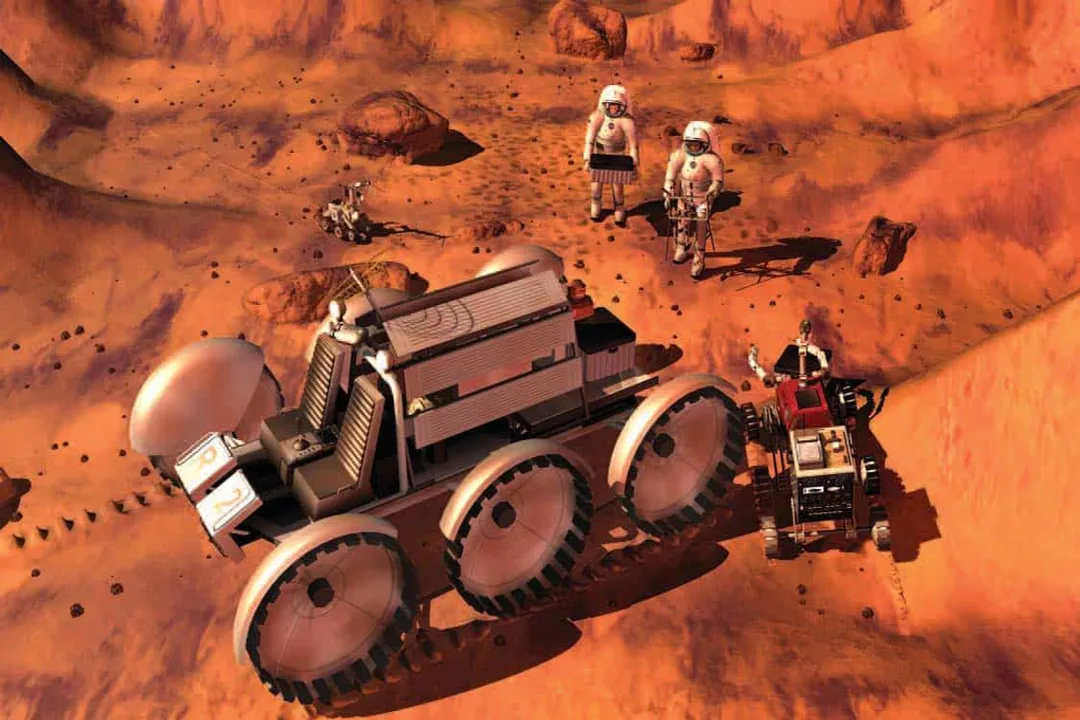
The prospect of a human being born on the Martian surface transitions quickly from science fiction to a complex engineering, biological, and philosophical quandary. While space agencies and private entities look toward making humanity a multi-planetary species, the simple act of gestation and birth presents challenges far exceeding those faced during initial landing or habitat construction. [1][7] Creating an environment that not only sustains life but allows for the delicate, multi-stage process of human fetal development requires overcoming immense hurdles related to radiation, gravity, and atmospheric integrity. [2][9]
# Environmental Barriers
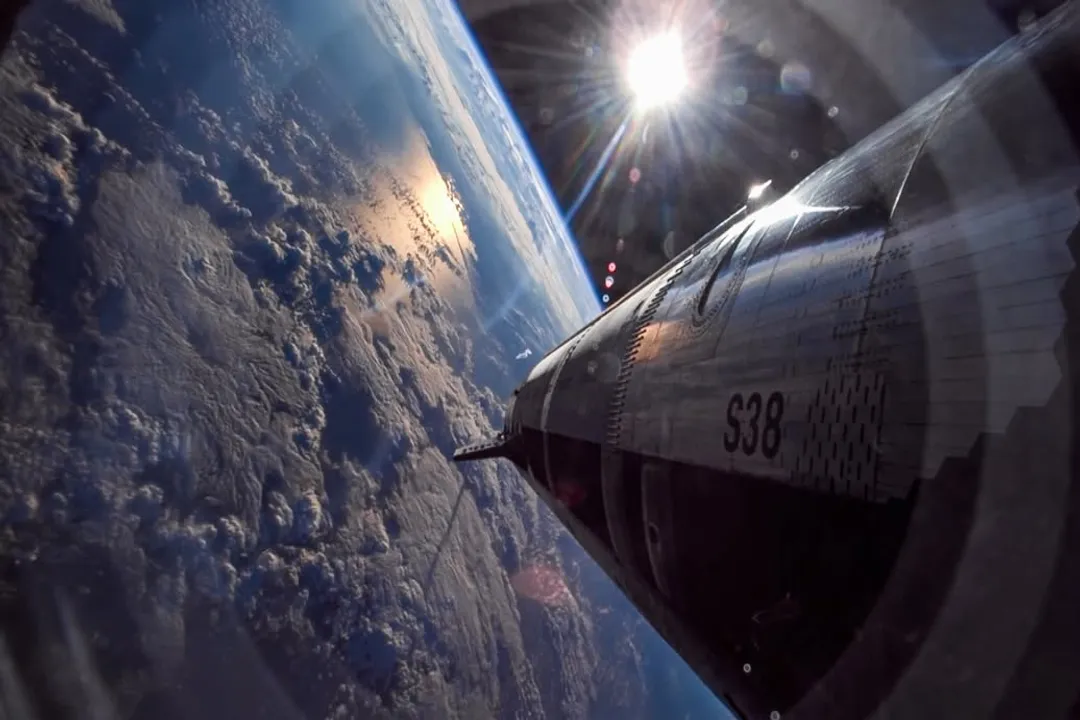
Mars is hostile terrain, presenting immediate threats to any developing embryo or fetus shielded only by an artificial habitat. The thin Martian atmosphere, which is less than 1% the density of Earth's, offers virtually no protection from cosmic and solar radiation. [2] Exposure to this radiation during critical developmental windows could cause cellular damage and potentially lead to severe health issues or termination of the pregnancy. [7] Any successful birth would require a robust, deeply shielded habitat, likely situated underground or beneath thick layers of Martian regolith, to keep radiation exposure within acceptable long-term limits for the developing child. [2]
Furthermore, the atmospheric composition is another non-negotiable issue. Humans require pressurized environments with Earth-like mixtures of nitrogen and oxygen. A habitat failure, even a slow leak, would be immediately catastrophic, something a pregnant colonist or a newborn infant would be acutely vulnerable to experiencing. [2] The initial Martian settlers must achieve near-perfect, long-term system reliability before even considering family planning. [1]
# Gravity Effects
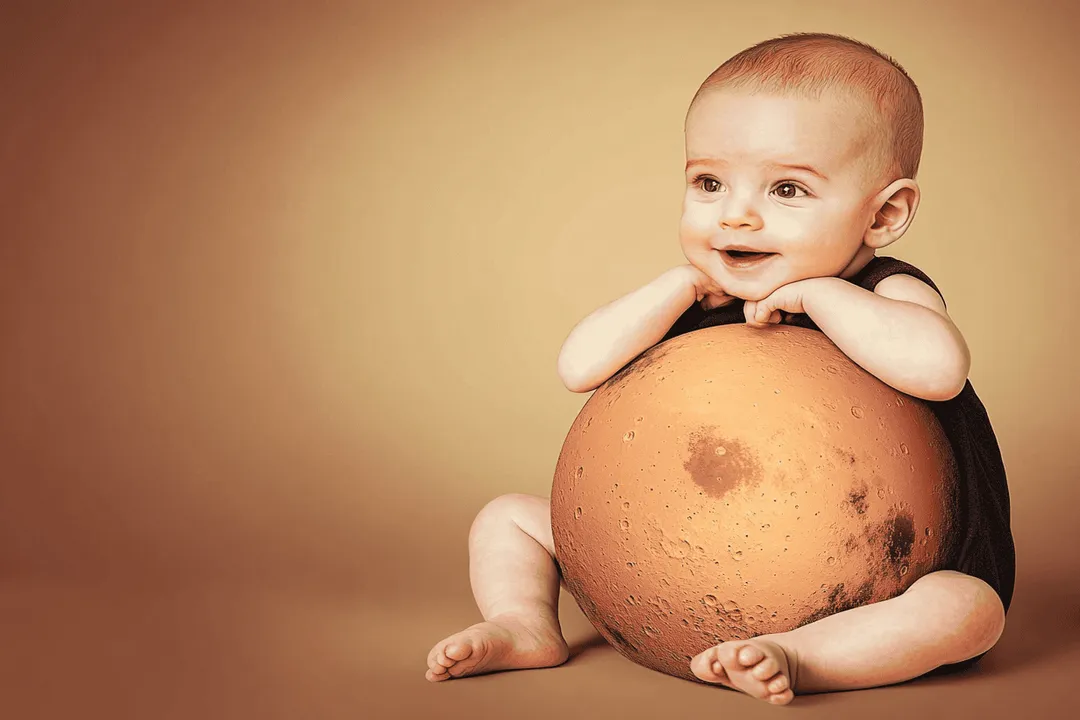
Perhaps the most profound unknown centers on the influence of Martian gravity, which is approximately 38% of Earth’s standard gravity (). [1] Human physiology is intricately tuned to the environment we evolved in. Developing an entire biological system—skeletal structure, cardiovascular system, muscle mass, and even inner ear balance—without the full gravitational load presents a massive biological question mark. [1][8]
If a fetus develops entirely in , its bones may form with significantly lower density and mass than required for terrestrial life, and its circulatory system might not develop the necessary muscular strength to pump blood effectively against Earth's stronger pull. [1]
Consider a hypothetical projection for skeletal maturation rates, keeping in mind that this is a simplified model based on known physiological responses to low gravity environments like the International Space Station ():
| Parameter | Earth () Development | Mars () Projection | Implication for Future Earth Return |
|---|---|---|---|
| Bone Mineral Density | Max density achieved by adulthood | Slower accretion rate; potentially low baseline | Significant risk of micro-fractures/osteoporosis |
| Muscle Mass | Develops against full weight load | Reduced load bearing requirement | Significant muscle atrophy upon exposure |
| Fetal Growth Time | Standard 9 months | Potentially altered due to fluid shifts and nutrient distribution | Unknown impact on organ system timing |
| Cardiovascular Load | Calibrated for Earth pressure | Heart may weaken due to lower pumping requirement | Orthostatic intolerance upon return |
This dependency on Mars’s gravity for development suggests that the first generation of Martians born on the planet may be fundamentally adapted only to Mars. [8] The concept of Homo martianus—a human subspecies adapted to lower gravity—becomes a serious, albeit speculative, outcome of successful reproduction there. [8]
# Gestation Logistics
Beyond the environmental and gravitational risks, the actual mechanics of pregnancy and childbirth demand terrestrial standards of medical care, which are incredibly difficult to replicate on a frontier outpost. [7] Pregnancy is a high-stakes, 24/7 commitment requiring constant monitoring, sterile conditions, and access to sophisticated diagnostic equipment. [1]
A birth on Mars would necessitate a fully functional, self-contained medical facility capable of managing standard delivery complications, premature births, or emergency Caesarean sections, all while operating under immense power and resource constraints. [7] Any medical supply shortage or equipment malfunction could spell disaster. Even a standard labor process would require a level of environmental stability and guaranteed functionality that no extraterrestrial habitat has yet demonstrated for long durations. [1] Furthermore, the psychological stress on the expectant parents and the medical team, knowing the nearest aid is months or years away, adds a layer of pressure that is impossible to quantify. [5]
# Ethical Questions
The capability to have a baby on Mars will certainly arrive before the global community agrees on the ethics of doing so. The establishment of reproductive rights for off-world colonies touches on deep moral territory. [5] Who decides when it is safe or appropriate to conceive? Is it the colonist, the mission director, or a governing body on Earth?. [5]
For the first generations born on Mars, their existence may be viewed through the lens of mission utility rather than individual autonomy. [5] There is the question of consent for a life lived in a profoundly constrained environment, one built entirely by others. [5]
A potential ethical checklist might be imagined by a governing body, even without formal consensus:
- Habitat Resilience Test: Minimum 5 years of independent, flawless closed-loop life support operation.
- Radiation Threshold Confirmation: Confirmed long-term radiation exposure below established terrestrial cancer risk thresholds for pediatric exposure.
- Return Viability Assessment: Clear communication regarding the probability of the child ever safely setting foot on Earth.
- Medical Autonomy Declaration: Signed agreements establishing medical decision-making authority for the colony’s medical lead versus Mission Control. [5]
This highlights that the decision to procreate becomes a geopolitical and ethical act before it is a personal one. [5]
# Earth Return Dilemma
If a child is successfully born and raised on Mars, they will be biologically and perhaps developmentally imprinted by the environment. [4][8] The question then becomes: what happens if that child ever wants or needs to come to Earth?. [4]
The physical transition from Martian gravity to Earth's gravity would likely be extraordinarily difficult, if not impossible, without extensive, long-term countermeasures. [4] A person whose entire skeletal structure has formed without the stress of Earth-normal gravity may suffer catastrophic bone density loss and muscle weakness upon arrival in a environment, potentially leading to immediate injury. [1][4] They might require years of intensive physical therapy and artificial gravity simulation just to function without constant pain or injury. [4]
This creates a severe ethical bind: parents choosing to conceive on Mars are effectively making a choice about the physical mobility and lifestyle options of their offspring for their entire lives, potentially stranding them on the new planet simply by virtue of their birth. [4][5] This is a form of irreversible commitment that sets Martian-born children apart from every previous generation of human explorers. [9]
# The First Martian Identity
Discussions about the first person born on Mars often involve speculation about the societal shift that person represents. [3] This individual would not just be an astronaut's child; they would be the first Martian human, possibly the first individual whose legal or cultural identity is tied to a different planet. [3] The excitement surrounding this potential event is immense, with some speculating publicly about the implications for branding and future habitation strategies. [6]
However, this first Martian will inherit profound challenges. They may grow up knowing that their physical body is unsuited for the ancestral home of humanity. Their entire social fabric, education, and cultural frame of reference will be built around the small, insulated world of the Martian habitat, entirely dependent on technology for survival. [9] They might view Earth not as a mother world, but as a theoretical place of great danger due to its high gravity and dense atmosphere. [4] The psychological burden of being the literal frontier—the first to experience these unique adaptive stresses—is a legacy that will require an equally unique form of psychological support and societal understanding. [3] Whether we are ready for the Homo martianus who results from these efforts remains an open question, tied less to rocketry and more to biology and morality. [8]
Related Questions
#Citations
Can humans have babies on Mars? It may be harder than you think.
Can You Have a Baby on Mars? - Science | HowStuffWorks
The first person ever to be born on Mars — will they ever be able to ...
If a child is ever born on Mars, will it ever be able to come to Earth?
Ethics of human reproduction on Mars
What would happen to humans born on Mars if they were to return to ...
Giving birth on Mars - Dr Maggie Lieu
Babies born on Mars could diverge from Earthlings within a couple ...
Mars-born children - Marspedia