Why are stars not visible in the USA?
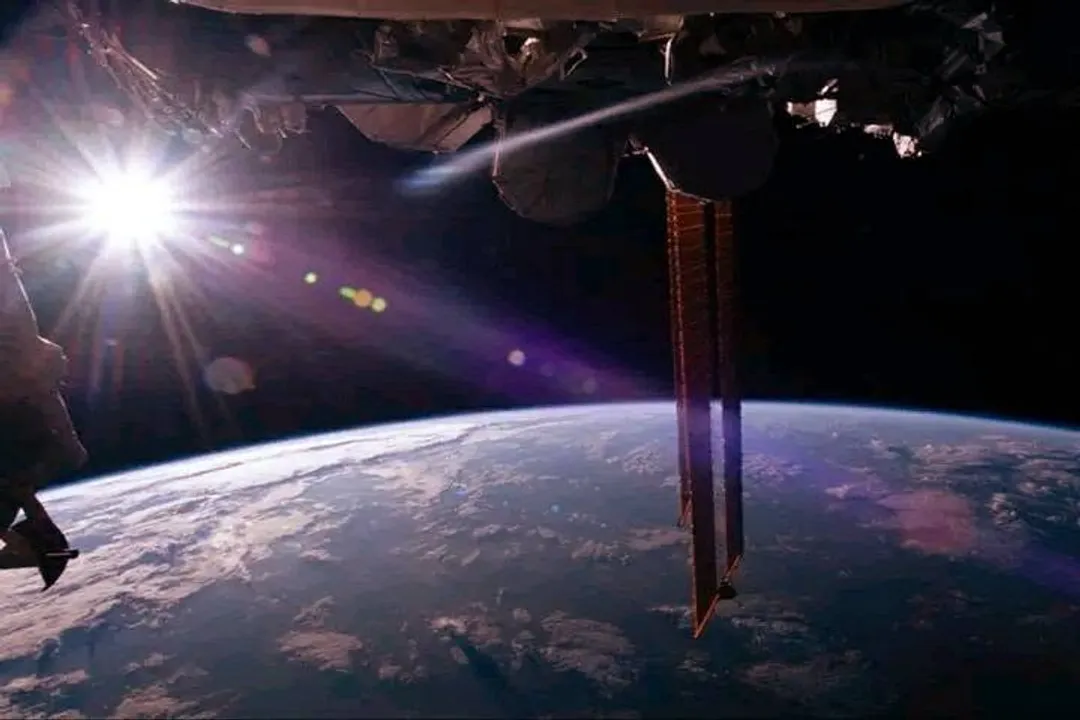
The night sky, once a breathtaking vista of countless pinpricks of light, often appears disappointingly empty, especially when viewed from most populated areas across the United States. [3][4] The immediate question that comes to mind is why these celestial bodies, which are always there, seem to vanish before our eyes. While the sheer scale of the universe plays a part, the most dramatic and recent change to our view is the pervasive glow cast upward from our own cities and towns: light pollution. [3][6]
# Distance Faintness
Before blaming modern infrastructure, it is essential to grasp the physics governing starlight visibility. Stars are incredibly distant, which naturally makes them appear faint. [2][8] The light we receive from them has traveled vast distances across space, meaning the intensity drops off dramatically according to the inverse square law. [8] Essentially, if you double the distance to a light source, its apparent brightness reduces to one-fourth of its original intensity. [8] This diminishing returns effect means that even the most brilliant stars are intrinsically very dim by the time their photons reach Earth. [2]
Furthermore, the Sun itself is a star, and it is overwhelmingly bright because it is so close relative to all others. [2] During the day, the Sun's light scatters in our atmosphere, creating the bright blue sky, which completely drowns out the light from all other stars. [2][7] At night, while the Sun is below the horizon, the sky darkens, but the atmosphere still plays a crucial role by scattering any available light—whether it's moonlight, starlight, or artificial light—making the background sky brighter than the faint points of light we seek. [7]
# Atmospheric Effect
The Earth’s atmosphere acts as both a necessary shield and an obscuring veil. Without it, we would see stars even during the day, as there would be no scattered light to create the blue backdrop. [7] At night, the air still contains molecules and aerosols that scatter light, a process known as airglow or skyglow. [7]
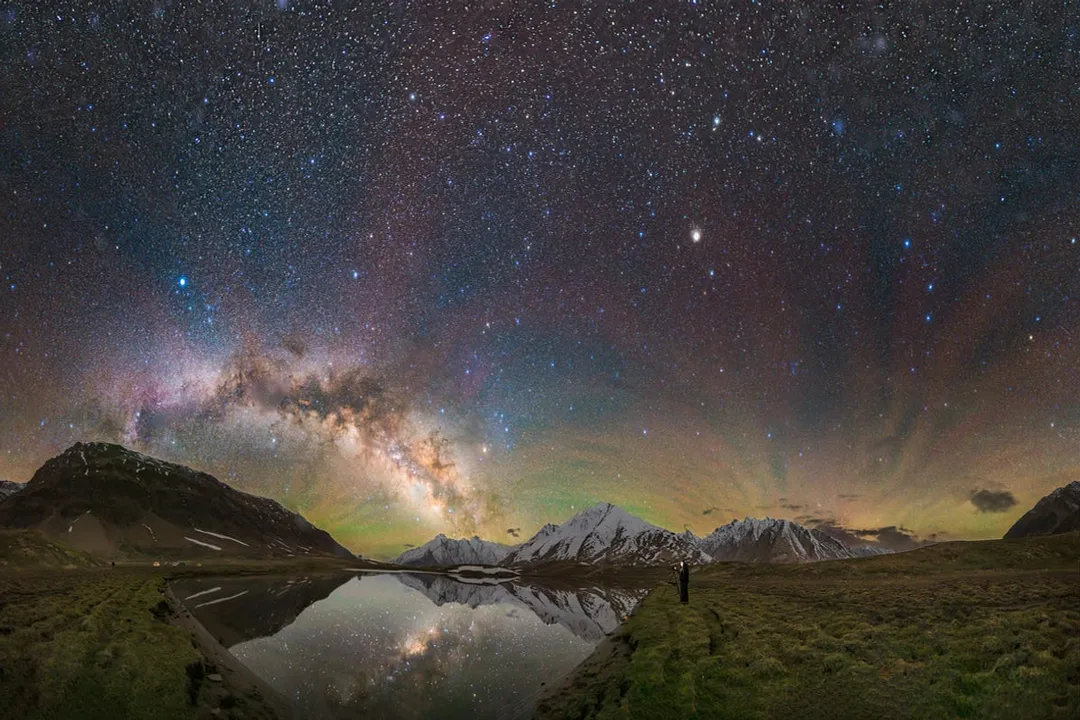
When observing the night sky, a star's light must pass through this layer of air. If the sky background is naturally dark—say, a magnitude of $21$ to $22$ on the apparent brightness scale—a star must be significantly brighter than that background to be noticed. [7] The issue in populated regions is that artificial lighting elevates the background brightness far above what it should naturally be, effectively washing out the fainter stars. [6]
# Artificial Glow
The primary culprit for the disappearance of thousands of stars visible from pristine dark sites is artificial lighting. [3][4][6] This phenomenon, broadly termed light pollution, occurs when outdoor lighting is misdirected, inefficiently shielded, or simply excessive, sending light horizontally or vertically into the atmosphere instead of only downward where it is needed. [4][6]
This scattered light forms a dome of brightness over urban and suburban areas. [4][6] For someone in a major U.S. city center, this persistent glow raises the sky background brightness significantly, often rendering only the brightest stars, planets, and the Moon visible. [6] A location that might normally reveal thousands of stars in excellent conditions might only show a few dozen near a metropolitan area. [5][6]
Consider the difference in contrast. If a distant star has a visual magnitude of $5.5$ (barely visible to the naked eye under good conditions), and the light pollution in your city raises the sky background brightness such that your eye perceives the background as being equivalent to a magnitude $3.0$ object, that faint star effectively disappears against the brighter curtain. [7] It's not that the star's light stops reaching you; it's that the light pollution adds so much noise to the system that your visual contrast mechanism can no longer separate the signal (starlight) from the interference (skyglow). [4]
# Urban Contrast
The geographical context matters immensely within the USA. Visibility loss is not uniform; it follows population density like a shadow. Areas along the Eastern Seaboard, for example, are often criticized for having a near-perpetual orange haze, making truly dark skies a rarity without significant travel. [4] Conversely, remote parts of the Mountain West or the deep desert regions still offer views close to the theoretical maximum visibility.
To put this into tangible terms, we can consider an estimated contrast loss based on location type. If we imagine a perfect, remote desert sky as having a background magnitude of $22.0$ (where an average human can see up to magnitude $6.5$ or $7.0$ objects), a typical suburban environment might boost that background to $18.0$ or $19.0$. [6] This shift means that stars dimmer than $6.0$ magnitude—which constitute the vast majority of visible stars—are lost. Imagine trying to read faint handwriting on a piece of paper that is being illuminated by a low-wattage desk lamp; the paper (the sky background) is now too bright to see the faint ink (the distant star) clearly.
This loss is cumulative. The human eye adapts to darkness to maximize light gathering over several minutes, an effect called dark adaptation. [3] When you are surrounded by excessive artificial light, your pupils contract, and the light-sensitive cells in your retina become less responsive, severely limiting your ability to perceive dim objects, regardless of how sensitive your equipment might be. [3]

# Understanding Magnitude
The apparent brightness of stars is measured using the magnitude scale, where lower numbers mean brighter objects. [7] The Sun, for instance, is around $-26.7$ magnitude. [2] A full moon is about $-12.6$. [2] On a truly dark night, the faintest stars visible to the unaided eye are around magnitude $6.0$ or $6.5$. [7]
Light pollution doesn't just mask magnitude $6.0$ stars; it washes out everything down to magnitude $4.0$ or $3.0$ very quickly as you move toward the city center. [6] If you consult an old star chart or an astronomy book from before the mid-20th century, the number of stars listed as visible will far exceed what someone in a major American city can perceive because the baseline sky brightness has drastically increased. [4]
# Practical Adjustments
While eliminating light pollution entirely is a massive undertaking requiring policy changes, individuals can take steps to improve their immediate viewing experience or contribute to conservation efforts.
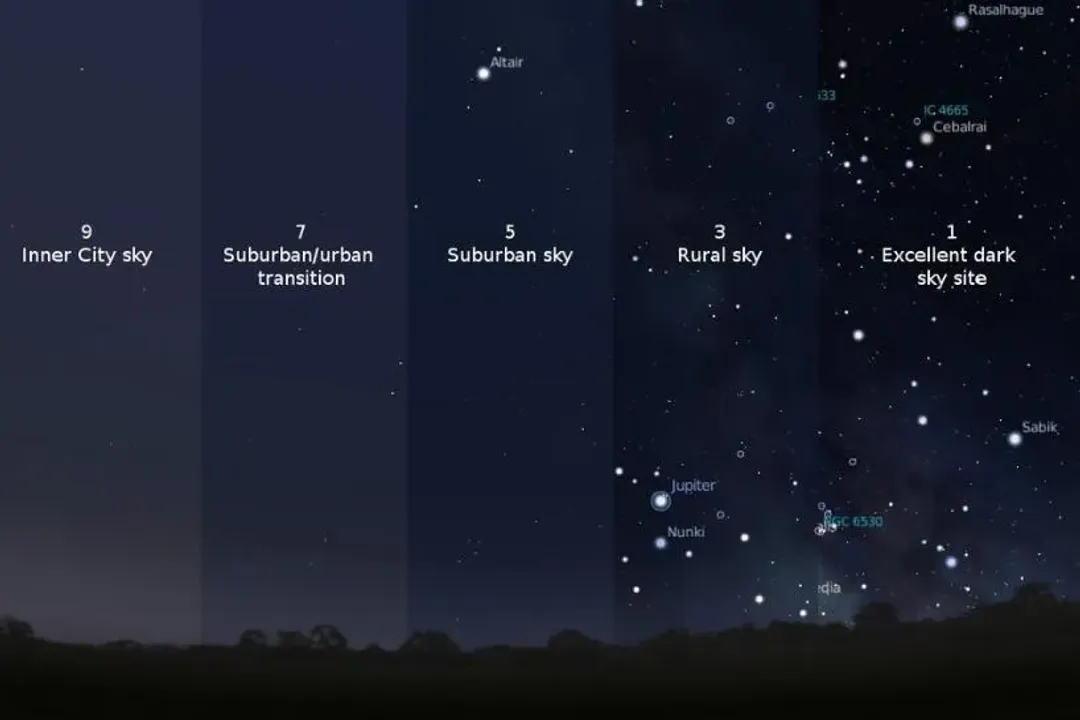
First, distance yourself from the source. [1] If you live in a city, a drive of just 30 to 60 miles away from the urban core can often lead to a dramatic improvement, moving you from a Bortle Class 8 or 9 sky (inner-city/suburban) to a Class 4 or 5 sky (rural/transition zone). [6] For many people in the USA, this travel is necessary to see anything beyond the major constellations.
Second, learn to adapt your vision. [3] Since the problem is low contrast, maximizing your eye's sensitivity is key. This involves avoiding all bright lights for at least 20 to 30 minutes before serious viewing. [3] When you must look at a map or watch a friend, use a flashlight covered with red cellophane or purchase a dedicated red-light headlamp. Red light, due to the physiology of the human eye, minimally affects the rod cells responsible for night vision, allowing you to maintain most of your dark adaptation. [3]
Third, become an advocate for responsible lighting. [3][4] A significant portion of the light polluting the night sky is simply wasted upward. Look at the lighting fixtures on your own property. Are they shielded? Does the light spill out to the side or upward? Proper lighting is fully shielded, pointing only where illumination is needed, and often uses warmer color temperatures (yellows/ambers) instead of harsh, blue-rich white light, which scatters more easily in the atmosphere. [4] Citizen science projects related to monitoring sky brightness rely on people noting when and where stars disappear, providing the evidence needed for local ordinances that mandate better lighting practices. [3]
# Faint Signals
It is interesting to consider that while light pollution obscures distant stars, it also impacts our understanding of deep-space objects. Even if you are trying to view a nebula or galaxy with a telescope, the enhanced sky background makes these fainter, extended objects even harder to resolve because the contrast between the object and the surrounding sky is reduced. [6] A telescope simply gathers more background light along with the faint light from the distant target.
The visibility of stars isn't a binary on/off switch; it's a gradient determined by the ratio of object brightness to background brightness, and in the modern USA, that background is increasingly dominated by terrestrial, artificial illumination. [4][6] The stars haven't gone anywhere—they are still shining reliably—but our experience of the cosmos has been dramatically curtailed by our own illumination choices. [3]
#Videos
Misconceptions in Astronomy - Stars are not Visible in Large Cities
Related Questions
#Citations
ELI5, Why are stars only visible in places where there is no artificial ...
Why are there no visible stars around us except for the Sun ... - Quora
Stars disappear before our eyes in light pollution, citizen scientists ...
The night sky is vanishing: 80 percent of Americans can no longer ...
Why can we see stars from Earth but not in space? - Facebook
Light pollution — why I cannot see as many stars in my night sky?
Why can I never see any stars in the night sky?
Misconceptions in Astronomy - Stars are not Visible in Large Cities
Why don't we receive light from all the stars in the universe?