Where is the location of the Sun right now?
The precise location of the Sun overhead is not a static piece of information; it is a constantly shifting value dependent entirely on two factors: the exact moment you ask and your specific location on Earth. [1][6] Because the Earth is spinning on its axis and orbiting the Sun, the celestial coordinates defining the Sun's position are updated second by second for any given spot on the globe. [2] To truly know where the Sun is right now, one must consult a system that can process the current date, time, and observer latitude and longitude to calculate its apparent position in the sky. [7][5]
# Positional Metrics

When astronomers, navigators, or even backyard stargazers determine the Sun's current location, they typically rely on a pair of angular measurements: altitude and azimuth. [1][7] Understanding these terms is key to interpreting the data provided by solar position calculators.
Altitude describes how high the Sun is above the horizon. This measurement ranges from when the Sun is exactly on the horizon (sunrise or sunset) to when the Sun is directly overhead at the zenith. [1] If the Sun is currently below the horizon, the altitude will be a negative value, ranging down to at the nadir (the point directly opposite the zenith). [7]
Azimuth, on the other hand, describes the Sun's compass direction along the horizon. This is measured as an angle starting from North (), moving eastward. Therefore, due East is , South is , and West is . [1] For an observer in London at midday, the Sun might show an azimuth close to (South), while in Sydney, the midday azimuth would be closer to or (North), illustrating how position changes dramatically with location. [2]
These two coordinates, Altitude and Azimuth, combine to give a unique, instant address for the Sun in the local sky. [7]
# Finding Current Data
Several specialized online resources exist specifically to answer this question by performing the complex calculations needed to pinpoint the Sun's coordinates for any moment. [3][5] These tools generally require the user to input their latitude and longitude—or sometimes just select a nearby city—alongside the current date and time. [7]
While numerical data (altitude and azimuth) is precise for an individual observer, other resources offer a broader, more contextual view of the Sun's position globally. For instance, twilight maps provide a visualization of the Earth shaded according to the Sun's angle relative to the horizon across the planet. [4] These maps clearly delineate the regions currently experiencing full daylight, various stages of twilight (civil, nautical, or astronomical), and full night. [4] This comparison shows that while a specific coordinate calculation tells you where the Sun is relative to you, the twilight map shows where on Earth the Sun is illuminating the surface at that precise second. [4]
A quick check using one of these calculators reveals that the Sun's position changes predictably. For example, at a specific moment, the Sun might have an altitude of and an azimuth of . [6] If you were to check again five minutes later, both numbers would have shifted slightly, reflecting the Earth’s rotation. [2]
# Seasonal Influence
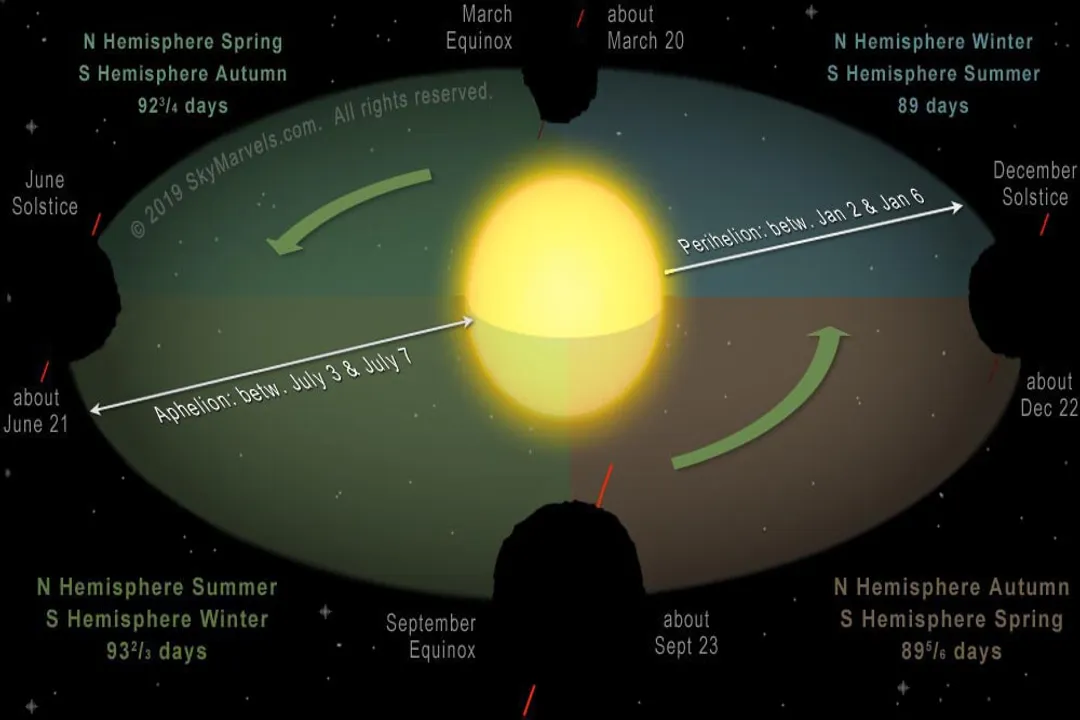
Though the current position is an immediate calculation, it is helpful to understand the seasonal context influencing the results provided by these tools. [1] The Sun’s apparent path across the sky is governed by the Earth’s axial tilt. This tilt means that the Sun never remains directly overhead (at altitude) except for locations within the tropics (the region between the Tropic of Cancer and the Tropic of Capricorn). [2]
For an observer in the Northern Hemisphere, the Sun’s highest daily altitude will occur around the Summer Solstice, resulting in a trajectory that arcs high across the southern sky. Conversely, near the Winter Solstice, the Sun’s highest altitude at noon will be significantly lower, meaning the arc traced during the day is much flatter. [1] This difference in apparent path explains why the same location can experience an altitude of at noon in July but only at noon in December. [1] The current reading you get from a solar calculator is simply one point along that specific seasonal arc.
If you are planning outdoor activities like photography or solar panel alignment, knowing the exact Azimuth is more valuable than just knowing the time of noon. [5] For example, if your home faces perfectly South ( azimuth), but the Sun at $1$ PM in winter is only tracking along an azimuth of due to the lower path, you will receive significantly less direct sunlight on your south-facing wall than you might expect based on a simple compass heading alone. [5] Knowing the precise azimuth allows for micro-adjustments in positioning equipment or positioning oneself for a particular view.
# Twilight Zones Defined
The concept of "where the Sun is" isn't only relevant when it’s visibly shining. The Sun’s position relative to the horizon dictates what kind of light reaches the ground, which is vital for everything from aviation safety to astronomical observation. [4] The different phases of twilight are defined by the Sun’s altitude below : [4]
- Civil Twilight: Occurs when the Sun is between and below the horizon. During this phase, there is enough light for outdoor activities without artificial lighting.
- Nautical Twilight: Extends from to below the horizon. The horizon line is usually discernible, allowing mariners to take star sightings.
- Astronomical Twilight: Covers the range from to . Below , the sky is considered truly dark, as the Sun's light is no longer interfering with most astronomical observations. [4]
By examining the difference between the current altitude and these twilight thresholds, one can immediately infer the ambient lighting conditions at any location globally, even if the Sun is technically below the horizon there. [4] For instance, if the calculated altitude is , you know that, despite the Sun being down, it is still bright enough outside for reading a book without a lamp. [4]
This reliance on precise angular measurement underscores the expertise required in these calculation tools. [7] They must account for atmospheric refraction—the bending of light as it passes through the atmosphere—which makes the Sun appear slightly higher than its true geometric position, especially near the horizon. [1] Trustworthy sources, like those used by navigators, often incorporate these atmospheric corrections to deliver the most accurate apparent position. [1]
Related Questions
#Citations
Day and Night World Map - Time and Date
The Sun: Complete Information & Live Data | TheSkyLive
SunCalc - sunrise, sunset, shadow length, solar eclipse, sun ...
Live map of where it is daytime, twilight or night time - In-The-Sky.org
SunCalc - sun position, sunlight phases, sunrise, sunset, dusk and ...
Calculation of sun's position in the sky for each ... - SunEarthTools.com
The Planets Today : A live view of the solar system
Current Sun - SkyMarvels.com