What was before the stars?

The universe, in its infancy, was a place vastly different from the star-studded expanse we observe tonight. Before the first fiery beacons ignited, there was an era defined by darkness, stretching across hundreds of millions of years following the initial expansion of space and time—the Big Bang. [2][8] Understanding what preceded the stars means tracing the timeline backward from the moment when matter first coalesced into self-sustaining fusion reactors.
# Early Matter

About $13.8$ billion years ago, the universe began with the Big Bang, an event that marked the beginning of space, time, and matter as we understand them. [2] In the immediate aftermath, the universe was an incredibly hot, dense soup of fundamental particles. As it expanded and cooled, these particles formed protons and neutrons, which eventually combined to create the first atomic nuclei, primarily hydrogen and helium. [4] This period is known as Big Bang Nucleosynthesis. [2]
For about $380,000$ years after the Big Bang, the universe remained a hot plasma, opaque to light. Once it cooled enough for electrons to combine with these nuclei, neutral atoms formed, and the universe became transparent. This moment released the cosmic microwave background (CMB) radiation—the oldest light we can detect. [2]
# Cosmic Dark Ages
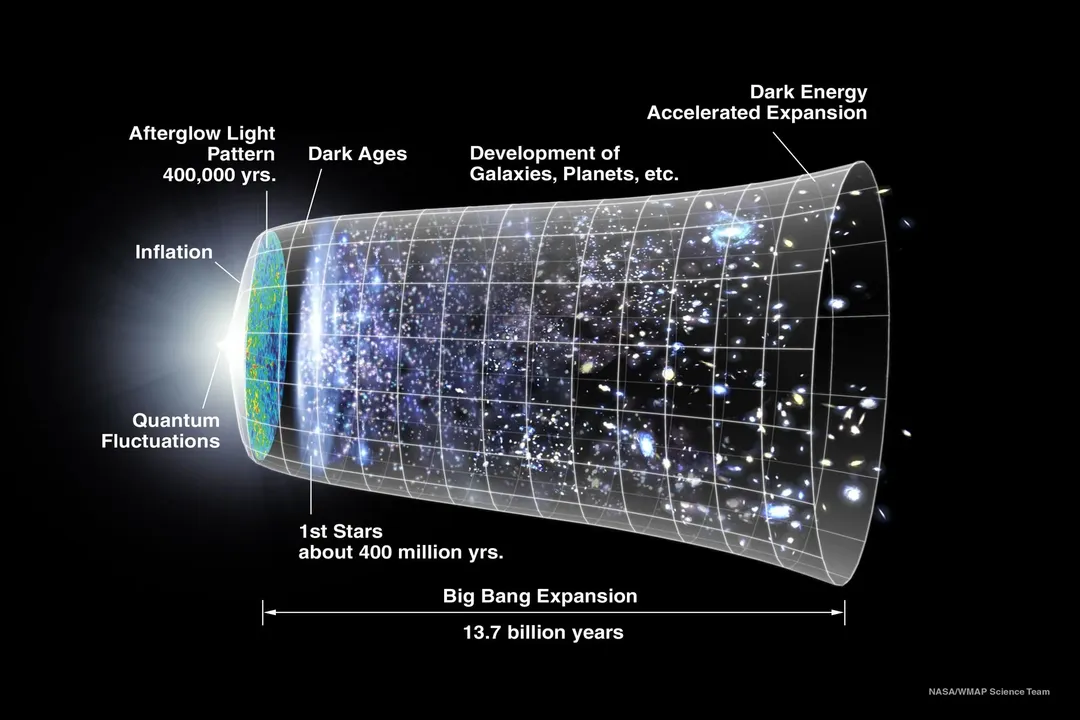
Following the release of the CMB, the universe entered what astronomers call the Cosmic Dark Ages. [8] This epoch lasted from roughly $380,000$ years after the Big Bang until the first stars began to shine, a period that lasted for several hundred million years. [2] During this time, there were no stars, no galaxies, and certainly no planets. The universe was almost entirely composed of neutral hydrogen and helium gas, interspersed with the invisible scaffolding of dark matter. [8] It was cold, dark, and dominated by gravity slowly pulling this primordial gas into denser clumps. [8]
If you were somehow able to view the universe during this time, the primary "structure" would have been the faint, uniform glow of the CMB, gradually fading as the universe expanded and redshifted the radiation into longer, cooler wavelengths. [8] The only significant energy left was gravitational potential energy, which acted upon the slight density fluctuations inherited from the very early universe. [2]
It is interesting to contrast the purity of this early environment with what we observe around us today. Modern stars, like our Sun, are rich in what astronomers call "metals"—any element heavier than helium. These metals were forged, ejected, and recycled through successive generations of stars. [4] The material present during the Dark Ages, however, was essentially pristine, containing only the primordial hydrogen and helium cooked up in the first few minutes of existence. [4] This lack of heavier elements—which help gas clouds cool more efficiently—meant that forming the very first stars required much greater initial concentrations of mass than is typical today. [4]

# First Light Ignites
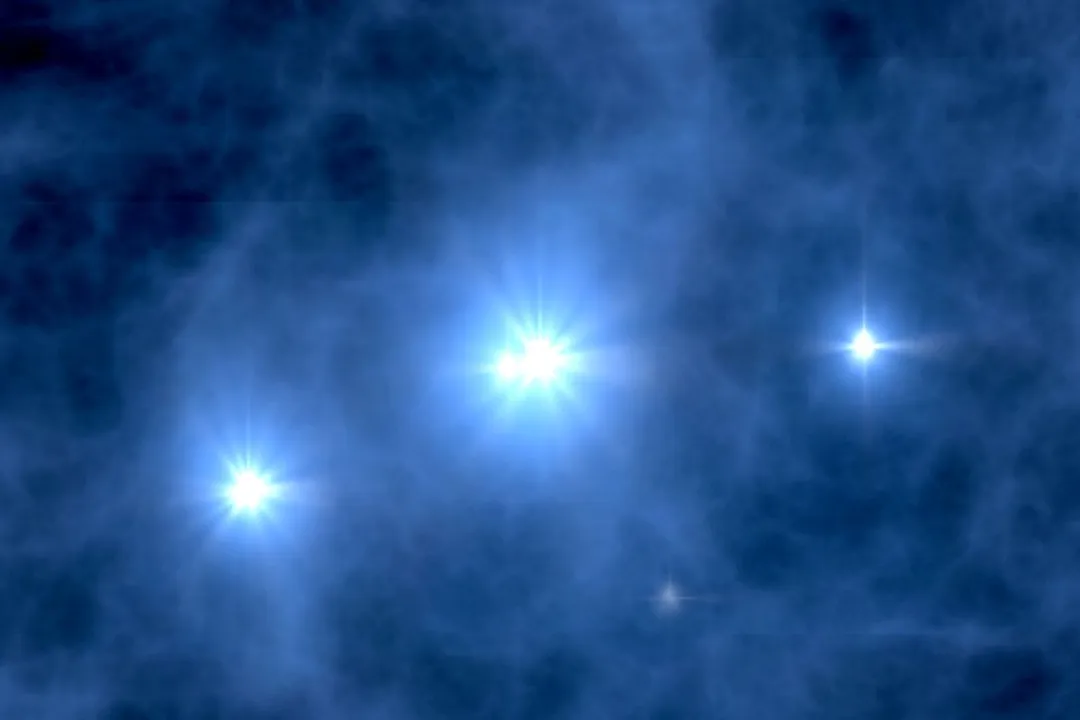
The Dark Ages ended when gravity finally compressed pockets of gas sufficiently for nuclear fusion to begin. This period is known as the Cosmic Dawn. [1] The stars born during this time are known as Population III stars. [4]
These first stars were fundamentally different from most stars we see today. Due to the lack of cooling agents (heavy elements), the gas clouds needed to collapse under their own gravity until they were extremely large to overcome the thermal pressure and ignite fusion. [4] Estimates suggest that these first stars were incredibly massive, perhaps a hundred to several hundred times the mass of our Sun, and they burned through their fuel very quickly. [4]
Their immense mass meant they lived fast and died young, often exploding as energetic pair-instability supernovae. [4] While the Dark Ages were defined by their absence, these first stars were the engines that ended the Dark Ages. [1]
The primary importance of Population III stars lies in their role as cosmic alchemists. When they exploded, they seeded the surrounding intergalactic medium with the first elements heavier than lithium—carbon, oxygen, iron, and all the others that make up rocky planets and life itself. [4] This enrichment process paved the way for the formation of the second generation of stars (Population II) and eventually stars like the Sun (Population I). [4] Missions like the James Webb Space Telescope (JWST) are actively searching for the faint light signatures or chemical traces left behind by these very first stars, seeking the potential first traces of the universe's earliest stellar populations. [1][9]
# Scales of Time
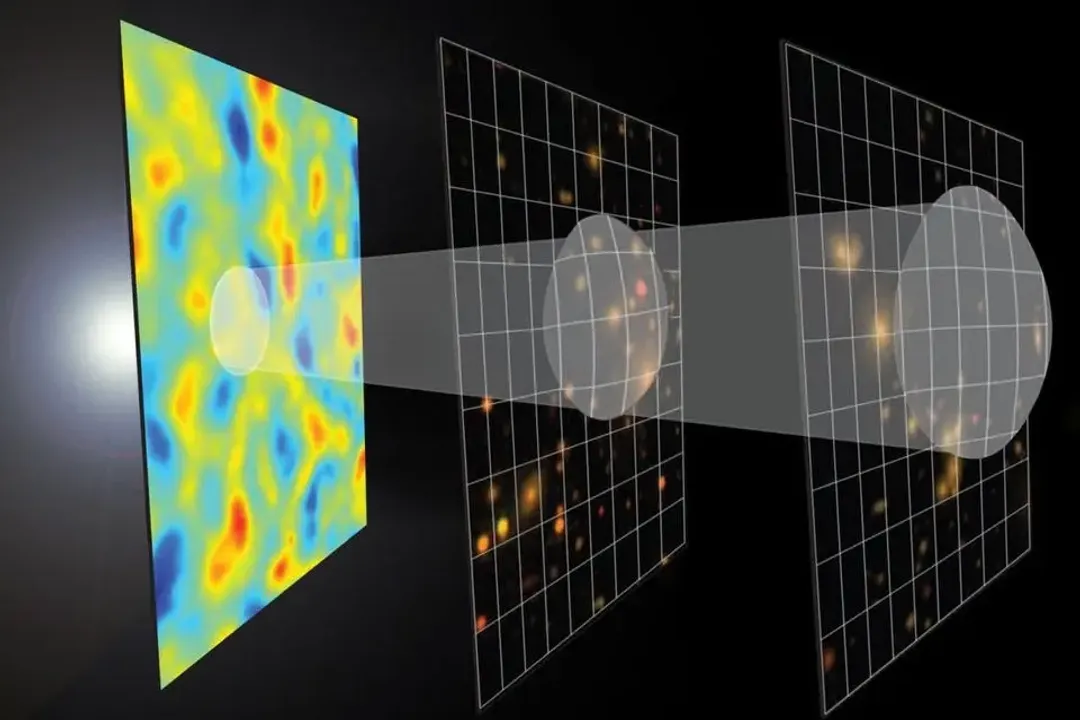
To grasp the sheer scale of the "before stars" period, considering the timeline against the age of our own Solar System is helpful. Our Sun ignited roughly $4.6$ billion years ago. [7] If the Big Bang occurred at time zero, the Cosmic Dawn, marking the ignition of the very first stars, began only a few hundred million years later. [2]
This means that the time interval during which the universe existed without any stars—the Dark Ages—was significant. If we consider the universe today as being $13.8$ billion years old, the Dark Ages consumed about $3%$ of that total history, yet it was a crucial preparatory stage. [2] By contrast, the time between our Sun's birth and today is only about one-third of the total cosmic age. [7] The universe spent a considerable chunk of its existence in that dark, gaseous state, waiting for gravity and quantum mechanics to conspire to produce the first light. [8]
# Pre-Bang Hypotheses
If one interprets the question "What was before the stars?" more fundamentally as "What existed before the Big Bang itself?", the scientific conversation shifts from astrophysics to theoretical cosmology and quantum gravity, where certainty gives way to mathematical models. [5]
When the Big Bang model is run backward, it predicts an infinitely hot, infinitely dense point called a singularity. [2] At this boundary, the known laws of physics break down, rendering a description of "before" meaningless in terms of standard space and time, as time itself is theorized to have begun at that instant. [5]
However, several theoretical concepts attempt to circumvent this singularity:
- Cyclic Models: These suggest that the Big Bang was not the absolute beginning but rather a "bounce" from a previous collapsing universe. [5] In this scenario, the universe undergoes endless cycles of expansion and contraction, meaning something existed before our current iteration expanded.
- Inflationary Scenarios: Some models involving cosmic inflation propose that the Big Bang was merely a local event within a much larger, eternally inflating "multiverse," implying an environment existed prior to our specific expansion. [6]
These ideas remain highly speculative, existing largely in the realm of mathematics rather than direct observational proof. [5][6] For now, the most concrete answer to "what was before the stars" pertains to the universe after the Big Bang, spanning those hundreds of millions of years of cold, dark neutral gas, waiting for the first massive Population III stars to end the silence. [8]
#Videos
What Did The Early Universe Look Like Before Stars Existed?
Related Questions
#Citations
Early Universe - NASA Science
Chronology of the universe - Wikipedia
What Did The Early Universe Look Like Before Stars Existed?
Understanding what the first stars in the Universe were like will shed ...
What was there "before" the Big Bang? : r/astrophysics - Reddit
Was there light in the Universe before the first stars formed?
What Was Here Before the Solar System? - Universe Today
What was it like when no stars yet existed? - Big Think
Potential first traces of the universe's earliest stars uncovered | NSF