What protective layer surrounds a rocket during reentry?

The fiery descent of a spacecraft back to Earth is one of the most dramatic and technically challenging phases of any space mission. When a vehicle traveling at orbital velocity—often exceeding 17,500 miles per hour—plows into the upper atmosphere, it doesn't just slow down; it encounters forces that can instantly vaporize metal. The question of what shields this vessel and its occupants from utter destruction boils down to an engineered marvel designed to manage incredible thermal loads: the Thermal Protection System (TPS), most commonly manifesting as a heat shield.
# Atmospheric Friction

To appreciate the necessity of this protective layer, one must understand the physics at play during reentry. It is a common misconception that the intense heat generated comes primarily from friction, much like rubbing two sticks together. While friction plays a small role, the overwhelming majority of the heat experienced by a returning capsule or spaceplane is caused by adiabatic compression. As the vehicle slams into the thin air at hypersonic speeds, it rapidly compresses the gas molecules immediately in front of its blunt face. This compression heats the air to thousands of degrees—temperatures far exceeding the melting point of steel. The protective layer must survive this plasma bath while ensuring the structure behind it remains habitable, often maintaining temperatures suitable for human occupants.
# The Protective Barrier
The essential answer to what surrounds the rocket or capsule during this phase is a specialized thermal protection system, frequently referred to as a heat shield. The design philosophy often centers around managing that superheated shock layer of compressed air standing off the vehicle's surface. In the context of NASA's expertise, this involves entry systems engineering, which balances aerodynamic shape, material response, and mission objectives.
For many capsules returning to Earth, like those that have historically followed similar paths to the Apollo missions or modern cargo haulers, the heat shield is often designed to be ablative.
# Ablative Shielding
Ablative shields work through a controlled sacrifice. They are composed of composite materials designed to intentionally burn away, or ablate, layer by layer during the most intense phase of reentry. As the outer layer heats up and decomposes, it vaporizes, carrying significant amounts of heat away from the spacecraft structure in the process. This continuous, sacrificial erosion effectively keeps the underlying structure cooler.
Consider a material choice. If a spacecraft is designed for a one-time reentry, an ablative system might be a very effective and relatively simple path to protecting the crew from that extreme heat. This material choice reflects a trade-off: the shield is destroyed in the process, meaning it cannot be reused for another flight without replacement.
# Reusable Surfaces
Not all vehicles employ the sacrificial ablative method. Systems like those used on the Space Shuttle or vehicles designed for rapid turnaround utilize reusable Thermal Protection Systems (TPS). These systems rely on materials that can endure the heat spikes and then cool down for the next mission. While the sources don't detail the exact composition of reusable systems extensively, they highlight that the goal remains the same: manage the thermal influx to protect the crew and internal systems. An interesting comparison to consider is that while reusable systems require more advanced, durable (and often more expensive) ceramic tiles or blankets, they save significant time and money between missions compared to stripping and reapplying an ablative layer.
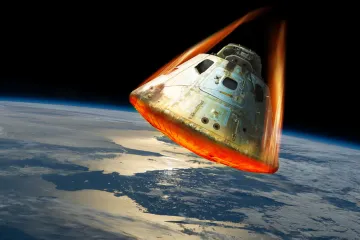
# Case Study: Orion's Heat Shield
To truly appreciate the complexity of this protective layer, examining real-world incidents provides invaluable experience. During the Artemis I mission in late 2022, the Orion spacecraft executed a high-speed reentry profile designed to stress the capsule’s heat shield to its limits. This test was critical for validating the vehicle's design for future crewed missions.
The protective system on Orion is a sophisticated ablative shield, designed to manage the intense heat of reentry from deep space trajectories. Reports indicated that during this test, portions of the material eroded away or burned off in a way that exceeded the engineering predictions. Specifically, video footage showed significant portions of the ablative material peeling off or being removed entirely during the descent. While the overall system performed its primary function—keeping the capsule intact and protecting the interior environment—the degree of material loss prompted immediate engineering review. This incident underscores that designing a protective layer is not just about preventing catastrophic failure, but about controlling the rate and pattern of material degradation to ensure structural integrity remains for the entire descent profile. The science team’s expertise in entry systems focuses on modeling these very scenarios to build in sufficient margins of safety.
# Design Considerations and Materials
The overall design dictates the required protective layer. A vehicle reentering from low Earth orbit experiences less severe conditions than one returning from the Moon, like Orion. The entry angle is also a crucial variable. A shallow, "skipping" reentry spreads the heating over a longer time, while a steep, direct reentry subjects the shield to peak heating very quickly.
For general engineering context, understanding that the choice between a blunt body shape (like a capsule) and a lifting body shape (like a spaceplane) directly influences the TPS requirements is key. A blunt body uses its shape to generate a large shock wave far from the surface, creating a pocket of cooler air that shields the vehicle, making the TPS’s job slightly easier by managing lower peak temperatures over a wider area. A lifting body manages its trajectory to generate aerodynamic lift, but this often means the surface stays closer to the superheated air for longer periods, demanding more resilient thermal materials.
When considering long-duration crew protection, an insightful perspective is to look at thermal inertia. The material must not only stop the heat from entering immediately, but it must also have low thermal conductivity so that the heat absorbed doesn't quickly transfer through to the structure where astronauts are sitting. This property, the ability to resist heat transfer, is just as important as the material’s ability to survive vaporization or high temperatures itself.
If we look at this from a project management view, specifying the TPS involves a massive data set spanning material coupons tested in arc jets, full-scale simulations, and flight data. A simple comparison of material costs versus mission cadence reveals a clear strategic choice: one-time mission systems favor cheaper, disposable ablators, whereas regular access to space pushes development toward high-cost, reusable ceramic or metallic heat shields that require complex inspection and refurbishment protocols.
#Videos
Can Sweating Heat Shields Solve Re-Entry Problems for Reusable ...
Related Questions
#Citations
bitlife astronaut question answers : r/BitLifeApp - Reddit
Bitlife Astronaut Technical Training Answers - VG247
Bitlife: All Astronaut Technical Training Answers - Game Rant
Starship needs a heat-shield to re-enter the earth atmosphere. Does ...
Core Area of Expertise: Entry Systems - NASA
What protective layer surrounds a rocket to protect it from intense heat
Protecting space crew from extreme heat during reentry
Can Sweating Heat Shields Solve Re-Entry Problems for Reusable ...
What Really Happened with Orion's Heat Shield During 2022 ...