What is the highest altitude a civilian rocket can fly?
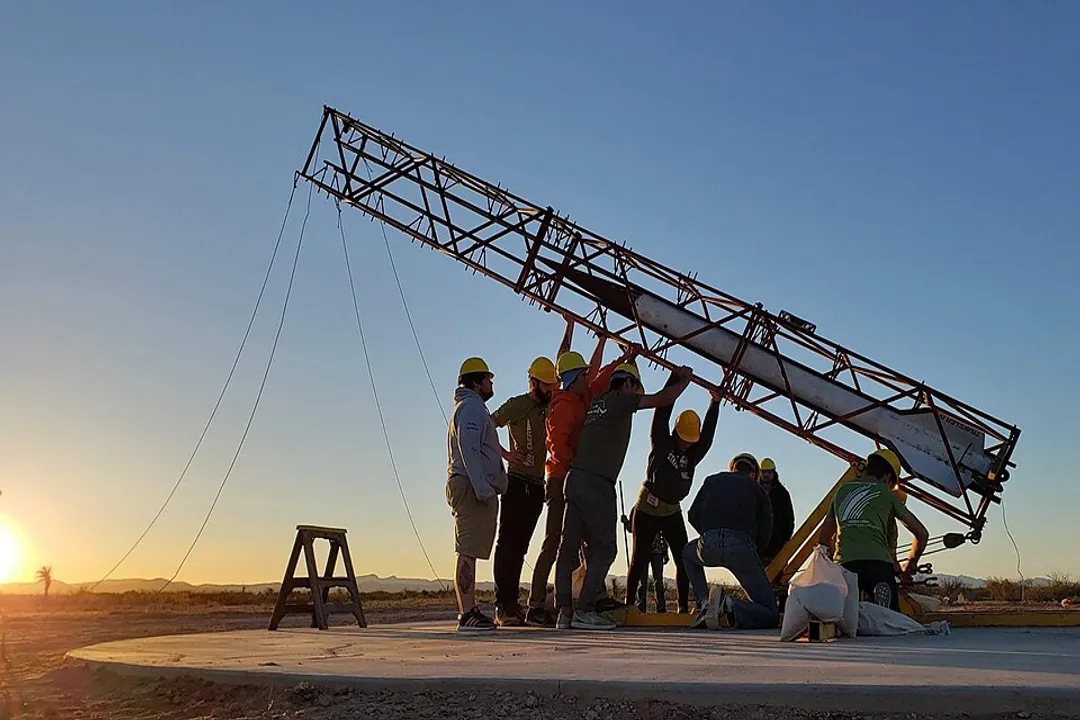
The pursuit of high-altitude flight within the civilian and amateur rocketry community is a driving force for innovation, pushing teams and individuals to test the limits of propulsion, materials science, and regulatory navigation. Defining the "highest altitude" isn't a single number; it depends entirely on whether one is discussing regulated model rockets, experimental amateur rockets, or student-led efforts. At the apex of this quest lies the Kármán line, the internationally accepted boundary marking where the atmosphere thins enough for conventional aerodynamic flight to become impossible, generally considered to be 100 kilometers (km) above sea level. [1]
# Space Records
For non-commercial entities, reaching the Kármán line is the ultimate achievement, an "amateur spaceshot". [1] The highest altitudes recorded by civilian rocketry teams are spectacular, primarily accomplished by groups utilizing solid-propellant motors. [1] The current pinnacle belongs to the University of Southern California's Rocket Propulsion Laboratory (USCRPL). Their Aftershock II vehicle, launched on October 20, 2024, from the Black Rock Desert in Nevada, reached an apogee of 143 kilometers (or 470,000 feet). [2] This flight not only smashed the previous record set by CSXT's GoFast (116 km in 2004) by a significant margin of 90,000 feet but also successfully demonstrated advanced thermal protection systems capable of handling hypersonic re-entry conditions. [1][2]
Before Aftershock II, student teams had already set major milestones. USCRPL’s earlier rocket, Traveler IV, was the first student-designed vehicle confirmed to have passed the Kármán line in April 2019, achieving 104 km. [1] More recently, in April 2025, Ethan Kosoof of New Zealand launched Meraki II, marking the first time an amateur rocket reached space outside the United States, achieving 121.6 kilometers. [1] This flight also claimed the record for the fastest amateur velocity to date. [1]
# Solid Versus Liquid Performance
When comparing the achievements, a stark divide appears between the two main propulsion types pursued by hobbyists: solid and liquid fuels. [1] The altitude records cited above—those exceeding the Kármán line—have only been achieved by solid-propellant amateur rockets. [1] Solid motors, especially those employing mixtures like "rocket candy" or Ammonium Perchlorate Composite Propellant (APCP), are often simpler to engineer for maximum impulse delivery in a high-power setup, allowing them to reach the edge of space. [1]
Amateur liquid rocketry, while incredibly complex, precise, and expensive due to the need for cryogenic or hazardous fuels and oxidizers, has not yet breached the Kármán line with any recorded flight. [1] The highest recorded apogee for an amateur liquid rocket, as tracked in recent records, belongs to the Deneb vehicle from Embry-Riddle Prescott, which peaked at 47,732 feet (about 14.5 km) in April 2023, utilizing a Jet-A/Liquid Oxygen blow-down system. [1] This significant disparity suggests that for the civilian rocketry community focused on raw altitude, solid motor technology remains the established path to orbit's doorstep, while liquid development focuses more on propulsion system research and complexity rather than brute altitude. [1]
# Regulatory Altitude Marks
For a civilian rocket, the highest altitude it can legally fly is heavily influenced by how the Federal Aviation Administration (FAA) classifies the vehicle, which depends more on mass and impulse than on the peak altitude itself, especially for the smallest class of rockets. [1]
# Classifications and Limits
Rockets are categorized under Federal Aviation Regulation (FAR) Part 101, which separates them into three classes: [1]
- Class 1 (Model Rocket): This is the most basic level, requiring no prior FAA approval or Air Traffic Control (ATC) notification, provided it operates safely. Key limitations are a maximum of 125 grams (4.4 ounces) of propellant and a total liftoff mass no more than 1,500 grams (53 ounces). [1] For these specific Class 1 rockets, the FAA does not impose an explicit maximum altitude ceiling; the limit is effectively what the small amount of propellant allows, which rarely exceeds a few thousand feet. [1]
- Class 2 (High Power Rocket) & Class 3 (Advanced High Power Rocket): These exceed the impulse or mass limits of Class 1 rockets. [1] For these larger vehicles, the primary regulatory restriction hinges on airspace: they cannot be flown in controlled airspace without prior authorization from the FAA. [1]
Interestingly, the FAA's technical definition of what constitutes an "Amateur rocket" allows for a maximum altitude of 150 kilometers (93.2 statute miles), provided the total impulse is less than 889,600 Newton-seconds. [1] When comparing this regulatory upper bound to the records, the Aftershock II flight at 143 km sits just under that 150 km maximum for FAA-recognized amateur flight. [1][2] While the student teams achieved this under their organizational umbrellas, it highlights that the current technical edge of non-commercial, non-governmental flight is very close to the regulatory ceiling defining the category itself. [1]
# Airspace and Local Controls
While the FAA sets the national stage, the actual altitude ceiling for any civilian launch is usually dictated by local air traffic management or organizational rules. [1] Launch clubs often have to file FAA waivers to fly higher than the baseline limitations allow, and common waiver ceilings might only extend to a couple thousand feet, such as 3,000 ft on the East Coast. [1] The real barrier is often the extent of Class G (uncontrolled) airspace at a specific location, as controlled airspace surrounding airports requires formal notification or a waiver. [1]
It is important for hobbyists to distinguish these rocketry regulations (Part 101) from the rules governing unmanned aerial vehicles (UAVs) or drones (often under Part 107 or Section 44809). The frequently cited 400-foot altitude limit generally applies to remotely operated, non-free-flight vehicles like drones and RC airplanes, not traditional model rockets operating under Part 101, unless an RC system has been added to the rocket, which can cause the FAA to interpret the vehicle as a UAS. This distinction often causes confusion, especially when rocket clubs share launch sites with RC flying clubs, necessitating clear ground rules or a Memorandum of Understanding (MoU) between the groups to manage different operating envelopes. [1] A practical tip for any club planning a large launch is to formally document these coordination efforts with local aviation authorities and site partners to ensure everyone operates under a shared, agreed-upon safety document. [1]
Ultimately, the highest altitude a civilian rocket can fly is determined not by an inherent technical barrier, but by the successful confluence of engineering capability, the availability of necessary regulatory authorization for the airspace, and the specific safety parameters set by the launch organization itself. [1] For now, that ceiling sits firmly beyond 140 kilometers, courtesy of dedicated student and amateur teams. [2]
Related Questions
#Citations
How high is too high? (legally) : r/rocketry - Reddit
Student Rocket Reaches Space, Smashes World Record for Highest ...
Amateur rocketry - Wikipedia
FAA Altitude Limit on Model Rockets??? 400 Feet????