What is the brightest object in the sky after the Sun?

The most brilliant beacon in our night sky, shining steadfastly once the Sun has dipped below the horizon or before it makes its morning appearance, is the planet Venus. [2][4] While the Moon claims the undisputed title for the brightest natural light source we see regularly, if we set the Moon aside, Venus takes the top spot, often appearing stunningly bright and easily noticeable even in twilight. [4][6] It is famously known by two contrasting nicknames, the "Evening Star" and the "Morning Star," depending on its position in its orbit relative to us and the Sun. [6]
# Why Venus Shines
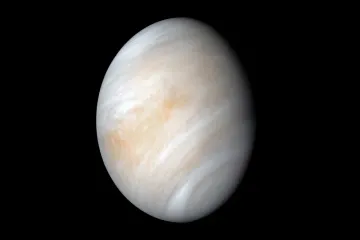
The extreme luminosity of Venus isn't due to it being the largest planet near Earth—that honor goes to Jupiter—nor is it because it emits its own light. Rather, it is a combination of its relative proximity to Earth and the composition of its atmosphere. Venus is the second planet from the Sun, meaning it can get quite close to our world as it orbits. [6] However, distance is only half the story; the real secret lies in its appearance, or albedo.
Venus is enveloped in thick, global clouds composed mainly of sulfuric acid droplets. [6] These clouds are incredibly effective at reflecting sunlight back into space, meaning they reflect nearly 77% of the light that strikes them, making it the most reflective planet in our solar system. [6] Because it reflects so much sunlight so efficiently, it appears dazzlingly bright when viewed from Earth.
To put its brilliance into perspective, we can look at apparent magnitude, the scale astronomers use to measure how bright celestial objects appear to us. Brighter objects have a lower (or more negative) number. The Sun is immensely bright, with an apparent magnitude around $-26.7$. The Full Moon is generally around $-12.7$. Venus, at its absolute brightest phase—when it is visible but only partially illuminated—can reach an apparent magnitude of about $-4.6$. This is substantially brighter than even Sirius, the brightest star in the night sky, which hovers around a magnitude of $-1.46$. [2] When we consider that every whole number on the magnitude scale represents a tenfold difference in brightness, the visual gap between Venus and even the brightest fixed stars is enormous. Observing Venus when it is at its maximum brightness is often an experience where the object seems to almost "glow" against the darkening sky, a clear demonstration of its superior reflectivity compared to its neighbors. [2]
# Orbital Dance
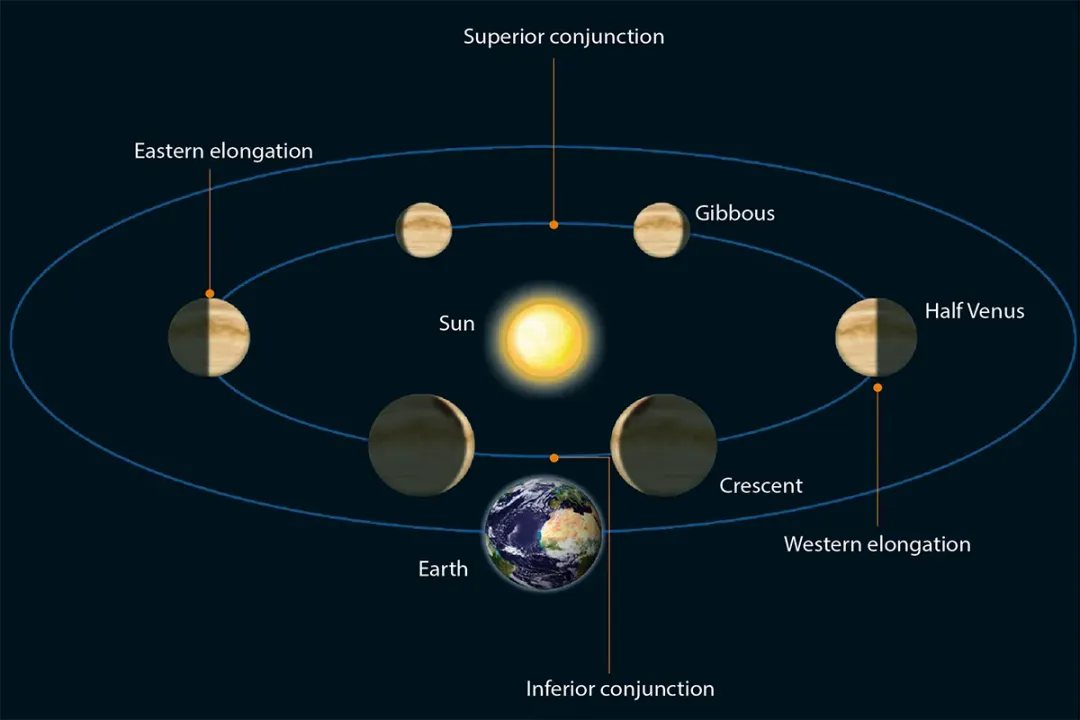
Venus’s dual identity as a morning or evening object is entirely dictated by its orbit, which lies inside Earth's orbit around the Sun. [6] Because it orbits closer to the Sun, we never see Venus high overhead in the middle of the night, as we do with Mars or Jupiter. [6] It always appears relatively close to the Sun's position in our sky.
When Venus is on the western side of the Sun as viewed from Earth, it sets shortly after the Sun, making it visible in the early evening sky—the Evening Star. [6] As it continues its orbit, it moves to the eastern side of the Sun, rising before the Sun appears on the horizon, thus earning the title of the Morning Star. [6] This cycle of visibility dictates when and where skywatchers should look for it.
Furthermore, just like our own Moon, Venus goes through phases because we see varying amounts of its sunlit surface as its position changes relative to Earth. [6] When Venus is a "gibbous" phase (more than half-lit), it appears smaller and less bright because it is farther away from Earth. [6] Conversely, when it is near its closest approach to Earth (a thin crescent phase), it appears much larger but is dimmer overall because the illuminated side is mostly facing away from us. [6] The time when it shines with maximum visual brilliance corresponds to a point between these two extremes, where the balance between its apparent size and the illuminated portion yields the greatest apparent magnitude.
# Planetary Brightness Ranking
While Venus is the consistent champion after the Moon, it is important to note that other bright objects make appearances that can sometimes cause confusion. Jupiter is frequently the third brightest object in the sky, sometimes rivaling Venus in brilliance if Venus is farther away or in a less favorable phase. [2] When both Venus and Jupiter are visible simultaneously, the contrast between the two gas giant and the inner planet is fascinating, yet Venus generally maintains its lead in overall luminosity. [2] Mars, while famous for its reddish hue, is significantly dimmer than Venus or Jupiter unless it is making a very close opposition with Earth. [2]
Here is a simplified look at the typical order of brightness for the prominent celestial bodies visible to the naked eye in our night sky (excluding the Sun):
| Object | Typical Appearance | Notes |
|---|---|---|
| The Moon | Very Bright | Varies significantly by phase |
| Venus | Extremely Bright | Generally the brightest "star-like" object [2] |
| Jupiter | Very Bright | Can occasionally rival Venus [2] |
| Mars | Moderately Bright | Reddish tint; brightness highly variable |
| Sirius | Brightest Star | Reference point for stellar brightness [2] |
It is worth noting that sometimes people mistake Venus for an Unidentified Flying Object (UFO) simply because its brightness is so unusual compared to the pinpricks of light we associate with true stars. [2] Its steadfast, brilliant appearance, unblinking like a star, is a good clue that you are looking at a planet, though its location low near the horizon is the biggest giveaway that it must be Venus or Jupiter.
# Observing Conditions
Since Venus is perpetually locked close to the Sun in our sky, successful observation requires paying attention to the local time and horizon. It is never visible high in the sky around midnight. [6] If you look for it in the early morning, you must be facing east just before sunrise. [6] If you are looking for the Evening Star, you must scan the western sky immediately after sunset. [6]
A practical tip for viewers is to watch the transition. The visibility of Venus is fleeting; it will only be visible for a few hours after sunset or before sunrise because it follows the Sun too closely across the sky for deep-night viewing. [6] Furthermore, because it hangs low near the horizon during these times, atmospheric distortion is common. The air near the horizon is thicker and more turbulent, which can cause Venus to appear to twinkle vigorously or even display momentary, faint color flashes, something rarely seen with objects high overhead. [2] This twinkling is an atmospheric effect, not a property of Venus itself, which is close enough to appear as a small disk rather than a point source of light, though it requires a telescope to resolve that disk shape clearly. [6]
The planet’s current position relative to Earth changes monthly, meaning its peak visibility as the brightest object—its greatest apparent magnitude—occurs only at specific points in its 584-day orbit around the Sun. This variability means that while Venus is always the primary contender for the title, the sheer brilliance you witness changes depending on the time of year you step outside to look.
#Videos
Top 10 Brightest Objects in the Solar System - YouTube
Related Questions
#Citations
Venus - Wikipedia
Top 10 brightest objects in our solar system - EarthSky
Venus is currently the brightest object in the sky directly after Sunset
Apart from the Sun and the Moon, what is the brightest object that we ...
What is the bright planet in the eastern sky? - Facebook
Why Venus is called the morning star or the evening star
Top 10 Brightest Objects in the Solar System - YouTube
Why is Venus so bright in the night sky? - Cool Cosmos