What has been discovered about Jupiter?
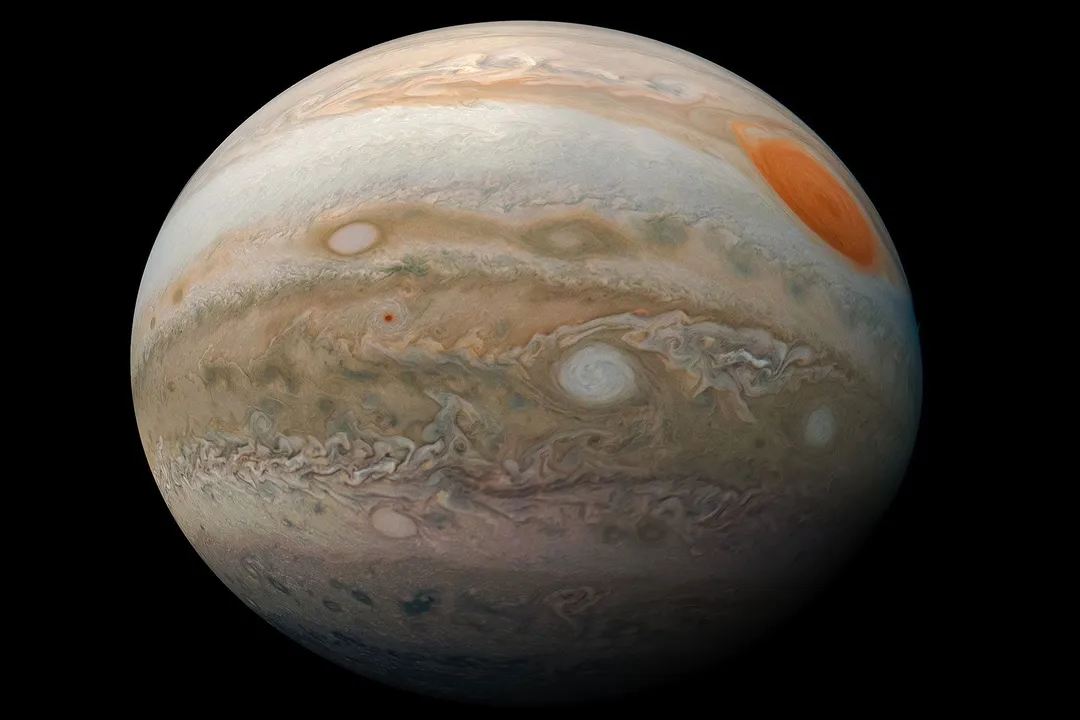
The sheer scale of Jupiter is often the first thing that strikes anyone studying it; it is a colossal world dwarfing all others in our solar system combined. Its mass is more than double that of every other planet put together, and it is so large that if you gathered all the other planets, Saturn, Uranus, Neptune, and the terrestrial worlds, Jupiter would still account for the majority of the system’s mass after the Sun. [2][7] As a gas giant, it lacks a true solid surface in the way Earth does, instead consisting primarily of hydrogen and helium, much like the Sun itself. [2][8] Despite its immense size, Jupiter rotates incredibly quickly, completing a full turn in less than ten Earth hours, a speed that contributes to its distinctly flattened shape, technically known as an oblate spheroid. [2][7]
Jupiter’s atmosphere is famous for its swirling, banded appearance, caused by the rapid rotation driving powerful east-west winds that create alternating zones of rising and sinking gas. [7] These atmospheric features are the subject of intense scientific scrutiny, revealing dynamic processes that far exceed terrestrial weather patterns. The most famous feature, the Great Red Spot, is a centuries-old anticyclonic storm, larger than Earth itself, though observations suggest it has been gradually shrinking over time. [4] Discoveries from missions like Voyager and Galileo mapped the complex cloud layers composed of ammonia ice crystals and ammonium hydrosulfide. [4]
# Exploration Milestones

The quest to understand this giant began long before spacecraft launched. Early astronomers charted its four largest moons, now named the Galilean satellites, which offered the first concrete evidence that not everything in the heavens orbited Earth. [6] The modern era of intimate study started in the 1970s with the Pioneer 10 and Pioneer 11 flybys, which provided the first close-up images and established the immense scale of Jupiter’s radiation environment. [3] These were followed by the highly successful Voyager 1 and Voyager 2 missions in 1979, which offered detailed views of the planet's complex cloud patterns and discovered volcanic activity on Io. [3][4]
The Galileo probe, which arrived at Jupiter in 1995, represented a major step change, spending eight years orbiting the planet and releasing an atmospheric probe that plunged into the clouds, transmitting data until the crushing pressure and heat overwhelmed it. [1][3] Subsequent flybys by Cassini and New Horizons added further data layers, preparing the groundwork for the current generation of deep-dive missions. [1] One observation that remained tantalizingly out of reach until recently was the true nature of its core, a question that drives the current flagship mission, Juno. [5]
When considering the timeline, it’s interesting to note how key dates shape our understanding. The first flyby by Pioneer 10 in 1973 kicked off the age of direct observation. [6] Then, the arrival of the Galileo orbiter in 1995 marked the first sustained study of the Jovian system over several years. [6] The launch of the Juno mission in 2011 initiated the current phase focused on interior structure, with arrival in 2016. [1][6]
# Inside Jupiter
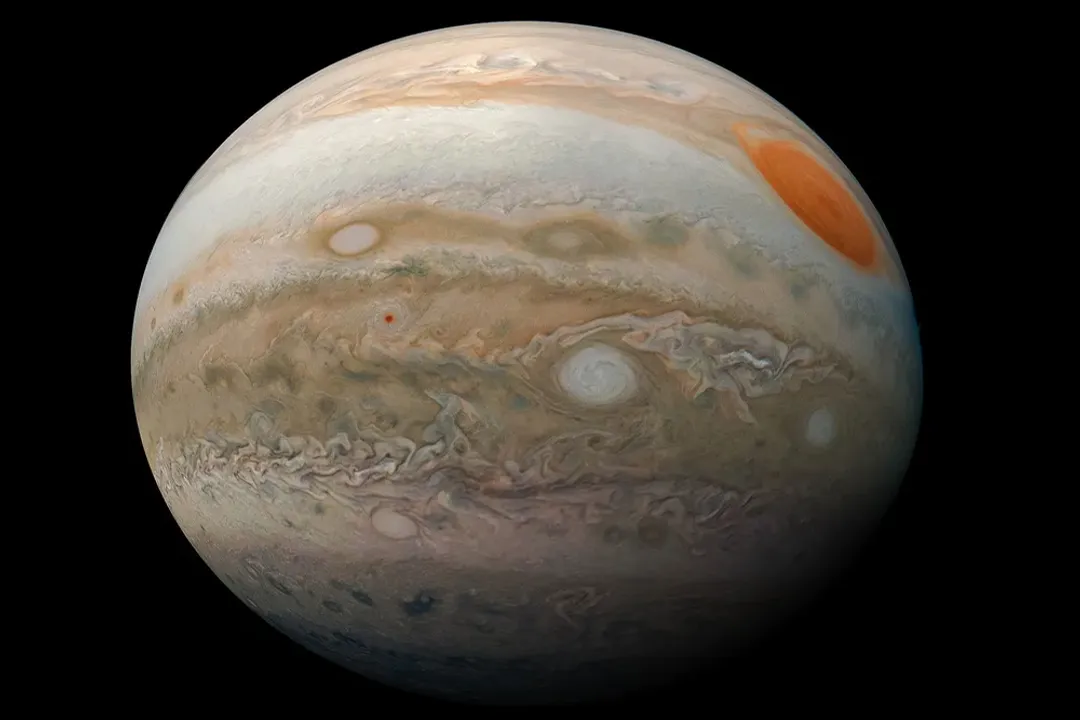
Unraveling what lies beneath Jupiter’s swirling veil has required specialized technology, primarily the Juno spacecraft. [5] Prior to Juno, scientists theorized Jupiter might have a solid, well-defined core made of heavy elements, similar to Earth’s structure but on a much grander scale. [5] Juno’s mission profile, specifically its close polar orbits, allows it to map the planet’s gravity and magnetic fields with unprecedented accuracy, providing the necessary data to constrain models of the interior. [1][5]
The results from Juno have challenged simpler models. Instead of a distinct, dense rock core, data suggests the core is "fuzzy" or dilute. [5] This indicates that the heavier elements—rock and ice—are not concentrated in a sharply defined sphere but rather are somewhat mixed and spread out within the overlying metallic hydrogen layer. [5] This configuration suggests that the immense pressure and heat cause a gradual transition zone rather than a hard boundary between the core and the mantle. [5] Imagine trying to find the exact point where a dark, dense syrup perfectly transitions into a lighter, pressurized fluid; this blurring is what scientists are finding at Jupiter’s center. [5]
This internal structure has profound implications for how Jupiter formed. A dilute core suggests that the planet accreted much of its mass rapidly, perhaps engulfing its initial core material along with vast amounts of lighter gas before the planet had time to settle into a neat, layered configuration. [5]
# Magnetic Power
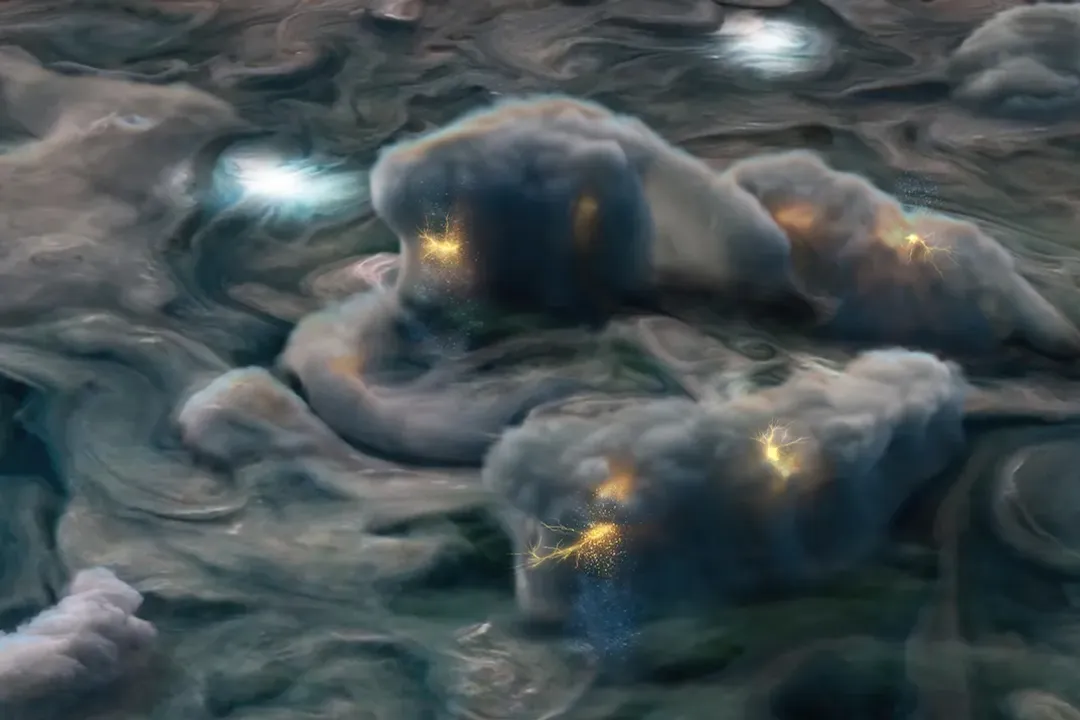
Jupiter possesses the most powerful magnetic field of any planet in the solar system, second only to the Sun itself. [4] This field is an astonishing 14 times stronger than Earth’s and extends millions of miles into space, sweeping past the inner solar system. [2][7] The field's origin is directly tied to the planet's interior structure. It is generated by the movement of electric charges within the vast layer of metallic hydrogen—hydrogen compressed under such extreme pressure that its electrons are squeezed free from their atoms, allowing the material to behave like an electrical conductor. [7][8]
The magnetosphere created by this field is gigantic. If it were visible from Earth, it would appear larger than the full Moon in our sky, even though it is millions of miles away. [7] This magnetic bubble traps energetic particles, creating intense radiation belts that pose a significant hazard to spacecraft, a critical engineering consideration for any mission planning a long stay near the planet. [1][4] Understanding the magnetic field is not just about strength; Juno has been studying its complex, asymmetrical nature, which doesn't align perfectly with Jupiter's rotational axis, hinting at swirling dynamics deep within the conductive fluid layer. [1]
# The Moon System
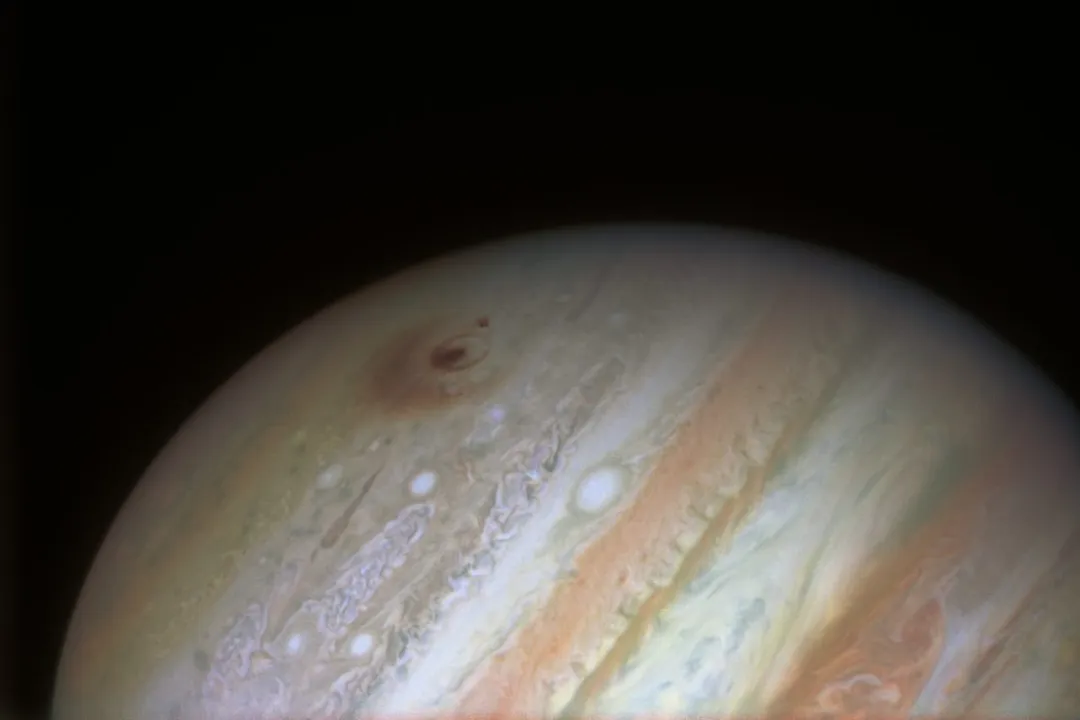
Jupiter's entourage includes at least 79 confirmed moons, a collection so vast it resembles a miniature solar system. [2][8] The four largest, discovered by Galileo Galilei, remain the most fascinating targets: Io, Europa, Ganymede, and Callisto. [4][8] These Galilean moons are worlds unto themselves, offering diverse environments and geophysical activity.
Io is the most volcanically active world known in our solar system, constantly resurfacing itself due to the intense tidal stretching and squeezing caused by the gravity of Jupiter and its neighboring moons. [4][8]
Europa is perhaps the most compelling target for astrobiology because strong evidence suggests it harbors a vast, salty liquid water ocean beneath its icy crust, making it a prime candidate for potentially habitable environments. [4][8] The recent flybys and data analysis continue to refine estimates of the ocean's depth and salinity, which is crucial for understanding its chemical makeup. [1]
Ganymede is unique among moons because it possesses its own intrinsic magnetic field, a rare trait among solar system satellites. [4][8] This feature suggests it also has a liquid, conductive layer deep inside, possibly a core or a deep subsurface ocean interacting with its magnetic field generation. [8]
Callisto, the outermost of the four large moons, appears geologically dead, covered in impact craters that date back billions of years, providing a relatively pristine record of the early solar system’s bombardment history. [8]
The diversity here—volcanism on Io, oceans on Europa, a magnetic field on Ganymede, and ancient scars on Callisto—shows that Jupiter's gravitational influence is a primary driver for geological activity across its entire family, a concept often overlooked when focusing solely on the planet itself. This gravitational kneading generates significant internal heat, keeping bodies like Io and Europa geophysically active over astronomical timescales. [4]
# Future Science
The scientific endeavor concerning Jupiter is far from complete. While Juno continues to refine our knowledge of the interior and magnetic field, future missions are already planned to address the tantalizing question of habitability around the giant world. [1][3]
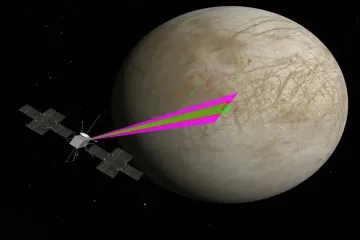
The European Space Agency's Jupiter Icy Moons Explorer (Juice) mission, launched in April 2023, is designed specifically to conduct detailed observations of Ganymede, Europa, and Callisto. [3] Juice will focus on characterizing the subsurface oceans of these icy worlds and investigating the potential for habitable conditions. [3] Following its long cruise, Juice is scheduled to arrive at the Jovian system in 2031. [3] Notably, Juice is slated to enter orbit around Ganymede, becoming the first spacecraft ever to orbit a moon other than Earth's Moon, offering an unparalleled, long-term view of that complex satellite. [3]
Meanwhile, Juno has already been extended beyond its initial mission parameters, allowing it to perform crucial close flybys of some of the major moons, gathering vital reconnaissance data to support Juice and future potential lander concepts. [1] This transition from simply studying the giant planet to focusing on its diverse, ocean-bearing moons represents the latest major shift in solar system exploration strategy. [3] The discoveries made about Jupiter’s intense radiation environment, first noted by the Pioneer missions, directly inform the design and operational plans for these subsequent, longer-term orbiters like Juice. [3] The sheer power of the magnetic field dictates that any close-up exploration of the icy moons must be carefully orchestrated to protect sensitive electronics, meaning the findings about the magnetosphere are just as critical for mission success as the data gathered about the moons themselves. [1][4]
The ongoing exploration paints a picture of Jupiter not just as a massive, static gas ball, but as the architect of a dynamic, complex system where internal pressures, external gravity, and radiation sculpt worlds that could potentially harbor life. From the fuzzy core dictating its gravity field to the tidal heating keeping Io molten, every piece of data builds a more intricate understanding of this planetary monarch. [5][7]
#Videos
What Did Scientists Discover on Jupiter? - YouTube
Related Questions
#Citations
Jupiter Exploration - NASA Science
A history of Jupiter exploration: the journey to Juice - ESA
The Seven Most Amazing Discoveries We've Made by Exploring ...
What's In Jupiter's Core? - Mission Juno
7 Important Dates in Jupiter History | Britannica
Jupiter Coverage - Space
Jupiter, the planet with a planetary system of its own
What Did Scientists Discover on Jupiter? - YouTube