What came before the stars?
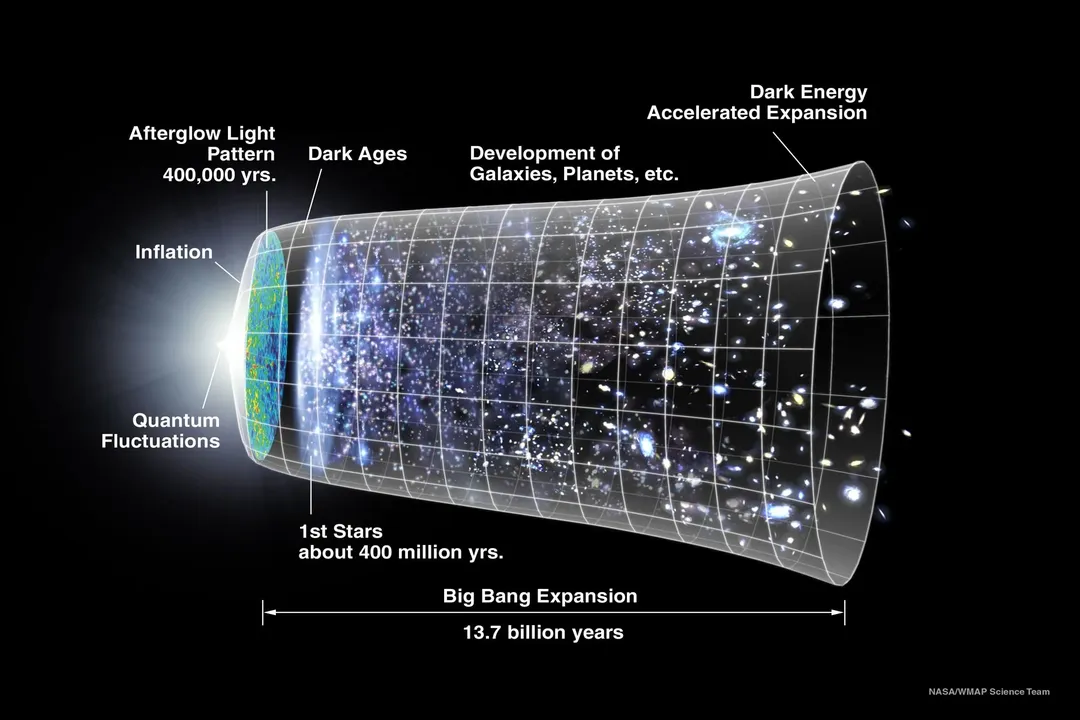
The grand cosmic tapestry we observe today, peppered with countless galaxies, nebulae, and the familiar glow of established stellar populations, is the result of an immensely long history. To understand what came before the stars began to shine, we must rewind the clock to a time when the universe was almost unrecognizable—a hot, dense, featureless expanse governed by physics on the grandest scales. Before the first fusion reactions ignited within contracting clouds of gas, before even the formation of the earliest galaxies, there was a period defined by fundamental particles, radiation, and a slow, methodical cooling process. [2]
The absolute beginning, according to our current best model, is the Big Bang, an event roughly 13.8 billion years ago that marked the start of the universe as we know it, initiating the expansion of space and time itself. [2] However, immediately following this singularity, the universe entered the Planck Epoch, a time so brief and extreme that our current laws of physics break down, leaving us with more questions than answers. [2] What succeeded this was the grand cooling. As the universe expanded, it cooled from an unimaginably hot, opaque plasma—a thick soup of fundamental particles and intense radiation—into something clearer. [2]
# Early Evolution
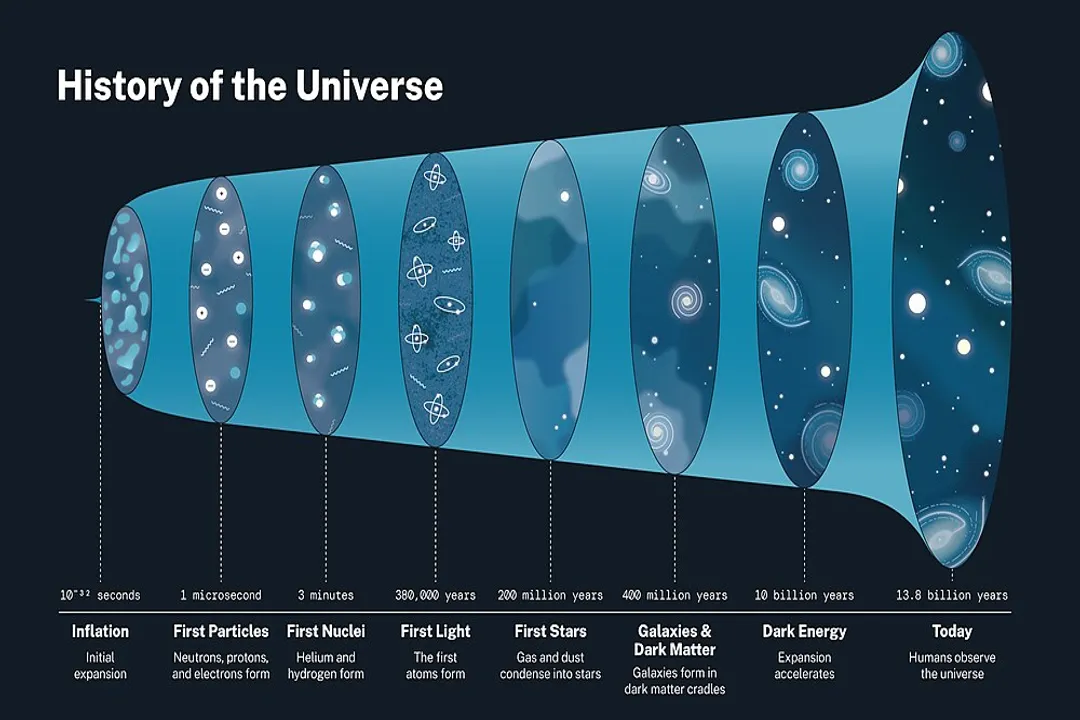
The chronology of the universe maps out these earliest phases with remarkable detail, even though direct observation is impossible. [2] After the initial fraction of a second where inflation stretched the cosmos exponentially, the universe was a sea of energetic particles. It took about 380,000 years for the temperature to drop sufficiently—down to about 3,000 Kelvin—for protons and electrons to combine, forming the first stable, neutral atoms, primarily hydrogen and helium. [2] This event, known as recombination, marks a crucial transition. Suddenly, photons (light particles) were free to travel unimpeded through space for the first time, rather than constantly scattering off free electrons. [2]
This first light, released when the universe became transparent, is what we detect today as the Cosmic Microwave Background (CMB) radiation. [2] The CMB is not the light before the stars; it is the glow of the universe before structure. It represents the last moment the universe was homogenous and dominated by radiation, existing in a state of near-perfect smoothness. [2][3]
# Cosmic Silence
Once the universe cooled enough for neutral atoms to form, the "Dark Ages" began. [2] This epoch stretches from the end of the radiation-dominated era (recombination, around 380,000 years after the Big Bang) up until the time when the first stars and quasars ionized the surrounding gas, a process called reionization. [2] During these dark eons, there were no light sources apart from the fading embers of the CMB. The universe was filled overwhelmingly with neutral hydrogen and helium gas, along with dark matter halos beginning to coalesce under gravity. [6]
It is important to grasp the nature of this silence. If you could somehow observe the universe during the Dark Ages, it would not be pitch black in the sense of absolute void; it would be filled with the faint, omnipresent warmth of the CMB, but critically, there would be no visible light originating from discrete, luminous objects like stars or galaxies. [2] The gas existed, it was massive, and it was slowly collapsing, but it had not yet reached the critical density and temperature required for sustained nuclear fusion. [6]
Consider this period like a vast, cool, dark ocean just before a storm breaks. Gravity was the unseen conductor, working subtly over hundreds of millions of years, pulling the primordial gas into denser clumps within the scaffolding provided by dark matter. [3] It was this relentless, gravitational assembly that set the stage for the cosmic ignition. The gas clouds thickened, their interiors heating up under the ever-increasing pressure, inching closer to the point of no return—the birth of the first light sources. [6]

# The First Ignition
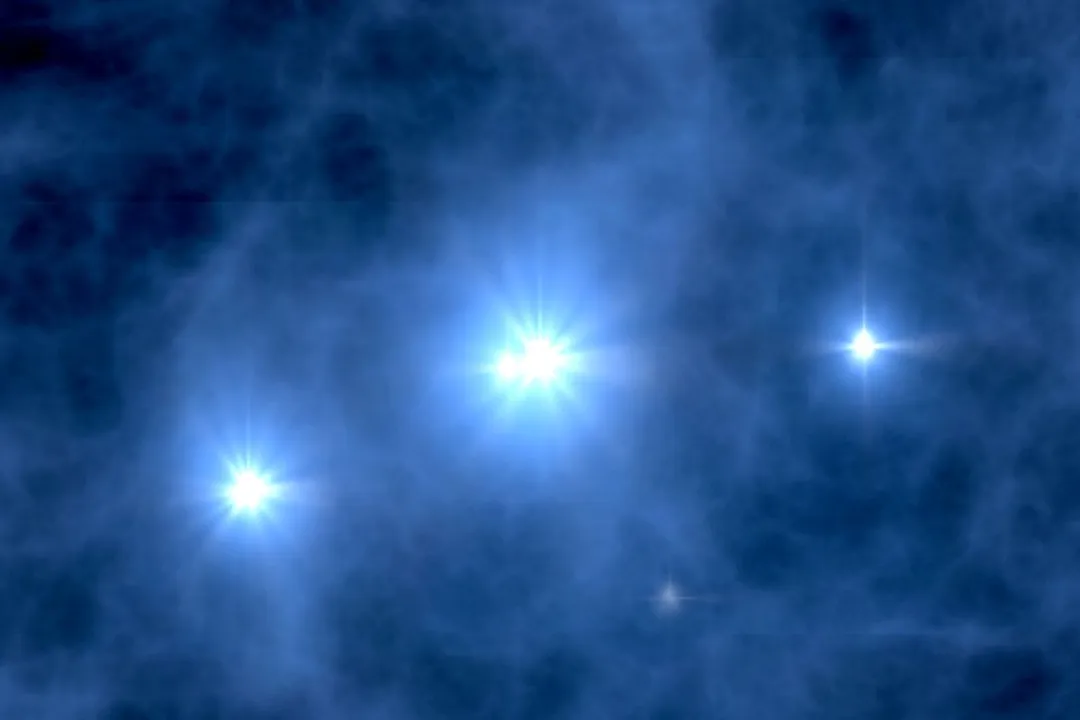
The transition out of the Dark Ages is defined by the birth of the very first stars, often designated as Population III stars. [6][8] These objects were the universe’s first beacons, forged entirely from the pristine, near-pure mixture of hydrogen and helium created in the Big Bang, as no heavier elements (which astronomers call "metals") had yet been created by stellar nucleosynthesis. [6][8]
These initial stars were fundamentally different from the Sun, which is a relatively metal-rich Population I star. [6] Theoretical models suggest that Population III stars were giants—hundreds of times the mass of our Sun, perhaps even reaching a million solar masses, and significantly hotter and brighter. [8] Their immense mass meant they lived incredibly short, brilliant lives, perhaps only a few million years, before exploding as powerful supernovae. [6][8] They did not have the luxury of long, stable main-sequence lives like modern stars.
The formation of these first luminous objects is precisely what current and future observational tools, like the James Webb Space Telescope (JWST), are designed to search for. [1] By looking at objects billions of light-years away, we are effectively looking back in time to witness the universe when it was only a few hundred million years old, hoping to catch the faint signature of these nascent stellar populations. [1]
Comparing the timelines reveals a clear sequence: first, the cooling plasma and the CMB; [2] second, the dark ages dominated by neutral gas and dark matter structures; [2][6] and finally, the ignition of Population III stars.
If we were to map out the initial building blocks of light based on our current understanding, it might look something like this synthesized sequence, focusing on the matter that eventually produced stars:
| Cosmic Era | Approximate Time After Big Bang | Dominant Component | Light Source Status |
|---|---|---|---|
| Plasma State | < 380,000 years | Ionized Gas/Radiation | Opaque |
| Recombination | ~380,000 years | Neutral Hydrogen/Helium | CMB Released (Last scattering) |
| Dark Ages | 380,000 years – ~150 Million years | Neutral Gas & Dark Matter | None (Universe appears dark) |
| First Stars (Pop III) | ~150 Million years + | First Stellar Nuclei | First localized light sources |
# Galaxies Versus Stars

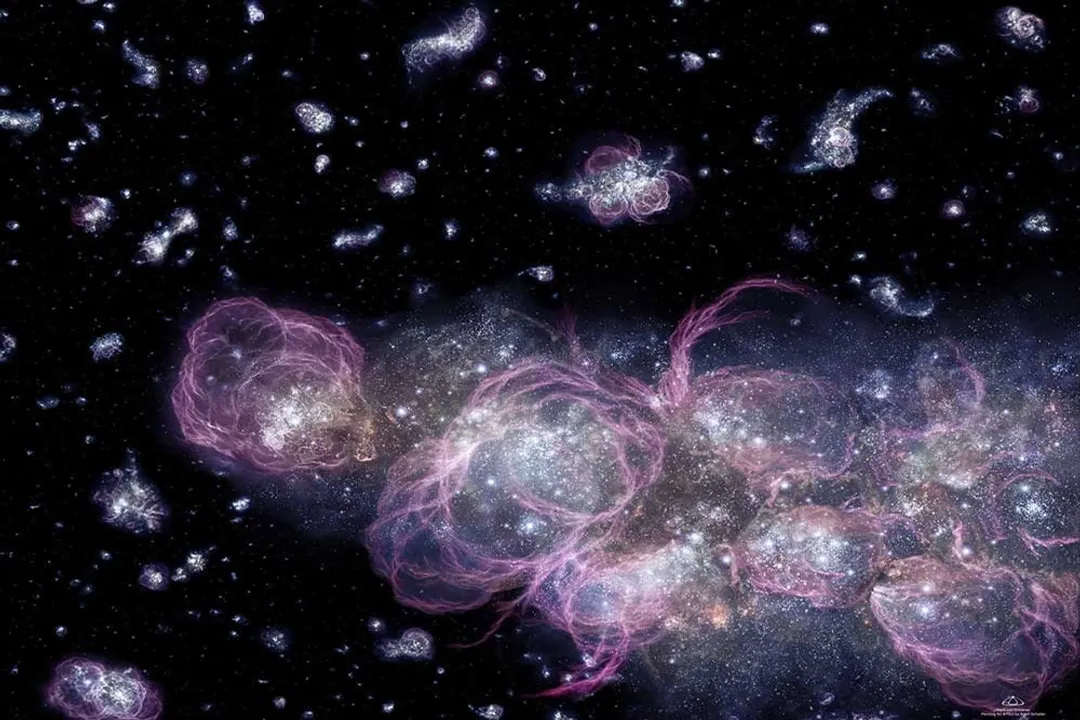
A common point of curiosity is whether the first massive structures were already recognizable as galaxies, or if the very first stars formed in isolation before being gathered into larger systems. Research suggests a distinct hierarchy in the assembly process. [4][5] The very first stars formed within localized gravitational potential wells created by dark matter halos. [5] These initial gravitational collapses led to stars forming before large, complex galaxies emerged. [4]
In fact, the first stars themselves were the seeds. When these massive Population III stars died, they enriched the surrounding primordial gas with the first heavy elements (carbon, oxygen, iron, etc.) synthesized during their brief nuclear lives or their subsequent supernova explosions. [6] This enriched gas was then available to form the next generation of stars, which could be smaller and longer-lived, and critically, these enriched clouds could begin to clump together more effectively to form the first protogalaxies. [6]
Therefore, stars came first. They were the fundamental, high-energy factories necessary to produce the material required for the more complex, organized structures we later identify as galaxies. [4] Galaxies, in this sense, are collections of these subsequent generations of stars and the enriched gas clouds they inhabit. While some very early, small galaxies containing newly formed stars are observed by JWST, the absolute first stellar objects predated the maturity of these large systems. [1] Think of it as starting with single, massive, brilliant candles before you have assembled the ornate structure of the chandelier. [4]
# Before the Bang
The focus on what precedes the stars naturally leads to the most profound cosmological question: What existed before the Big Bang event itself? This realm moves from established astrophysics into theoretical and speculative physics, as the standard Big Bang model describes the start of the universe, not what may have initiated it. [9]
The concept of "time" as we experience it is intrinsically linked to the expansion of the universe initiated by the Big Bang. [9] If time itself began at that instant, then asking what happened before is akin to asking what is north of the North Pole—the framework for the question might not apply. [9]
However, several theoretical models attempt to address this boundary condition. Some suggest a cyclical model where the universe undergoes endless cycles of expansion (Big Bang) and contraction (Big Crunch), implying a universe before our current one existed. [9] Others propose models like eternal inflation, where our Big Bang was merely one 'bubble' nucleation event in a much larger, eternally inflating meta-verse. [9] These frameworks offer possibilities for a continuous existence preceding our cosmic inflation, but they remain heavily theoretical constructs, unlike the well-evidenced physics describing the Dark Ages or Population III stars. [9]
When considering these pre-Bang scenarios, it is useful to remember that the conditions necessary for star formation—gravity, cool gas, and a measurable timeline—require the universe to have already undergone that initial expansion phase described by the Big Bang chronology. [2] The environment required for even the simplest hydrogen atom to exist, let alone collapse under gravity, simply did not exist in the singularity or the Planck Epoch preceding it. The cosmic ingredients for stars—the elements themselves—were absent until the very first stars formed and began cooking heavier matter. [6]
The universe before the stars was one of near-perfect simplicity: an expanding gas of hydrogen and helium, permeated by radiation, slowly accumulating mass under the subtle, persistent force of gravity, waiting for the density threshold to be crossed to finally break the cosmic silence with the universe’s very first light.
#Videos
What Was Here Before the Solar System? - YouTube
Related Questions
#Citations
Early Universe - NASA Science
Chronology of the universe - Wikipedia
Early Universe | Center for Astrophysics | Harvard & Smithsonian
Which came first: Galaxies <=> Stars <=> Planets?
What is the timeline and history of star and planet formation ... - Reddit
Understanding what the first stars in the Universe were like will shed ...
What Was Here Before the Solar System? - YouTube
What existed before the Big Bang? - BBC