What are the forces in a star?
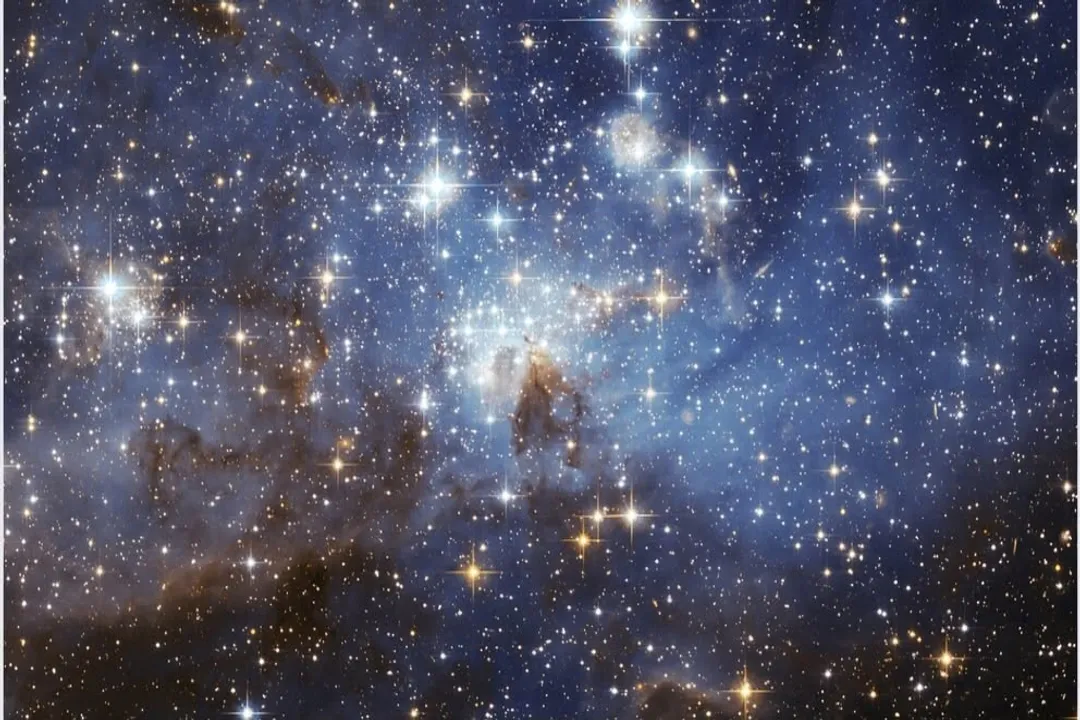
The cosmic object we see shining across billions of miles, the star, is not a static monument of light, but rather a gigantic, ongoing negotiation between two fundamental, opposing forces. At its very essence, a star is a massive sphere of gas, predominantly hydrogen and helium, held together by an immense internal tension. This tension is the daily, moment-by-moment battle between the crushing weight of its own mass pulling everything toward the center, and the incredible energy generated deep within its core pushing everything outward. The physical state that allows these colossal structures to exist across eons is a delicate, dynamic standoff known as hydrostatic equilibrium.
# Gravity's Pull
The primary antagonist in this cosmic struggle is gravity, the self-attraction of all the star's constituent matter. Since a star is built from such an enormous amount of material—our own Sun, for example, contains over $330,000$ times the mass of Earth—gravity exerts a relentless, inward-directed pressure. Imagine trying to compress an entire star; that immense, inexorable desire to collapse defines the gravitational force.
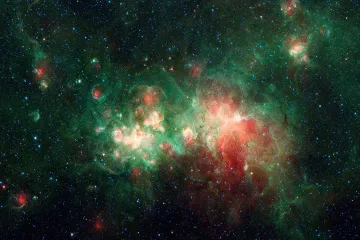
The process of star birth clearly illustrates the dominance of gravity in the initial stages. Stars originate from vast, cold, diffuse clouds of gas and dust, known as nebulae. In these nurseries, gravity begins the process by causing localized regions within the cloud to contract and pull material inward. As this material falls toward the center of the gathering clump, the gravitational potential energy is converted into kinetic energy, which manifests as intense heat. This heating continues until the core becomes dense and hot enough to ignite nuclear reactions, marking the official birth of the star. Thus, gravity is both the sculptor that builds the star and the ever-present force attempting to crush it once formed.
If we consider a main sequence star like our Sun, gravity is acting on every parcel of gas, attempting to shrink the star to an infinitely small point. The sheer magnitude of this inward pull means that only an equally powerful counterforce can sustain the star's size and structure against instantaneous implosion.
# Fusion's Push
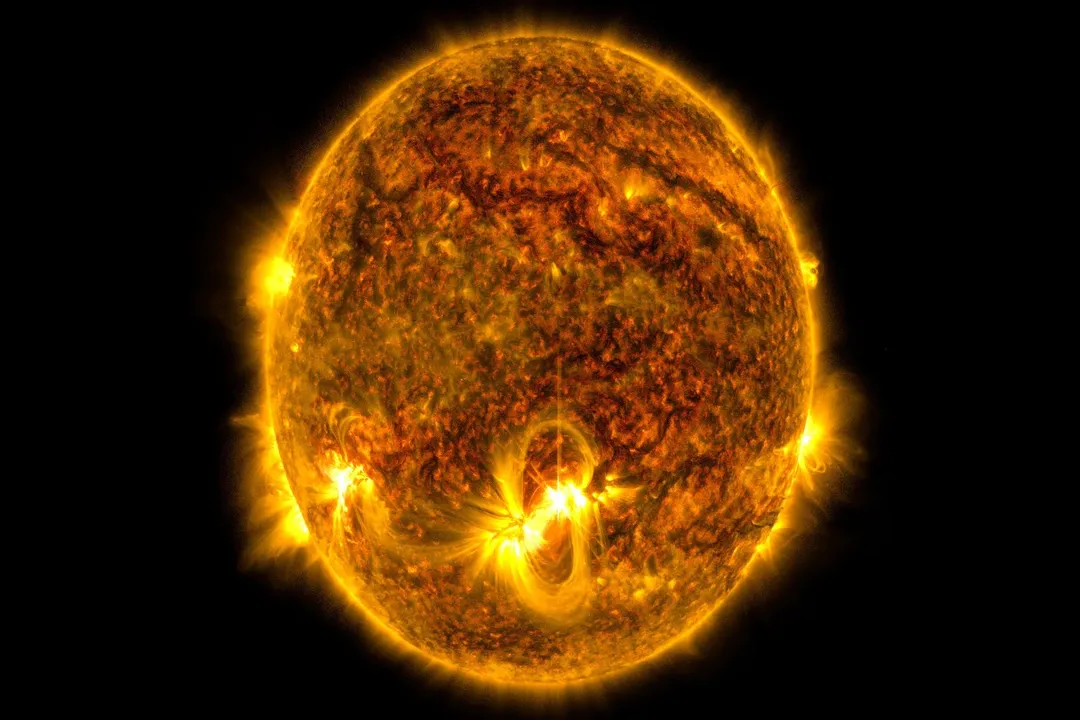
The resisting force, the one that keeps the star inflated against the crushing weight of gravity, originates in the star's furnace: the core. This outward push is a form of thermal and radiation pressure generated by nuclear fusion.
In the scorching hot and incredibly dense stellar core, atomic nuclei—primarily hydrogen—are forced together under extreme conditions to form heavier elements, most commonly helium. This process releases an enormous amount of energy, following Einstein’s mass-energy equivalence principle, . This energy manifests in two main ways that contribute to the outward pressure:
- Thermal Pressure: The core reaches temperatures high enough to excite the particles (ions and electrons) to move at extremely high speeds, generating intense heat. This rapid, chaotic motion of particles creates outward pressure against the overlying layers of the star.
- Radiation Pressure: The fusion reactions produce high-energy photons (light particles). As these photons move outward from the core toward the surface, they collide with surrounding matter, effectively pushing it away from the center.
For a star to be stable—meaning it is not collapsing or rapidly expanding—the outward flux of energy must perfectly match the inward pull of gravity. It’s a continuous production of energy precisely tuned to resist the ever-present gravitational stress. A common way to conceptualize this is that the star is constantly engaged in a massive, self-sustaining explosion that is perfectly contained by its own mass. This internal requirement to maintain the outward push is what governs the star's entire existence, demanding a continuous fuel supply.
# Equilibrium State
The condition where the star maintains a stable size, neither shrinking nor growing, is called hydrostatic equilibrium. This balance is not static; it is dynamic. The outward pressure must be precisely balanced against the inward force of gravity at every layer within the star, not just the overall mass.
Think of it this way: for any imaginary shell of material inside the star, the force pulling that shell inward (due to the mass above it) must equal the pressure pushing that shell outward (due to the energy generated below it).
The stability paradox here is profound: for a star to maintain its life, it must maintain the conditions for its destruction. If the fusion rate in the core slightly decreases for any reason, gravity momentarily gains the upper hand, compressing the core, which actually increases the temperature and density, thus speeding up the fusion rate again until balance is restored. Conversely, if fusion momentarily speeds up, the star expands slightly, lowering the core temperature and pressure until the fusion rate drops back down. This self-regulating feedback loop is what keeps stars burning steadily on the main sequence for billions of years.
| Force Component | Direction of Action | Origin/Cause | Effect on Star Structure |
|---|---|---|---|
| Gravity | Inward | Self-attraction of stellar mass | Attempts collapse; dictates core density |
| Thermal Pressure | Outward | High-speed motion of plasma particles | Resists gravity; maintains volume |
| Radiation Pressure | Outward | Outward flow of photons from fusion | Resists gravity; contributes to luminosity |
If we examine the core temperatures required for sustained hydrogen fusion, we see a stark threshold. For an object to become a true star, its core needs to reach around $15$ million Kelvin (). Objects that fail to reach this threshold, like brown dwarfs, are often called "failed stars" because they cannot generate the sustained outward pressure needed to halt gravitational collapse; their structure is supported primarily by electron degeneracy pressure, a quantum mechanical effect, rather than fusion pressure.
# Plasma State
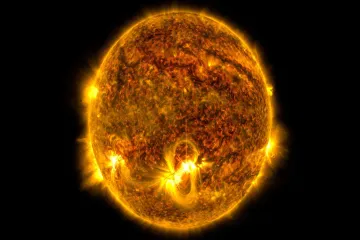
To understand how the outward pressure works, we must understand the state of the star's material. Stars are not composed of ordinary solid or gas; the immense heat and pressure within their interiors force the matter into a state called plasma.
Plasma is often called the fourth state of matter. In this state, the temperatures are so high that the electrons are stripped away from the atomic nuclei. This creates a superheated, ionized soup of free-moving electrons and positively charged atomic nuclei. This ionized gas is essential because it allows for the high-density conditions necessary to force nuclei close enough together to overcome their natural electromagnetic repulsion and allow the strong nuclear force to initiate fusion. The ability of this plasma to react violently to temperature changes—expanding quickly when heated and compressing sharply when cooled—is what allows the hydrostatic balance to self-correct, as discussed earlier.
# Evolution Link
The life story of a star, known as stellar evolution, is fundamentally the story of how the balance between these two forces changes over time.
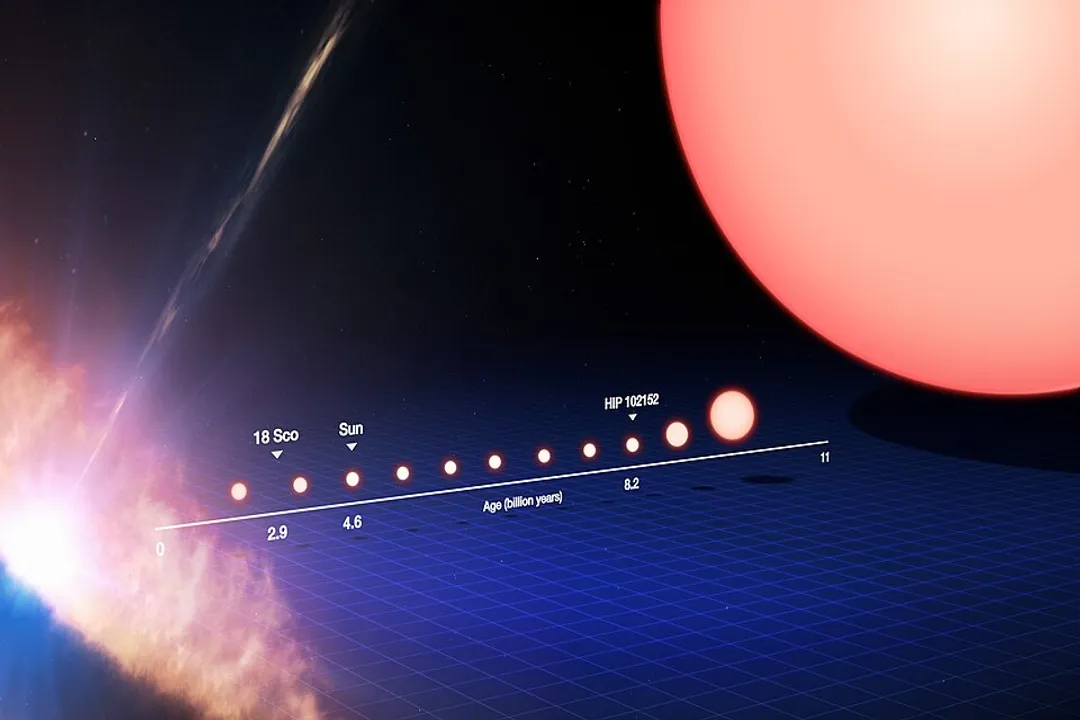
A star spends the longest part of its life on the main sequence while it fuses hydrogen into helium in its core. This is the period of peak hydrostatic equilibrium. However, this process is finite; the star eventually depletes the hydrogen fuel in its very core.
When the core runs out of hydrogen, the fusion engine stalls in that region. Since the outward thermal pressure immediately drops locally, gravity wins the local battle, and the core begins to contract and heat up again. This gravitational squeeze on the now-inert helium core increases the temperature to the point where hydrogen fusion can begin again in a shell surrounding the core. This new shell fusion is often more energetic than the previous core fusion, causing the outer layers of the star to expand dramatically and cool, turning the star into a Red Giant.
This expansion represents a temporary, dramatic imbalance where the new energy generation rate temporarily overwhelms the gravitational pull, causing the star's radius to balloon. The subsequent fate depends entirely on the star's initial mass, which dictates the strength of the forces it initially generated.
For Sun-like stars, after the helium core eventually ignites, the star will exhaust its fuel and gently shed its outer layers, leaving behind a dense, hot remnant core called a white dwarf. The white dwarf no longer generates energy via fusion; its existence is supported only by quantum mechanical pressure resisting gravity, allowing it to cool over cosmic timescales.
For much more massive stars, the core contracts so violently after hydrogen depletion that it reaches temperatures high enough to fuse heavier elements—carbon, neon, oxygen, and so on—until it forms an iron core. Iron fusion consumes energy rather than releasing it, meaning that when the iron core forms, the outward pressure instantly vanishes. Gravity completely and catastrophically wins this final contest, leading to an instantaneous collapse that triggers a supernova explosion and leaves behind either a neutron star or, for the most massive stars, a black hole.
# Mass Factor
The initial mass of a star dictates the intensity of both the gravitational collapse and the resulting outward pressure, creating a cosmic spectrum of stellar lifespans and endpoints. Stars much more massive than the Sun burn their fuel at an exponentially higher rate because the gravitational pressure is so much greater, requiring extreme core temperatures to maintain equilibrium.
Consider a star ten times the mass of the Sun. Its gravity is far stronger, necessitating a far higher rate of fusion to prevent collapse. While this star might shine thousands of times brighter than our Sun, it burns through its hydrogen reserves in only a few million years, compared to the Sun’s expected ten billion years. This difference in timescale highlights a central theme: the greater the inward gravitational force acting on the star, the more violent the necessary outward nuclear push must be, and the shorter the lifespan required to achieve that required rate of energy output. It seems counterintuitive that a heavier object, one with more fuel, has a shorter life, but it is a direct consequence of the non-linear relationship between mass, gravity, and the threshold required for sustaining fusion pressure.
The entire existence of a star, from its birth in a collapsing cloud to its final remnant, is a narrative shaped by this fundamental, continuous balancing act. Every photon emitted, every change in radius, and every final transformation is a direct result of either perfect alignment or transient failure in the battle between the crushing power of mass and the explosive energy of nuclear creation.
#Videos
The Forces in a Star's Main Sequence Stage - YouTube
Related Questions
#Citations
Star Basics - NASA Science
Stellar evolution - Wikipedia
Are stars essentially a war between nuclear fusion and gravity?
Stars - Imagine the Universe! - NASA
What are the balanced forces present in a star? - Quora
Stars and their life-cycle (article) | Khan Academy
The Forces in a Star's Main Sequence Stage - YouTube
Life Cycle of Stars and Stellar Nurseries - Facebook
Star Life Cycle - ASPIRE