What are the colors of the nebulae?
The universe presents an astonishing palette when we look toward nebulae, those immense clouds of gas and dust that represent stellar nurseries or the final breaths of dying stars. [3] Whether we are gazing at the Pillars of Creation or a planetary nebula like the Ring Nebula, the colors—the vivid reds, deep blues, and ethereal greens—are what truly capture the imagination. However, understanding these hues requires looking past the immediate visual splendor to the underlying physics and the photographic techniques used to reveal them.
# Atomic Light
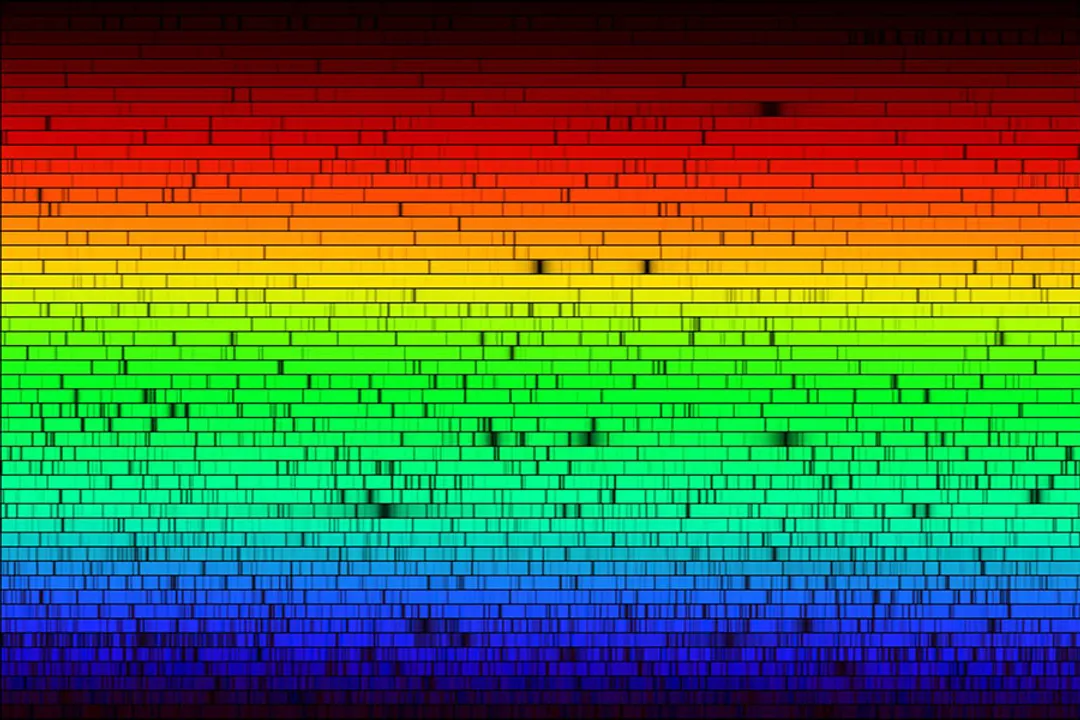
The colors we perceive in space are not arbitrary; they are the direct signature of atomic physics at work. [7] Light itself is the smallest package of energy, carried by a particle called a photon. [3] This light is generated when an electron within an atom becomes excited—gaining energy and jumping to a higher state—and then drops back down to its original, lower energy level, releasing that excess energy as a photon. [3] The specific color of that photon is determined by the exact amount of energy released, which corresponds to a unique wavelength. [3]
Because every chemical element, such as hydrogen, oxygen, or nitrogen, has a unique atomic structure, its electrons can only transition between specific energy levels. [3][5] This means each element emits light only at its own set of characteristic wavelengths, creating what is known as an emission spectrum. [3][5] When astronomers analyze this spectrum, they can effectively read the chemical fingerprint of the cloud millions of light-years away. [3]
# Specific Hues
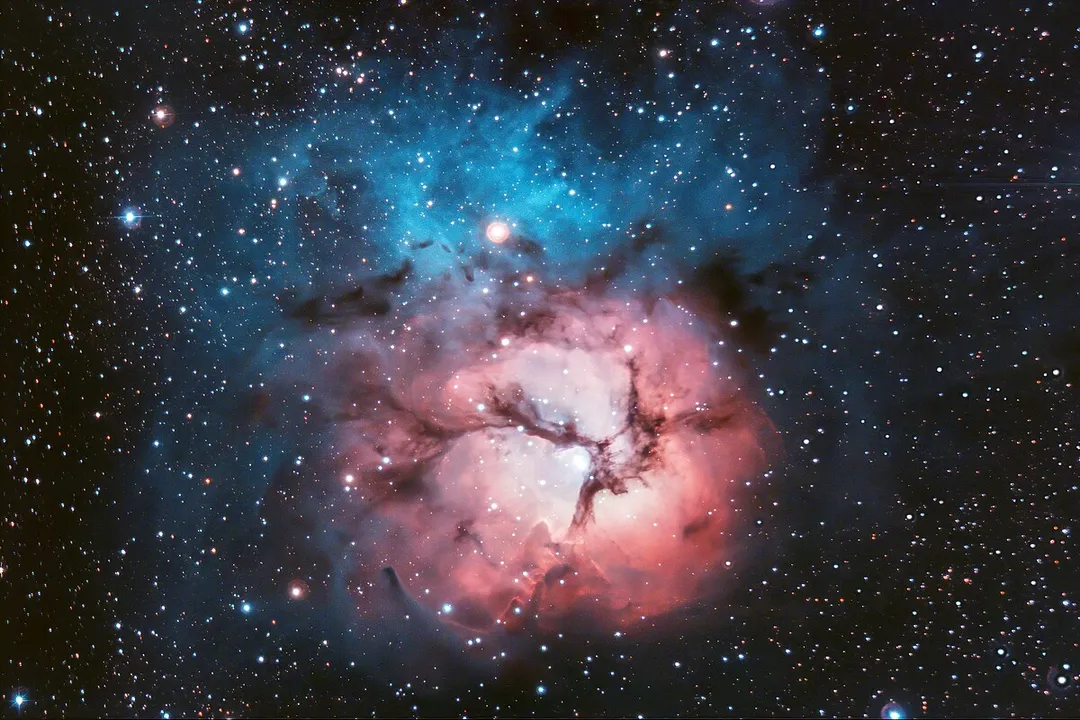
In emission nebulae, we are primarily seeing light generated by the ionized gas being energized, often by nearby hot, young stars. Certain elements are far more abundant and produce the most dominant colors in these glowing regions. [2]
Hydrogen, the most common element in the cosmos, produces light in the deep red end of the visible spectrum via the (Hydrogen-alpha) transition. [5] In many large emission nebulae, this red light is so intense that it can easily overshine other features. [2] For example, in planetary nebulae, the colors often result from glowing gases like hydrogen, helium, nitrogen, and oxygen. Specifically:
- Red/Pink is often attributed to emission, but ionized nitrogen () and sulfur () can also contribute. [5]
- Green/Teal generally signals forbidden transitions in ionized oxygen (). [5] For instance, the Ring Nebula () famously presents a bright green glow.
- Blue/Blue-Green can be a mix, often involving oxygen lines, or it may simply be the appearance of dense, hotter gas regions in planetary nebulae, such as the Ghost of Jupiter () appearing greenish-blue.
It is important to note the distinction in astronomical notation: emission lines found under the extremely low densities characteristic of nebulae are often denoted with brackets, such as , indicating a physical process—a collisionally excited line—that cannot be replicated in standard laboratory conditions on Earth. [4]
# Perceived Reality
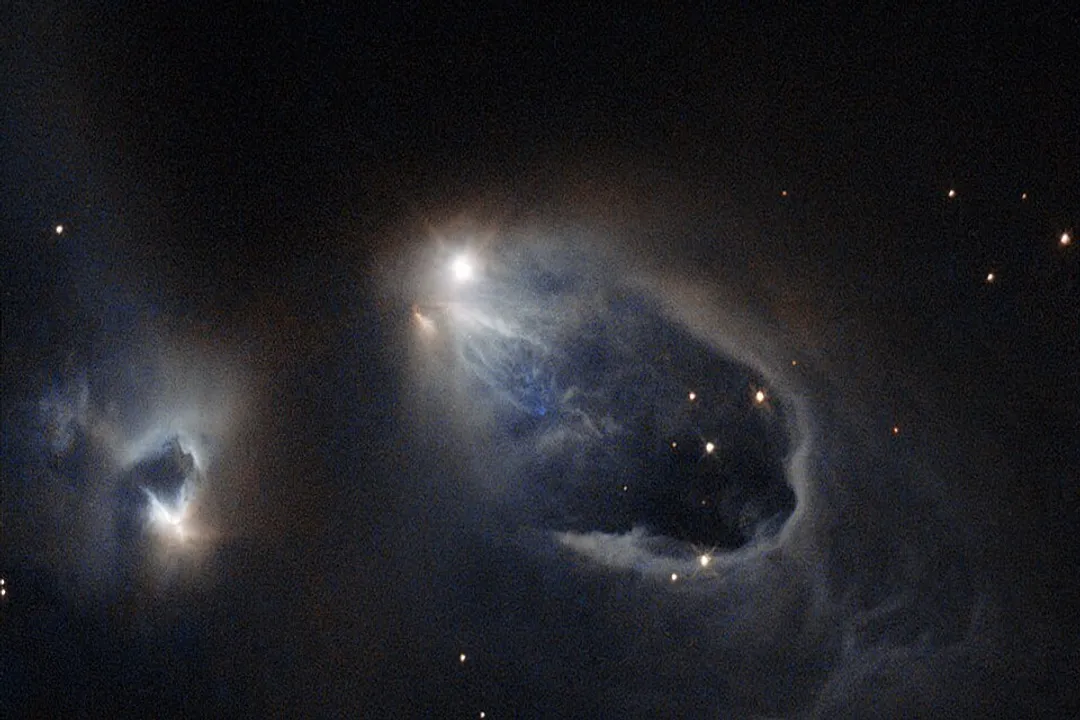
The vibrant photographs of nebulae we see published by space agencies are rarely what the human eye perceives when looking through a standard telescope. [3] The stark difference boils down to light intensity and human biology.
Our eyes contain two types of light receptors: cones for color detection, which require relatively bright light, and rods for low-light, black-and-white vision. [3] Because the light arriving from a distant nebula is incredibly faint, it is generally insufficient to activate the color-sensing cones. [3] Instead, only the highly sensitive rods register the faint light, causing the nebula to appear as a gray or whitish smudge against the black background. [3] For comparison, objects like Mars or the brighter planets (Uranus or Neptune) are close and bright enough that their light saturates our cones, allowing us to see their distinct colors.
This difference between what the camera records over long exposures and what the eye sees momentarily means there are generally two categories of nebula images: "true color" (or natural color) and "false color". [2]
# Data Mapping
The vivid, multi-hued images produced by observatories are a result of careful data capture and color assignment, which can sometimes be deliberately false to enhance specific details. [2]
Natural Color Images (): These images attempt to replicate the light as the eye would see it if it could gather enough photons. They are created by taking separate exposures using filters for Red, Green, and Blue () and then assigning that recorded data back to those corresponding visible colors. [2] However, even this approach is an interpretation. Because hydrogen is the dominant gas, a "natural color" image of an emission nebula can look almost entirely red, masking the subtle structures caused by other elements. [2][4]
False Color Images (): For scientific contrast, astrophotographers often employ narrowband imaging, using highly specific filters that isolate only the light emitted by particular elements, such as Sulfur (), Hydrogen-alpha (), and Oxygen (). [2] The colors are then assigned artificially during processing. A common technique is the Hubble Palette, where is mapped to Red, to Green, and to Blue. [2] This assignment highlights the physical complexity—the structure and interaction between different gases—that would otherwise be washed out by the dominant signal. [2]
A simple comparison shows the trade-off: an image using only filters shows the overall glow (the "natural" appearance), while an image mapping the three primary emission lines to reveals distinct structures in gold, blue, and magenta that reflect the composition ratios, even though the colors themselves are not physically accurate representations of those specific wavelengths. [2]
This processing choice means that one image prioritizes overall appearance based on elemental abundance, while the other prioritizes maximizing the visual separation of different physical components present in the gas. [2]
# Telescope View
For the backyard observer, embracing the grayscale view is key to appreciation. [3] While a telescope with a large aperture (say, 6 inches or more) and dark skies might reveal hints of color in the brightest, densest planetary nebulae—like the distinct blue-green of or the green of the Ring Nebula ()—extended, fainter clouds will remain monochromatic.
A helpful perspective for the observer is to realize that the visual appearance is intrinsically limited by retinal biology; the camera, conversely, collects light continuously over minutes or hours, allowing faint photons to accumulate until they build up enough signal to trigger the cones, or until the data is intentionally mapped. [3] If you are out observing, remember that the color is there physically, but your visual apparatus cannot collect enough of it per second to register the hue. Focusing on high-contrast, compact objects like (the Blue Snowball), which is ideal even under light-polluted skies, maximizes the chance of seeing even a faint tint. A successful observation is not about matching a deep-space photograph, but about successfully detecting that faint, distant envelope of light that represents the remains of a star. [3]
#Videos
Understanding Nebulae And Their Colors - YouTube
Related Questions
#Citations
Understanding Nebulae And Their Colors - YouTube
Comparing true color and false color images of the Seagull Nebula
Lighting Up the Universe - Bell Museum
The Astrophysics of Nebulae Colours | Spaceaustralia
Nebula and its colors - Astronomy Stack Exchange
Nebula - Wikipedia
The sky's top 10 colorful planetary nebulae - Astronomy Magazine