How was the comet discovered?
Ancient Records
The story of how comets are discovered stretches back much further than the invention of the telescope. For millennia, these celestial visitors were viewed with a mixture of awe and dread, appearing suddenly in the night sky as fleeting, fuzzy patches of light often sporting magnificent tails. [3] Ancient civilizations meticulously recorded these appearances, believing they signaled shifts in fortune or divine messages. For example, records exist detailing sightings dating back to ancient China and Babylon. [3] These early observations were purely visual; they were noted based on where the object appeared relative to known constellations and how its apparent movement differed from the fixed background stars. [3] However, without the mathematics or instruments to track them precisely, these early sky-watchers could only document that a comet appeared, not where or when it might return.
# Orbital Proof

A fundamental shift in understanding how to "discover" a comet—moving from mere sighting to genuine prediction—is tied directly to the work of Edmond Halley in the late 17th and early 18th centuries. [1] Halley didn't physically spot the comet that now bears his name; rather, he employed the newly established laws of gravity and motion developed by Isaac Newton. [1] He gathered the recorded observations of notable comets seen in 1531, 1607, and 1682. [1] By applying this rigorous mathematical modeling, Halley demonstrated that these were not unrelated random events, but rather the same body following a predictable, elliptical orbit around the Sun. [1]
This represented a monumental change in the process of discovery. Before Halley, a comet was "discovered" upon its first visible appearance. After Halley, a comet could be predicted before it was ever seen again, effectively becoming a discovered object years, or even decades, in advance. [1][3] When the comet returned exactly as predicted in 1758, the confirmation cemented the understanding that comets were permanent members of the solar system, not transient phenomena. [1]
To illustrate the sheer technical leap, consider the difference in observational effort:
| Era | Primary Tool | Discovery Goal | Key Technique |
|---|---|---|---|
| Ancient/Pre-Telescope | Naked Eye | Documenting appearance | Sketching position against constellations [3] |
| Halley's Era (c. 1700) | Small Telescope/Mathematics | Calculating orbit/periodicity | Keplerian/Newtonian mechanics [1] |
| Modern Era (c. 2000+) | Automated Surveys/Digital Cameras | Detecting faint trails/motion | Image subtraction and pattern recognition [9] |
# Naming Rules
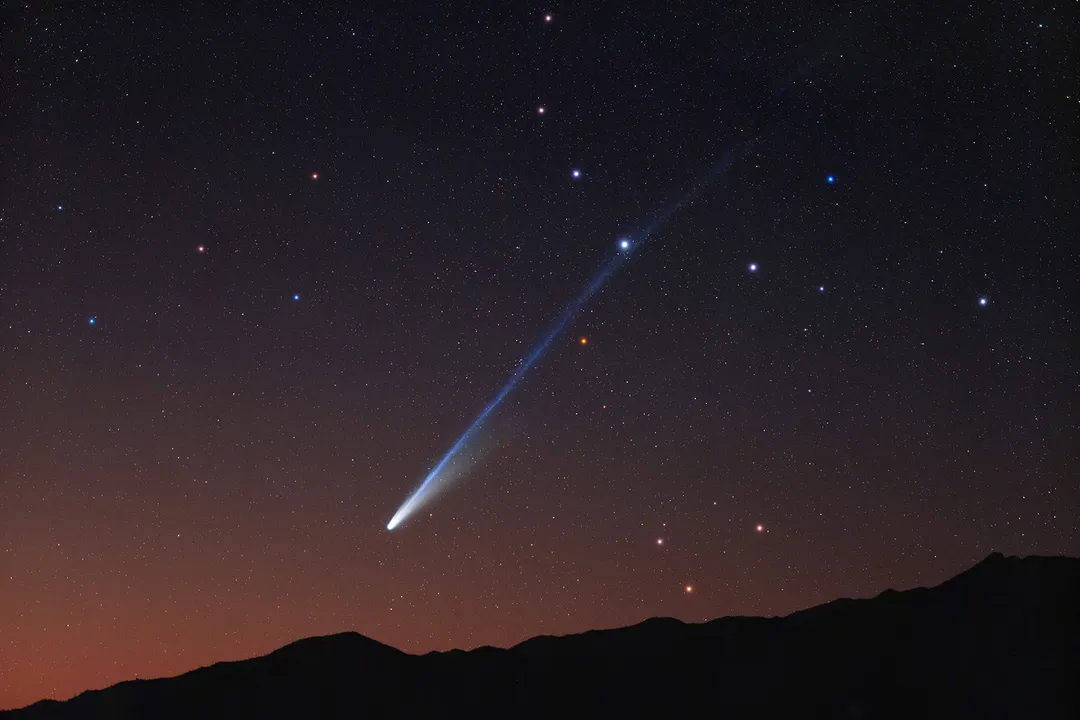
Once a comet is spotted, its designation follows a relatively consistent, though evolving, set of rules that inherently link the discovery to the discoverer. [5] In the days before automated surveys, the convention was straightforward: the comet was named after the first person who reported it. [5] This system naturally favored sharp-eyed individuals, often dedicated amateurs or professionals scanning the skies. [9] For instance, the famous comet C/1811 F1 (Harkness), or any comet named after a single person like Halley, clearly follows this tradition. [5]
However, as telescopic surveys became commonplace, a single observer rarely got the credit. If multiple independent observers spot the same object within a short window, all their names are typically appended to the designation. [5] For example, a comet might be known as C/1993 F2 (Shoemaker–Levy 9). [5] Further complexity is added by modern automated comet surveys, such as the Catalina Sky Survey, which is responsible for finding numerous new objects. [9] If a comet is found by a survey team, it is named after the survey itself. [5] This evolution reflects the technical shift: the person making the discovery is often an algorithm, so the finding entity (the survey program) receives the credit. [5]
# Digital Hunt
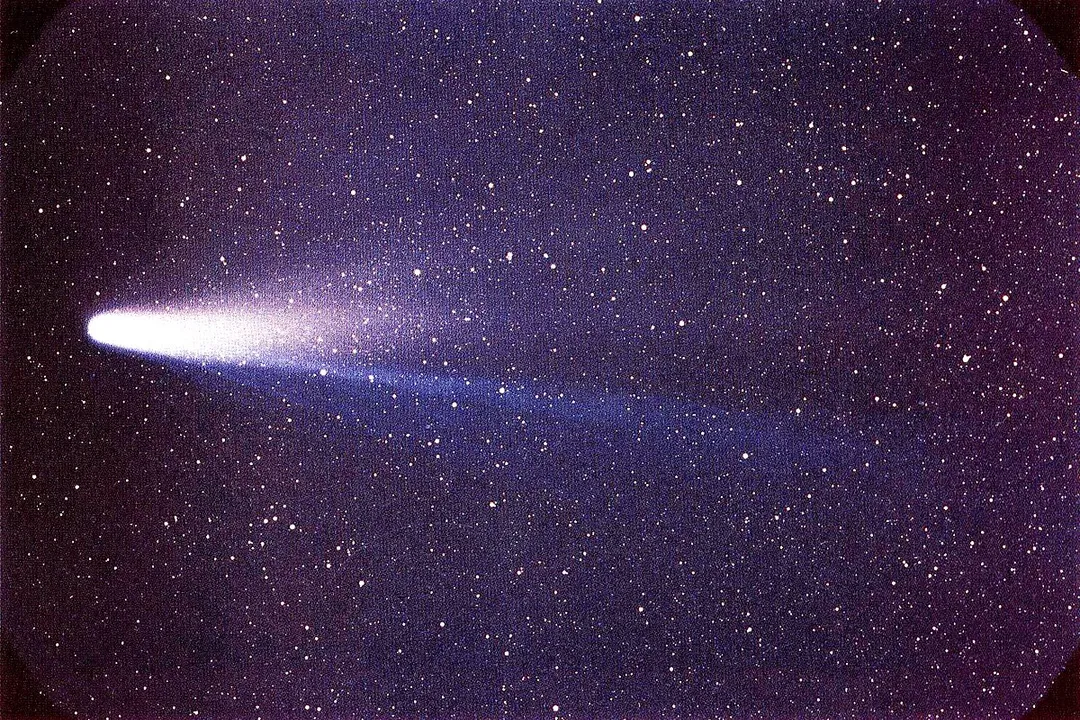
Today, the process of discovering a comet has transformed from a patient, visual vigil to a high-speed digital comparison process. [9] Modern comet discovery is largely performed by professional observatories running automated sky surveys that repeatedly image large swaths of the sky. [9] These systems do not rely on a human eye to notice a faint smudge moving over hours. Instead, advanced computer software is programmed to rapidly compare sequential images taken of the same area. [9]
The key to finding a comet digitally is identifying motion. A true comet will move against the background of fixed stars over the time elapsed between the two photographs. [9] The software identifies objects that exhibit this motion, which is the signature of a solar system body. [9] Amateur astronomers still play a vital role, often serving as the crucial second pair of eyes, either spotting something missed by the automated systems or confirming the motion of a suspected object found by a survey. [9] The challenge, even with powerful tools, remains separating the faint, slow-moving ice balls from foreground asteroids, which also move, albeit typically at different rates or along different orbital planes. [9] In fact, the skill lies in knowing how to tune the software to filter out noise and correctly identify the subtle drift that separates a new comet from an already cataloged near-Earth object. [9]
# Unbound Visitors
One of the most exciting developments in modern discovery relates to comets that do not originate in our solar system at all. These are interstellar objects. [8] The discovery process for these objects is even more specialized because they are moving much faster relative to the Sun than typical comets, which are gravitationally bound to us. [8]
The detection of an interstellar visitor, such as the one NASA observed moving through the solar system, requires telescopes capable of capturing objects that are moving at hyperbolic speeds—meaning their path is not a closed loop but an open trajectory that will eventually carry them out of the solar system permanently. [8] The initial sighting is usually made by a professional survey, as noted above, but the confirmation requires immediate follow-up observations from multiple facilities across the globe to precisely map its trajectory and confirm its hyperbolic path. [8]
For instance, the detection of the interstellar comet 3I/2019 Borisov and the later discovery of another interstellar object in 2025 demonstrate this process in action. [4][8] The confirmation that an object is interstellar—meaning its velocity is too high to be gravitationally captured by the Sun—is a result of precise orbital mechanics calculations done very shortly after the initial detection. [8] This distinction is critical; while a typical comet discovery confirms a new member of our extended family, an interstellar comet discovery confirms a visitor from another star system. [8] Observing these transient visitors gives scientists rare, direct data on the chemistry and composition of materials formed around other stars, which is information impossible to gather otherwise. [10]
Related Questions
#Citations
Halley's Comet - Wikipedia
Comet Facts - NASA Science
Comet - Origins, Formation, & Discovery | Britannica
How 2025 became the year of comet — The rise of interstellar 3I ...
All About Comets: Origins, Discoveries and their Names
Astronomers have confirmed the discovery of a comet from beyond ...
The Story of Halley's Comet - NASA ADS
Q&A: Look up! What it takes to discover a comet
A History of Comets - Part 3 <br>On the origin of comets