How many LEO satellites does Globalstar have?

The Globalstar Low Earth Orbit (LEO) constellation is a fascinating subject, often discussed in terms of its service capabilities rather than its raw numbers, yet the size of the fleet is fundamental to its operation. When asking how many LEO satellites Globalstar possesses, the answer depends slightly on whether one counts just the current primary operational spacecraft, the spares, or the total number ever launched for their service. Officially, Globalstar owns and operates a LEO constellation currently structured in what they call a Walker-24 configuration. This configuration implies a network built around 24 primary slots. More precisely, documentation often cites the second-generation constellation as consisting of 25 satellites.
However, this figure can be cross-referenced with older data suggesting a different total. For instance, one source notes the constellation consists of 48 LEO satellites, with an additional four satellites in orbit as spares. This latter number might reflect the initial design goals or the total number of functional satellites in the original system deployment. More recently, another tracker lists the 'globalstar' constellation as having 88 Active Satellites and 88 Total Launched. Given the continuous launches, replenishment programs, and retirements over decades, this higher number likely represents a historical tally or includes other orbital assets, but the current, fully functional, primary operational network is reliably quantified in the low twenties, aligning with the Walker-24 description.
# Orbital Mechanics
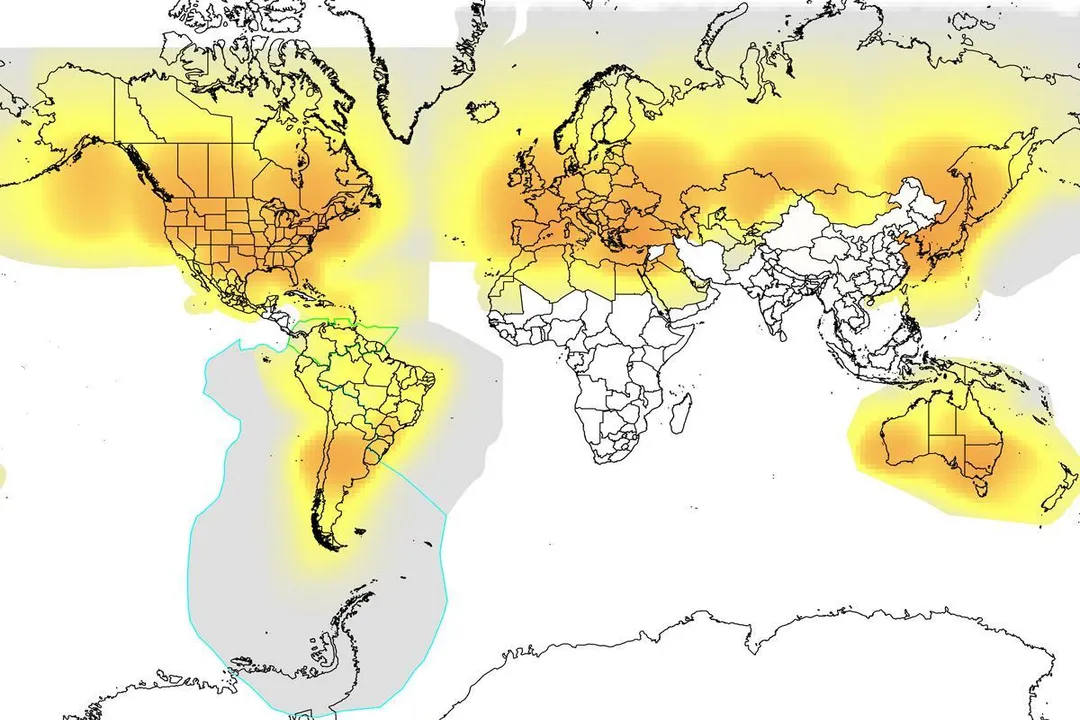
Globalstar’s satellites inhabit a specific orbital regime vital for minimizing communication latency. They operate in Low Earth Orbit (LEO) at an altitude of approximately 1,400 kilometers (or 876 miles). This relatively close proximity to Earth ensures that the time delay, or latency, for a voice call or data transmission is imperceptible to the user.
The constellation is not placed randomly but follows a structured layout known as a Walker constellation. Specifically, the current setup utilizes a Walker-24 layout, featuring 8 orbital planes, each containing 3 satellites, spaced evenly around the equator. The satellites are placed in orbits inclined at 52 degrees relative to the equator.
This specific inclination has a direct consequence for coverage: the system does not cover the extreme polar regions. Service is designed to reach users from 70° North latitude to 70° South latitude. The operational lifespan of these second-generation satellites is significant, designed for a life expectancy of 15 years, substantially longer than the 7.5-year design life of their first-generation predecessors. Considering the first generation began showing amplifier degradation issues around 2007–2008, the investment in the second generation to last a full decade and a half represents a calculated move toward long-term stability, essentially doubling the expected service life per asset launch. This extended life also helps manage the cost per operational year, a key factor in maintaining competitive pricing for their L-Band services.
# Architecture Simplicity

A core distinguishing feature of the Globalstar system is its satellite design philosophy. Unlike some other LEO networks that rely on complex inter-satellite links, Globalstar employs a "bent-pipe" architecture. In this design, the satellites act primarily as simple, albeit highly sophisticated, mirrors or transparent relays in the sky. They receive signals from user terminals (like SPOT devices or satellite phones) using L-Band antennas and immediately retransmit them via S-Band antennas down to a ground station.
This simplicity offers several operational advantages. Because the complex processing and routing software resides on the ground rather than onboard each satellite, Globalstar can perform system maintenance and technology upgrades much more easily and quickly by updating its terrestrial gateway infrastructure. This contrasts with 'mesh' constellations which require more complex, heavier hardware onboard the spacecraft, which is harder to update once launched. The system leverages CDMA technology for communication.
The reliance on ground stations is crucial. The satellites only provide service when they are in view of one of the company’s ground gateways. Globalstar operates a network of these stations to bridge the LEO constellation with the public switched telephone network and the Internet. While the system serves over 120 countries, service cannot be provided in remote areas where a gateway is not physically present, such as certain mid-ocean regions or the poles. The company utilizes 28 ground stations across 18 countries. Furthermore, the structure allows Globalstar to offer localized regional phone numbers to customers, avoiding the high international dialing costs associated with systems that require satellite-to-satellite relay for every transmission.

# Replenishment and Expansion Plans

The constellation is not static; Globalstar is actively investing to ensure service continuity and enhance capacity. The second-generation fleet, which began launching in 2010, was intended to carry the service forward until at least 2025. To look further ahead, Globalstar has undertaken a significant replenishment program. In February 2022, the company selected MDA, in partnership with Rocket Lab, to design and manufacture 17 new satellites, with options available to purchase up to nine more. These new spacecraft are scheduled for launch by the end of 2025.
The introduction of these new assets signals a planned evolution in the constellation’s structure. Globalstar intends to expand its orbital configuration from the current Walker-24 setup to a Walker-32 configuration. This expansion is planned to feature 8 orbital planes, each supporting 4 satellites per plane, aiming for improved coverage and redundancy. If the Walker-32 configuration results in 32 operational satellites, this would represent an increase of roughly 8 satellites over the current approximate operational count of 24 or 25.
This modernization effort is partly driven by commercial relationships, notably the one with Apple Inc. Globalstar provides the satellite infrastructure for the Emergency SOS via satellite feature on certain iPhone models, reserving 85% of its network capacity for this service. The required infrastructure upgrades, including the construction of 10 new gateways globally, underscore the strategic importance of this new generation of satellites and the associated ground network improvements.
# Service Portfolio and Limitations
Globalstar's service offering is divided largely between Simplex (one-way transmission, primarily for asset tracking like SPOT devices) and Duplex (two-way voice and data) services. Their Simplex services, which utilize the L-band uplink, proved resilient even when the first-generation satellites experienced S-band amplifier degradation affecting duplex communications. Today, their portfolio includes voice and data modules, industrial IoT tracking (like the SmartOne line), and personal safety messengers (SPOT products).
A key commercial differentiator for Globalstar is the integration of its LEO network with terrestrial wireless capabilities through its licensed Band 53 spectrum. This mid-band spectrum, also known as n53 in 3GPP specifications, is licensed for terrestrial use for private LTE/5G networks. This strategy of blending satellite connectivity with localized, licensed terrestrial spectrum gives Globalstar a unique position in the connectivity market, enabling robust, high-performance coverage that can scale from a remote asset tracker to a dedicated private network backbone.
Despite the global reach, the limitations inherent to LEO constellations with moderate inclination must be acknowledged. The 52-degree inclination means service is unavailable in the far northern and southern latitudes, specifically above 70 degrees latitude. Furthermore, because the system relies on "bent-pipe" communication, service quality is intrinsically linked to the physical location of the ground stations. In areas lacking a nearby gateway, two-way voice and data services may be non-functional, even if a satellite is overhead. This is an important factor for maritime or aeronautical users crossing vast oceanic regions far from land-based infrastructure.
To manage the gaps in service that can occur as satellites move out of view of a gateway, Globalstar’s second-generation system uses patented path and gateway diversity technologies. This allows a communication link to be automatically transferred to the next available satellite or gateway, helping to ensure uninterrupted communication even in challenging environments like urban canyons or mountainous terrain, provided a functioning gateway is in sight.

# Insight into Operational Strategy
The transition from the first generation to the second provides a clear insight into the operational planning of satellite infrastructure providers. The initial first-generation satellites were designed for about 7.5 years of life. When reliability issues arose with their S-band amplifiers, Globalstar launched eight spares in 2007 to prop up the failing system while engineering a full replacement. The subsequent second-generation satellites, launched between 2010 and 2013, were designed for 15 years of life. This doubling of the design life indicates a significant shift towards prioritizing asset longevity and reducing the frequency of expensive, multi-launch replenishment cycles, which directly impacts capital expenditure planning.
The current replenishment order—17 new satellites with options for 9 more—is not just about replacing aging assets; it’s about upgrading the architecture itself by moving to the Walker-32 configuration. This planned increase in the number of planes from 8 (in Walker-24) to 8 planes with 4 satellites each (in Walker-32) suggests a strategic focus on increasing the number of simultaneous beams available to the ground stations, thereby boosting overall network capacity rather than just maintaining the current service level. This capacity increase is especially critical given the commitment of 85% of network resources to the Apple partnership. The sheer scale of the new construction contract, valued at $327 million USD, highlights that this is a complete capacity augmentation, not merely a low-cost refresh.
Related Questions
#Citations
Who We Are | Globalstar | US
Globalstar - Wikipedia
Globalstar satellites - N2YO.com
globalstar Constellation - 88 satellites | SatelliteMap.space
Globalstar Facts For Kids | AstroSafe Search - DIY.ORG
MDA to Build 17 Satellites to Enhance Globalstar's LEO Const
Globalstar Satellite Network – Low‑Cost L‑Band Coverage