How is a star born step by step?
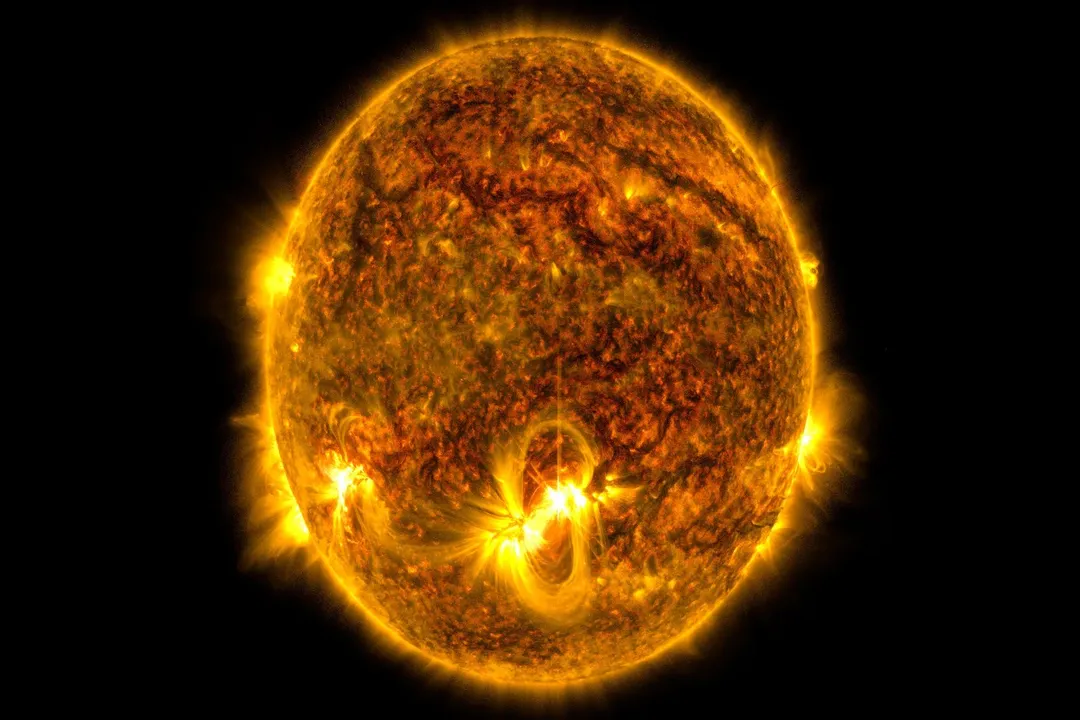
The birth of a star is one of the universe’s most dramatic and prolonged processes, beginning in the coldest, darkest recesses of space and culminating in a brilliant nuclear furnace. It is a story dictated entirely by the fundamental tug-of-war between gravity, trying to pull everything together, and pressure, pushing outward. [2][4] This celestial genesis doesn't happen randomly; it requires specific conditions and follows a predictable, albeit lengthy, sequence of transformations that can take millions of years to complete. [5]
# Cosmic Nurseries
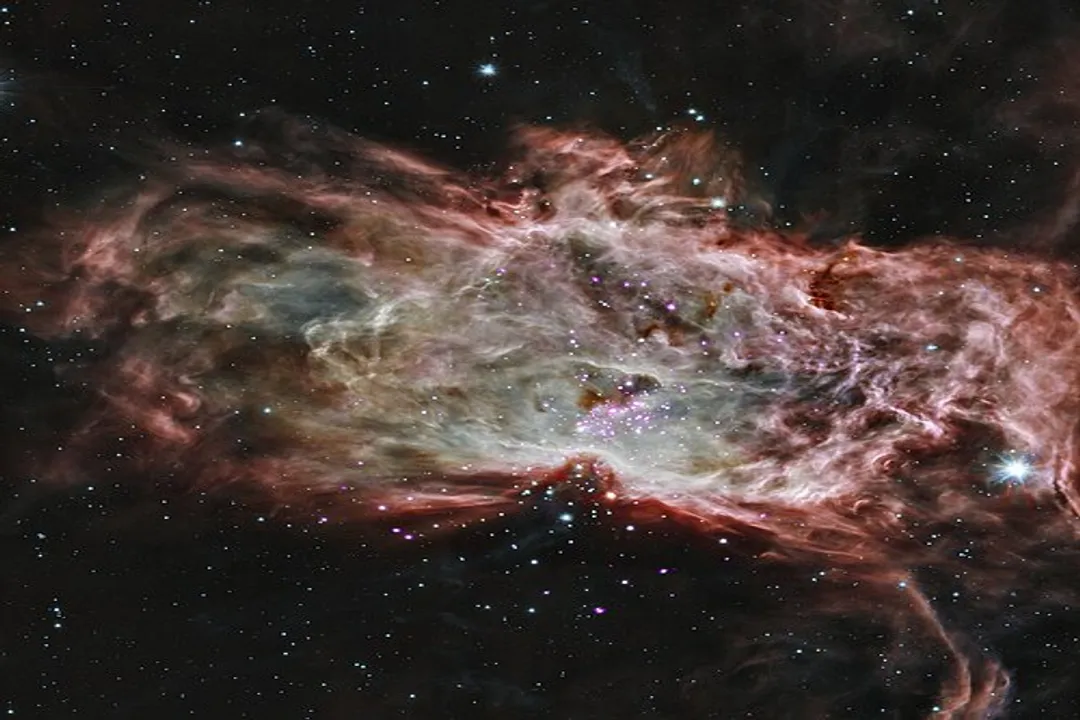
The stage for star birth is set within Giant Molecular Clouds (GMCs), which are immense reservoirs of the raw materials needed: gas, primarily hydrogen, and trace amounts of dust. [4][3] These clouds are the largest known objects in the galaxy, spanning hundreds of light-years and containing masses equivalent to millions of times the mass of our Sun. [4][7] Despite their impressive mass, GMCs are incredibly diffuse—far less dense than the best vacuum we can create on Earth. [7] What makes them special, however, is their temperature. They are frigid, often hovering around $10$ Kelvin ( degrees Celsius). [4][7] This extreme cold is crucial because low thermal energy translates directly to low internal pressure, making the cloud susceptible to collapse under its own weight. [7]
The majority of the gas in these clouds remains in the molecular form, primarily , which is relatively transparent to the background radiation, allowing the cloud to cool efficiently and maintain its low temperature until collapse begins. [7]
# Instigating Collapse
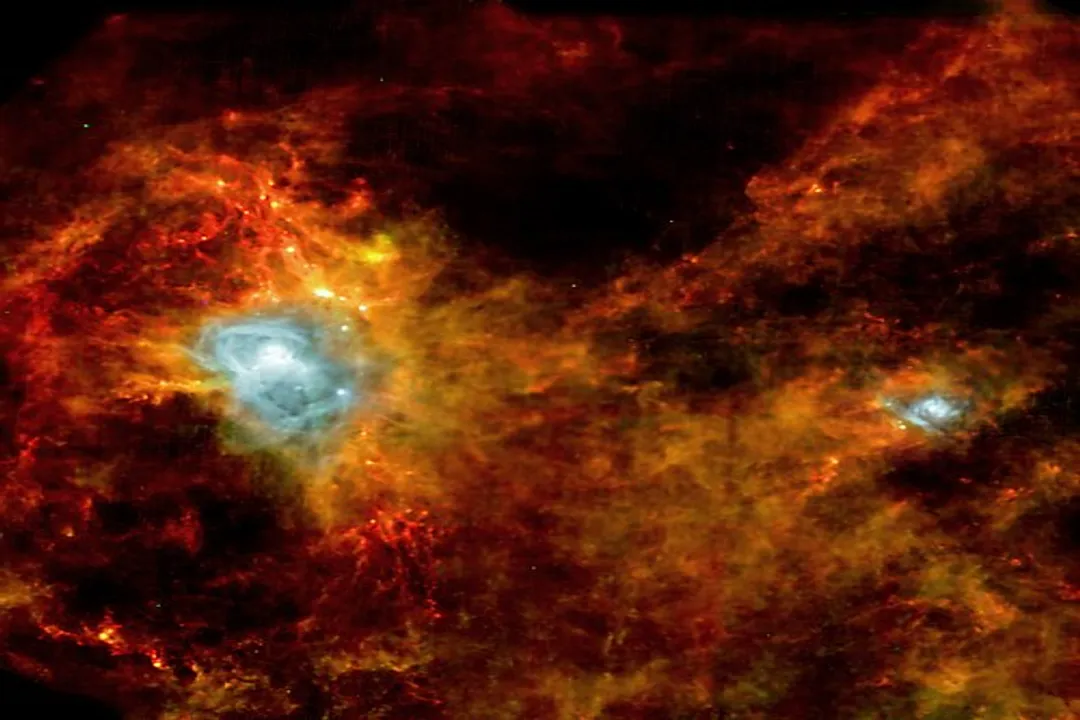
A GMC cloud, even one that is very cold, often maintains a tenuous equilibrium where the outward pressure from the gas slightly balances the inward pull of its own gravity. For star formation to kick off, this balance must be upset, tilting the scales in favor of gravity. [7] This initial perturbation, the trigger, can come from several sources. [3]
One common mechanism involves external shockwaves. The violent explosion of a nearby massive star—a supernova—sends a powerful ripple through the interstellar medium. When this shockwave slams into a GMC, it compresses portions of the cloud, creating localized areas of higher density. [7][3] Similarly, the passage of the spiral arm density wave through a galaxy can compress clouds as they move into the arm's denser region. [5] Think of it like stepping on a loose pile of fine sand; a small push creates a distinct, deeper depression where the sand piles up more tightly.
When these regions become sufficiently dense, gravity takes over. This leads to a process called fragmentation. [7][5] Instead of the entire GMC collapsing into one gigantic object, the immense cloud breaks up into smaller, denser clumps or cores. [7] Each of these fragments is destined to become one or more stars. [5] The efficiency and speed of this initial fragmentation determine the resulting population of stars; a highly turbulent cloud may spawn many small fragments, leading to a cluster dominated by smaller stars, whereas a more quiescent cloud might produce fewer, larger fragments. [5]

# Gravitational Freefall
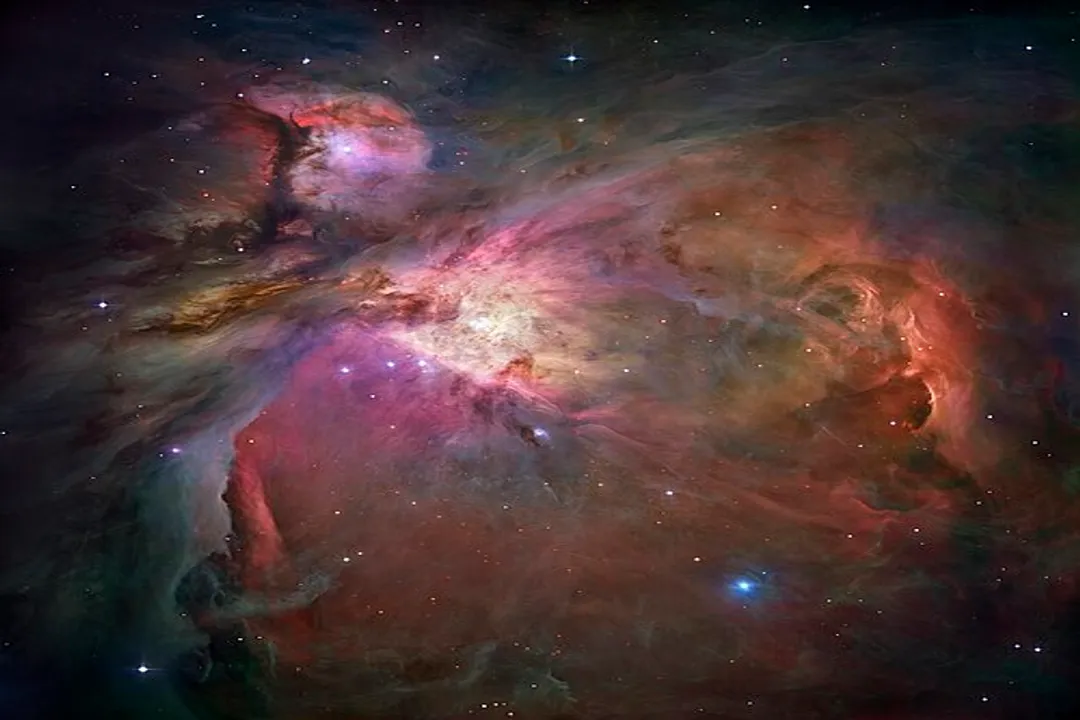
Once a core has become gravitationally unstable, it begins to contract rapidly. This stage is characterized by the material falling inward, drawn relentlessly toward the center of mass of that specific clump. [5][3] As the clump shrinks, the conservation of angular momentum—the same principle that causes an ice skater to spin faster when they pull their arms in—causes the collapsing material to spin more rapidly. [5]
This rotation is extremely important because it prevents all the material from falling directly to the center. Instead, the centrifugal force flattens the spinning material into a pancake-like structure surrounding the central core, forming what we call a protostellar disk or accretion disk. [5][7] This disk acts like a reservoir, channeling gas and dust onto the central object over time. [5]
The central region itself becomes incredibly dense and hot. The kinetic energy of the infalling particles—the energy of their motion towards the center—is converted into thermal energy (heat) as they collide and slow down. [5] This growing, hot, dense core is the protostar. [5] At this stage, the object is not yet a true star; it glows, but its energy source is purely gravitational contraction, not sustained nuclear reactions. [2][7] This nascent object is often obscured from view by the remaining envelope of gas and dust that has yet to fall in or be blown away. [5]
# Accretion and Jets
The protostar continues to grow by consuming matter from the surrounding accretion disk. [5] This accretion process is not entirely smooth; it happens in bursts, leading to variations in the protostar's luminosity. [5] Simultaneously, the extreme conditions near the rapidly spinning protostar and its disk often lead to the formation of powerful, collimated outflows known as bipolar jets. [5][7] These jets erupt perpendicular to the accretion disk, blasting away some of the surrounding gas. [5] The existence of these jets is essential because they help carry away excess angular momentum from the system, allowing more material to fall onto the protostar rather than piling up indefinitely in the disk. [5]
If we were observing a star forming from a cloud similar to the one that made our Sun, this accretion phase could easily last for several million years. [5] However, the more massive the protostar, the quicker the collapse and accretion phase proceeds; massive stars are born in a hurry. [5]
# Pre-Main Sequence Phase
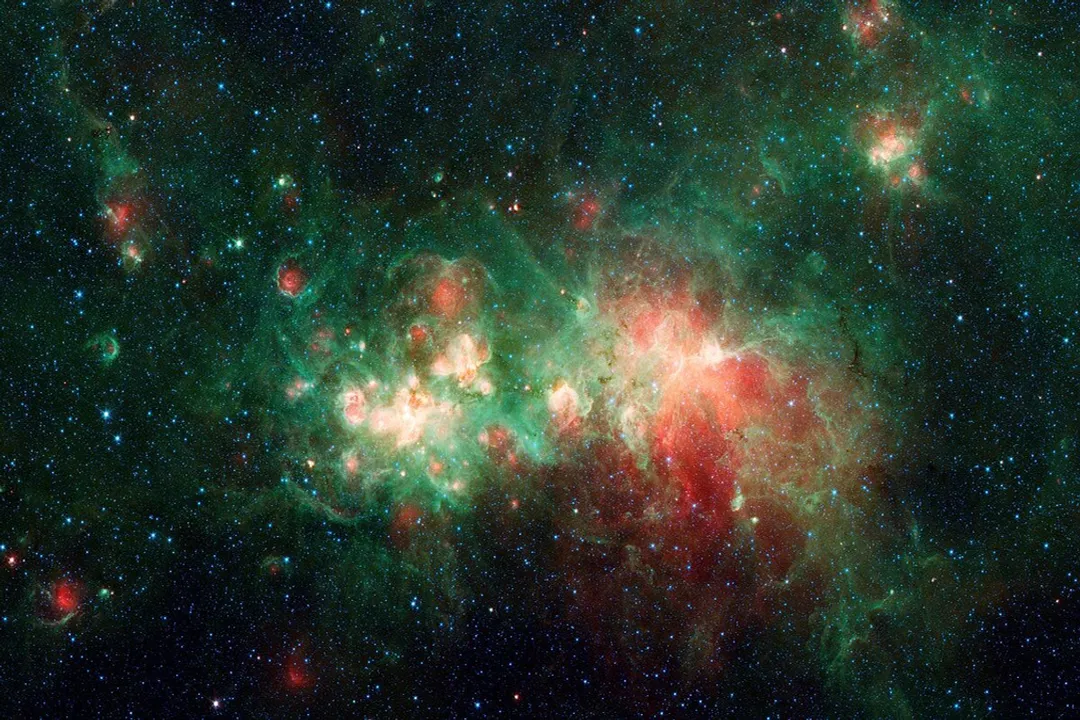
As the protostar continues to contract and heat up, it sheds its dusty cocoon. For stars like our Sun, this transition phase is often characterized by the T Tauri star stage. [5][7] T Tauri stars are defined by their variability and strong stellar winds, which act like a broom, sweeping away the last vestiges of the envelope and exposing the young stellar object. [5][7]
During this pre-main sequence phase, the core continues to compress, causing the internal temperature to climb steadily. The star now shines primarily from the energy released by gravitational contraction, though some low-level fusion may begin in the very deepest layers. [7] The star follows a track on the Hertzsprung-Russell (H-R) diagram, contracting and generally becoming slightly hotter as it evolves toward its final state. [2]
It is fascinating to consider the sheer range of outcomes possible from this one initial process. A fragment that accumulates significantly less than about $0.08$ times the mass of the Sun will never reach the core temperatures required for hydrogen fusion; it becomes a brown dwarf, a "failed star" that shines dimly from residual heat. [4][7] Conversely, if the initial core mass is several dozen times that of the Sun, the process is so rapid and energetic that the star will transition to the main sequence very quickly, likely becoming a blue giant soon after birth. [5] The mass of the initial core fragment is, therefore, the single most determinative factor in a star's entire life history, from its lifespan to its eventual death. [4]
# Final Ignition
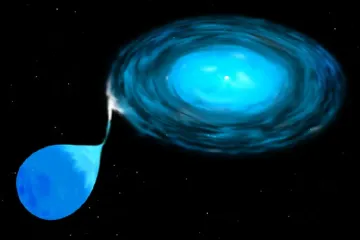
The defining moment in a star's life—the true birth—occurs when the pressure and temperature in the very center of the contracting core reach the threshold required to initiate sustained nuclear fusion. [2][4][7] For a star like the Sun, this critical temperature is about Kelvin. [2] At this point, the intense heat and pressure overcome the electrostatic repulsion between hydrogen nuclei, allowing them to fuse together, primarily forming helium. [2][7]
This fusion process releases an enormous amount of energy, creating a powerful outward pressure. [2][4] This new, stable outward pressure perfectly counteracts the inward crush of gravity. [2][7] When this state of hydrostatic equilibrium is finally achieved, the star stops contracting and settles onto the main sequence. [2][4] It has achieved stellar maturity. [7] This moment marks the true end of the birth process and the beginning of the star's long, stable adult life, where it will spend the vast majority of its existence burning hydrogen fuel. [4][2] The amount of time spent in the preceding collapse stages is quite short compared to the billions of years it will spend on the main sequence, much like the intense, formative years of childhood compared to the decades of settled adulthood. [5]
# Stellar Outcomes
While the general steps are the same, the final mass of the star dramatically influences its appearance and longevity on the main sequence. [4] The most common stars, like the Sun (a G-type star), will live for billions of years. [4] In contrast, stars born with masses many times that of the Sun burn their fuel at an astonishing rate, leading to main sequence lives measured in mere millions of years. [4]
It's worth noting that while we speak of "a star," the collapse of a single GMC core often results in a cluster of stars, sometimes even a binary or multiple-star system, due to the complex fragmentation processes that occur early on. [5] The conditions within the initial core dictate not just if a star forms, but how many form together from the same collapsing material. [5] This clustering effect means that most stars, including our Sun, were likely born in the company of siblings, though over cosmic time, these clusters tend to disperse. [5] The very dust and gas that created them become the building blocks for the next generation, cycling material throughout the galaxy. [4]
#Videos
How the Universe Works - A Star is Born - YouTube
Related Questions
#Citations
Chapter 1 - A Star is Born - NASA Science
how a star is born? - The Physics of the Universe
Star Formation | Center for Astrophysics | Harvard & Smithsonian
27.1 The birth of a star | Birth, life and death of a star | Siyavula
How the Universe Works - A Star is Born - YouTube
Star formation - Wikipedia
Stellar Evolution - | The Schools' Observatory
Birth of stars (video) - Khan Academy