Why has the scientific classification of objects like Pluto changed significantly in the last two decades?
Answer
The discovery of numerous other bodies and improved measurement technology.
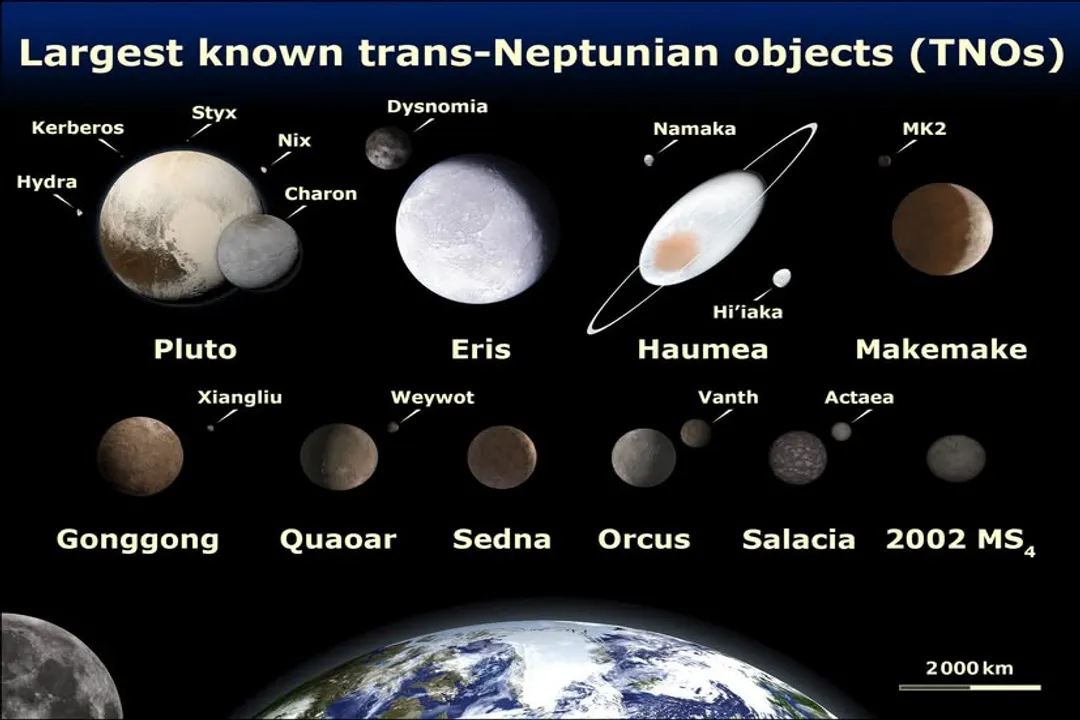
Over the last twenty years, researchers have discovered hundreds of new objects in the outer solar system. Technological advancements in both telescopes and observational strategies have allowed for much more precise measurements of size and mass. This influx of data forced scientists to refine their definitions and classification systems for dwarf planets and other icy bodies.
Related Questions
What is the primary defining characteristic of a Trans-Neptunian Object?How do the physical characteristics of Pluto and Eris differ regarding size and mass?What is the primary difficulty astronomers face when measuring the physical size of a Trans-Neptunian Object?What does the higher density of Eris compared to Pluto suggest about its formation history?Which observation method allows scientists to determine the precise size of a distant Trans-Neptunian Object?What distinctive physical characteristic sets Haumea apart from many other Trans-Neptunian Objects?What are tholins and how do they affect the appearance of Trans-Neptunian Objects?Why has the scientific classification of objects like Pluto changed significantly in the last two decades?What notable feature is associated with the Trans-Neptunian Object known as Quaoar?Which characteristic defines the orbit of the Trans-Neptunian Object Sedna?