Can China access the International Space Station?
The presence of China aboard the International Space Station (ISS) is a subject often discussed in global policy circles, and the current reality is quite clear: Chinese astronauts, or taikonauts, are officially barred from participating in the ISS program. [1][2] This exclusion is not due to a lack of technical capability—China has demonstrated high proficiency in crewed spaceflight—but is instead deeply rooted in legal and political decisions made primarily by the United States government. [4][6] Since around 2011, Chinese astronauts have been officially prevented from visiting the orbiting laboratory. [1]
# Political Foundation

The primary mechanism enforcing this exclusion is US domestic legislation. Specifically, the Wolf Amendment, introduced in 2011, significantly restricts NASA's ability to engage in bilateral cooperation with China or any Chinese-owned entity concerning human spaceflight activities. [6] This policy effectively prevents NASA, which is the lead agency for the ISS, from hosting or facilitating the travel of Chinese nationals to the station. [4][3] While the prohibition centers on bilateral ties between the two nations' space agencies, the ISS itself is governed by a complex set of agreements among the primary partners: the US, Russia, Europe (ESA), Japan (JAXA), and Canada (CSA). [4] China was not an original signatory to these founding memoranda of understanding. [3]
The genesis of this situation predates the official 2011 ban, reflecting broader geopolitical tensions and security concerns that have long characterized the US-China relationship in sensitive technological areas. [4] Some sources point to historical concerns regarding technology transfer and espionage risks as central to these restrictive policies. [6] Even if the political climate were to improve, altering the structure of the ISS partnership would require consensus among all established members, a politically difficult feat when one of the primary members is legally prohibited from engaging. [3]
# Historical Stance

When the ISS project was first conceived and structured in the aftermath of the Cold War, the geopolitical landscape was different, yet China was still not integrated into the core partnership framework. [3] The station represents an assembly of established space-faring entities working toward a shared goal. [4] As the project moved forward, with modules launching and being assembled, the opportunity for China to join the initial collaboration window closed. [3] This left China to develop its space program independently, following a different trajectory than the multilateral approach adopted for the ISS. [8]
It is worth noting the stark contrast in philosophy. The ISS is perhaps the highest-profile example of international space cooperation, born from a desire to bridge political divides through science. [4] China’s exclusion, therefore, highlights the enduring nature of certain security concerns that prevent such large-scale, politically sensitive partnerships from being fully inclusive.
# National Response
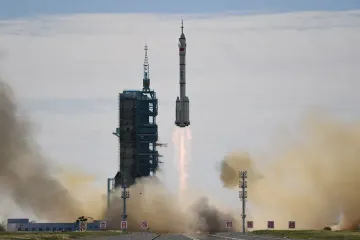
Faced with the inability to access the primary international orbiting laboratory, China chose to forge its own path, resulting in the development and deployment of its own modular space station, Tiangong. [5][8] This initiative showcases China's commitment to maintaining an independent, continuous human presence in low Earth orbit. [8] The successful launch and ongoing operation of Tiangong serve as a powerful statement of national capability and technological autonomy. [5]
The decision to pursue a fully national station, rather than simply an uncrewed lab, bypasses the political vetoes currently imposed on ISS access. [9] This independent approach ensures that Chinese astronauts have a platform for long-duration research and operational experience, separate from the political constraints tying US cooperation to the ISS. [8] While the initial phase of the ISS was characterized by international collaboration, Tiangong is firmly established as a project driven by Chinese national goals and managed by the China Manned Space Agency (CMSA). [5]
One interesting aspect that arises from this bifurcation is the differing operational models. The ISS, being a shared asset, requires constant negotiation regarding scheduling, maintenance, and scientific priorities among multiple agencies. [4] Tiangong, being state-owned and operated, offers a more streamlined, singular command structure for its domestic users. [9] This difference in governance structure could, over time, lead to distinct operational philosophies regarding crew management and emergency response protocols between the two facilities.
# International Openings
Despite the official block on US-China cooperation regarding the ISS, China has actively sought to position Tiangong as an internationally accessible platform. [8] While NASA personnel cannot visit, China has invited research proposals from other nations and international organizations to conduct experiments aboard its station. [8] This pivot essentially turns the tables: where China was once barred from an existing international facility, it is now attempting to establish its own center for international engagement in space. [5]
The long-term trajectory suggests that while direct access to the ISS for Chinese astronauts is unlikely under the current legislative environment in Washington, the cooperation landscape in space is not entirely stagnant. [6] For scientists worldwide looking for opportunities in a functional low Earth orbit laboratory, Tiangong presents an alternative door that the ISS, due to its political makeup, currently keeps closed to Beijing. [8] Analyzing the current status, one might project that any future rapprochement concerning the ISS would require a significant, sustained shift in the underlying security and diplomatic concerns that originally solidified the Wolf Amendment and the initial ISS exclusion. [4] The separation of the two programs—one built on broad, historical multilateralism, the other on focused national sovereignty—creates two distinct arenas for human space exploration in the coming decades. [9]
#Videos
Why China Is Banned From The Space Station - YouTube
Related Questions
#Citations
TIL Since 2011, Chinese astronauts are officially banned from ...
The silly reason the Chinese aren't allowed on the space station
Why is China not involved in the International Space Station (ISS ...
Why is China still not invited to the ISS? (Or, why do certain ...
Nasa bans Chinese nationals from working on its space programmes
NASA Banned Chinese Nationals From Space Programs: Reports
Why China Is Banned From The Space Station - YouTube
China: A Global Power's Ambitions in Outer Space
China's space station and international law-making - ScienceDirect