What is the brightest event in the universe?
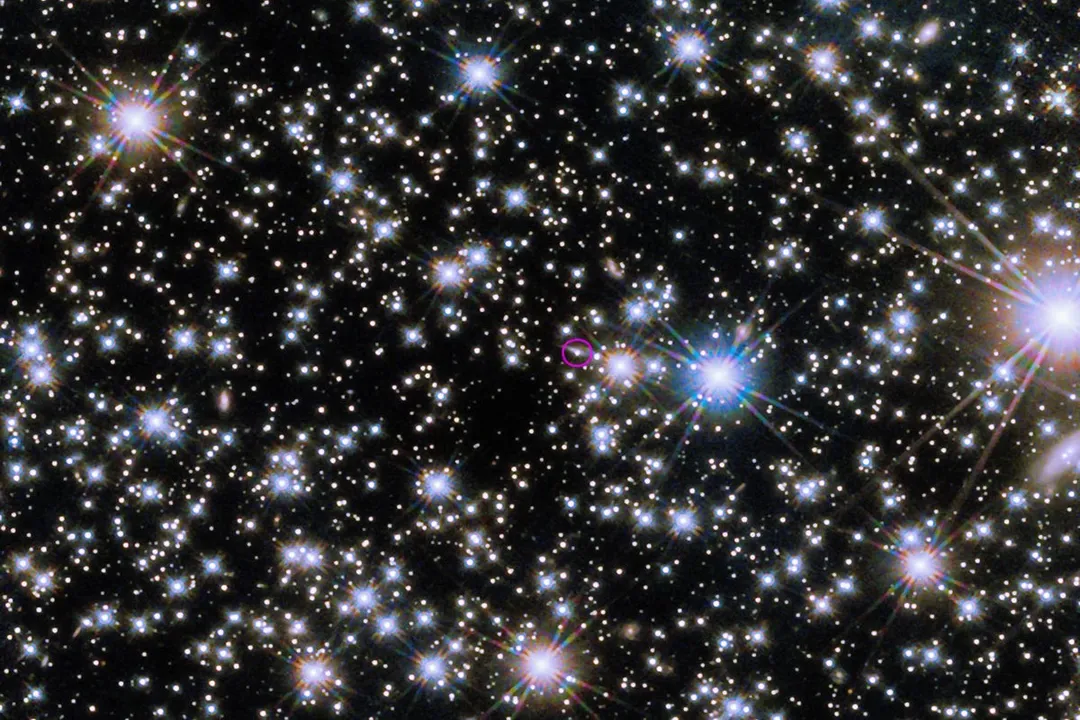
The most extreme events in the cosmos often defy easy comprehension, yet one particular cosmic explosion, detected by astronomers relatively recently, currently holds the title for the most powerful single emission ever observed: a Gamma-Ray Burst (GRB) designated GRB 220429A. [1] This event earned the evocative nickname BOAT, standing for the Brightest Of All Time. [2][7] It stands as the most energetic event in the universe yet recorded by our instruments, [1] representing a violent stellar demise occurring billions of years ago. [2][5]
# The Cosmic Record Breaker

The detection of this immense burst occurred on April 29, 2022, initially spotted by NASA's Swift satellite. [1] While Gamma-Ray Bursts themselves are known to be the most luminous electromagnetic events in the universe, typically lasting only a fraction of a second to a few minutes, GRB 220429A shattered previous benchmarks for sheer power. [7] The sheer magnitude of its energy output is what sets it apart from the regular population of these bursts. [7]
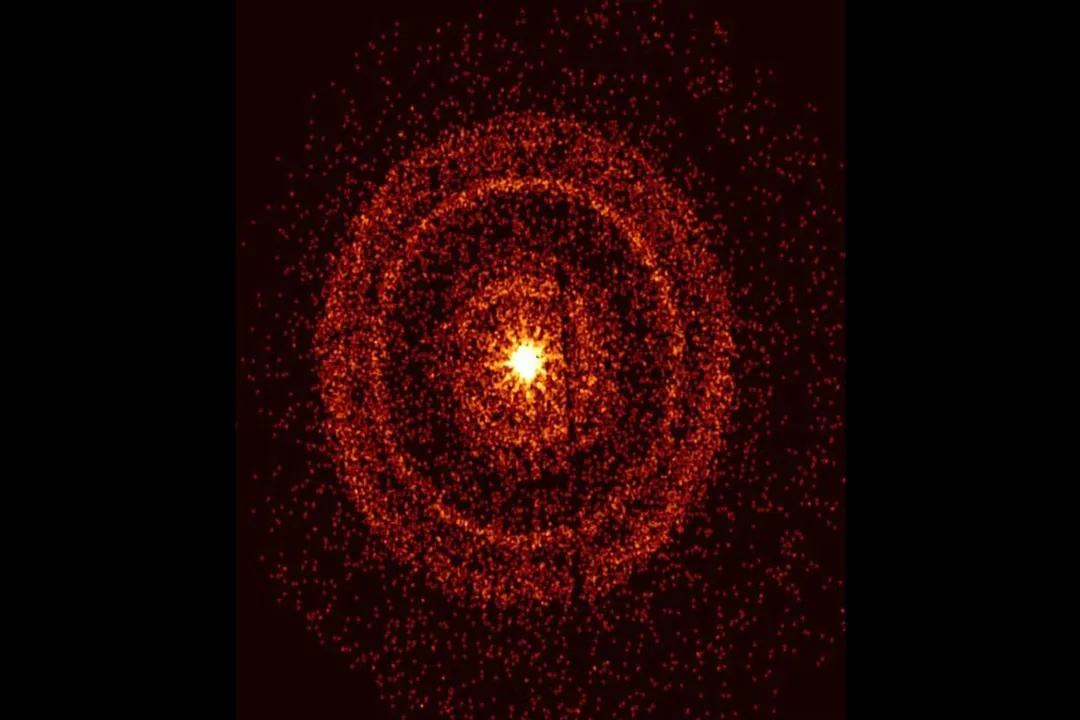
The initial "prompt emission"—the very first flash of high-energy gamma rays—was what secured its place in the record books. [7] Follow-up observations using other powerful instruments, including the Hubble Space Telescope and NASA’s Nuclear Spectroscopic Telescope Array (), helped paint a fuller picture of this extraordinary explosion. [1][3] The X-ray and optical afterglow, the fading light that trails the initial burst, was also remarkably bright, drawing significant scientific attention. [1]
One analysis suggests that the energy released during this single event, when converted into radiation, might equate to the total energy output of our Sun over its entire $10$-billion-year lifespan, compressed into mere seconds of intense emission. [5] This staggering comparison underscores the almost incomprehensible power packed into this stellar death event. If we look at the estimated frequency of such events, some researchers suggest that GRB 220429A might be a 1-in-10,000-year event based on the rate of similar occurrences observed over cosmic history. [9]
# A Distant Snapshot
Understanding the context of this brightness requires looking across the vastness of space and time. GRB 220429A originated approximately $9$ billion light-years away from Earth. [2][5] This immense distance means that we are not witnessing the explosion as it happened today; rather, we are seeing the light that left the source $9$ billion years ago. [2]
Considering the universe began approximately $13.8$ billion years ago, seeing an event from $9$ billion years in the past places the BOAT firmly in the Cosmic Noon era of star formation, a period when the universe was much younger and star creation rates were significantly higher than they are now. [5] The conditions in the early universe favored the formation of the very massive, short-lived stars that give rise to events like this. Therefore, while this specific burst is the brightest we have seen, it provides a critical window into the physics governing the most extreme stellar deaths when the cosmos was teeming with such massive stellar nurseries. This high-energy emission, seen so clearly across such a gulf of time, suggests that these "standard" GRBs may be the rule rather than the exception in that early epoch. [5]
# Stellar Collapse Physics
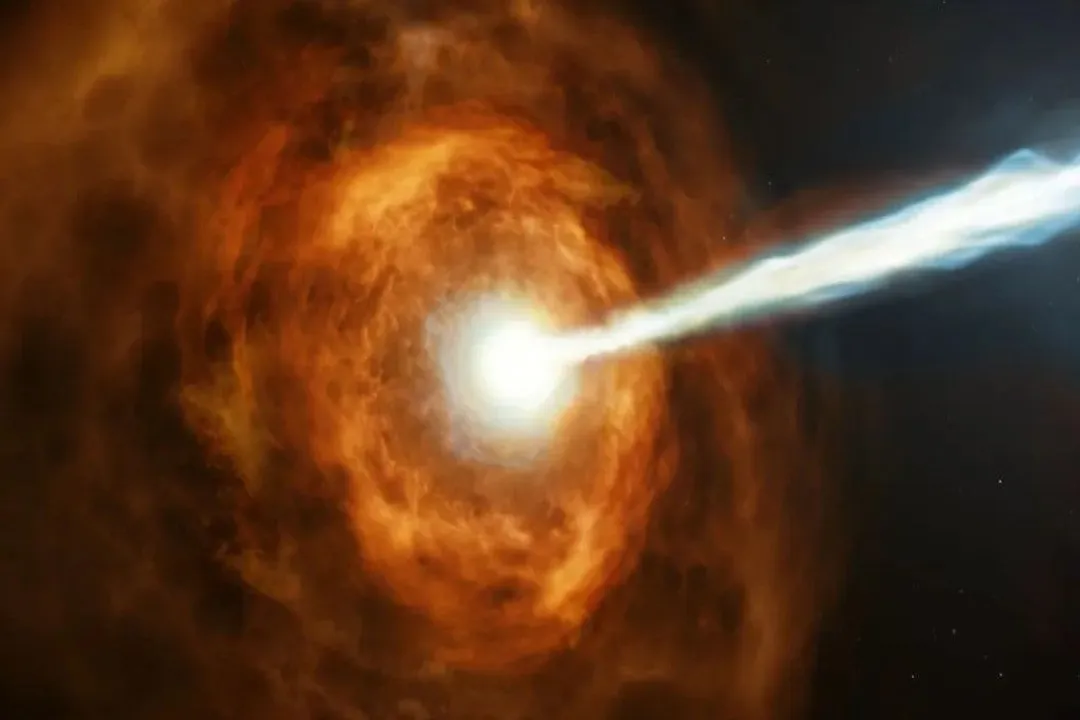
The mechanism behind the BOAT is believed to be the catastrophic collapse of an extremely massive star, leading to the formation of a black hole. [2][5] This process results in a hypernova, an explosion far more energetic than a typical supernova. [2]
When a truly colossal star exhausts its nuclear fuel, its core collapses under its own immense gravity. [5] If the star is massive enough, the collapse doesn't halt; it continues until a singularity—a black hole—is formed. [5] The material falling into this newly formed black hole doesn't simply vanish. Instead, magnetic fields channel some of this infalling plasma into two incredibly tight, focused beams or relativistic jets that blast outward from the star's poles at speeds approaching the speed of light. [2][5]
It is these jets that produce the gamma rays we observe. [5] The jet pierces through the remaining outer layers of the dying star, and as the material in the jet slams into the surrounding interstellar medium, it generates a tremendous shockwave, producing the intense, brief flash of gamma rays known as the prompt emission. [5] For us on Earth to see the peak brightness, we must be directly in the line of sight of one of these narrow jets, a fortunate, or perhaps infrequent, alignment. [2]
# Measuring Extreme Light

The detection of GRB 220429A required measuring photons across a vast energy spectrum. The gamma rays detected by Swift were astonishingly energetic, with individual photons reaching energies up to $18.7$ GeV (Giga-electron Volts). [1] To put this into perspective, $1$ GeV is equivalent to the energy of a single proton accelerated in a terrestrial particle accelerator like the LHC, meaning these particles carried thousands of times the energy of standard particle collisions, yet they traveled across $9$ billion light-years of space. [1]
The energy measurements derived from the prompt emission and the subsequent X-ray observations are what led scientists to label it the brightest event ever recorded. [5] Standard models used to interpret GRB afterglows often rely on synchrotron emission from electrons accelerated within the jet's shock waves. [7] The detection of photons at such extreme energies places a serious constraint on the physical parameters of the jet itself. For photons to retain this much energy after traveling across billions of light-years, the jet must have been moving incredibly fast, and the initial emission region must have been exceptionally hot and dense. [1]
This outlier status presents a challenge for astrophysical modeling. While many GRBs can be categorized, the sheer energy of the BOAT strains established theoretical limits for jet composition and velocity. If the standard synchrotron model holds, the inferred velocity of the jet material would be nearly impossibly high, leading some researchers to suggest that either the physics governing the emission in these most extreme cases is different than in typical GRBs, or that our viewing geometry was perfectly, almost impossibly, aligned with the jet's narrowest, most energetic core. [7]
# The Tools of Discovery
The successful identification and characterization of GRB 220429A relied on a multi-instrument approach, showcasing modern astrophysical coordination. [1][3]
The initial alert came from the Swift satellite, which is specifically designed to rapidly detect and locate GRBs, slewing its instruments towards the source within seconds of detection to capture the fading X-ray and optical light that follows the initial gamma-ray flash. [1] Following Swift's alert, ground-based telescopes and other space assets were immediately pointed at the location. [1]
The Hubble Space Telescope played a role by observing the fading afterglow in visible and ultraviolet light, allowing astronomers to study the host galaxy—the environment from which the star exploded—which is crucial for understanding the star's formation history. [1]
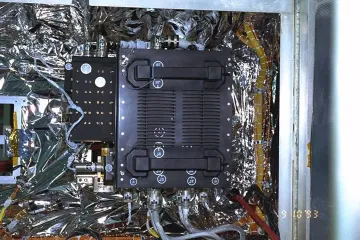
Crucially, NASA’s NuSTAR (Nuclear Spectroscopic Telescope Array) provided high-energy X-ray data. [3] NuSTAR is exceptionally good at detecting higher-energy X-rays, which are vital for accurately modeling the overall energy budget of the burst. By measuring the spectrum across multiple energy bands (gamma rays, X-rays, optical), scientists can reconstruct the physical processes occurring in the jet shock waves. [3] The data from NuSTAR confirmed the intense nature of the afterglow, helping to solidify the classification of this event as a super-energetic outlier. [3]
If we consider the cumulative data gathering, the sequence of discovery highlights a particular workflow in transient astronomy. A wide-field, rapid-response telescope (Swift) provides the trigger, followed by targeted, highly sensitive instruments (Hubble, NuSTAR) to dissect the remnant signal. This layered approach is essential when dealing with events that fade so quickly, as missing the initial 60-second window can mean losing the chance to confirm a new record-holder. [1]
# Comparing Cosmic Explosions
To fully appreciate the BOAT, one must compare it to other known cosmic phenomena. Supernovae, the explosions of stars that are not massive enough to form black holes, are brilliant events, yet they are dwarfed by the energy of a powerful GRB like GRB 220429A. [5] Even the most luminous supernovae pale in comparison to the prompt gamma-ray flash of the brightest GRBs. [7]
The difference is primarily one of mechanism and focus. A supernova releases its energy outward in a sphere, illuminating its entire surrounding nebula over weeks or months. [5] A GRB, on the other hand, channels the majority of its energy into two highly focused, narrow jets, creating an effect known as beaming. [2][5] If we could somehow capture the total energy of a GRB jet integrated across all angles, it would likely still be a hypernova, but the observed intensity for an on-axis observer is magnified by the narrowness of the beam.
This beaming factor is a critical piece of astrophysics when assessing "brightness." The term can mean total isotropic energy released (energy radiated equally in all directions) or the flux (the energy received at Earth). The BOAT sets a record for the observed flux due to its extreme intrinsic energy and its fortunate alignment with our instruments. [2] If another event of equal intrinsic power occurred, but was pointed away from us, it would remain undetected or categorized as a much weaker burst. This dependency on jet alignment means that GRB 220429A represents the best-case scenario for observing a stellar collapse jet head-on. [5]
The fact that an event this powerful, occurring $9$ billion years ago, was captured, implies that the physics driving these jets is not a rare fluke of the early universe, but rather a consequence of the most massive stars reaching their explosive end points. It forces us to accept that the universe regularly produces explosions far exceeding our most energetic conventional stellar events.
The energy signature of GRB 220429A—especially the presence of the $18.7$ GeV photons—may eventually lead to a refinement in how we classify and understand GRB physics. Future large-scale surveys aim to find more of these outliers to better map out the parameter space between a standard GRB and an event of BOAT-level intensity. Pinpointing the exact distance and energy spectrum from these events allows scientists to place constraints on fundamental physics, such as the density of the intergalactic medium through which the gamma rays traveled, and the properties of the very first stars that existed in the universe's history. The BOAT is not just a loud bang; it is a precise physical measurement delivered across cosmic time.
#Videos
Record Breaking! Astronomers Caught the Brightest Cosmic Blast ...
Related Questions
#Citations
Gamma-Ray Burst Found to be Most Energetic Event in Universe
Scientists identify origin of the 'BOAT' — the brightest cosmic blast of ...
Brightest Cosmic Explosion Ever Detected Had Other Unique Features
Biggest cosmic explosion on record since the Big Bang is revealing ...
The brightest explosion ever seen - Niels Bohr Institutet
What is the brightest x-ray burst ever detected in space? - Facebook
Gamma-ray burst is the new B.O.A.T. — brightest of all-time - Medium
Record Breaking! Astronomers Caught the Brightest Cosmic Blast ...
Brightest gamma-ray burst ever recorded may be 1-in ... - Penn State