What is the alpha star of Pisces?
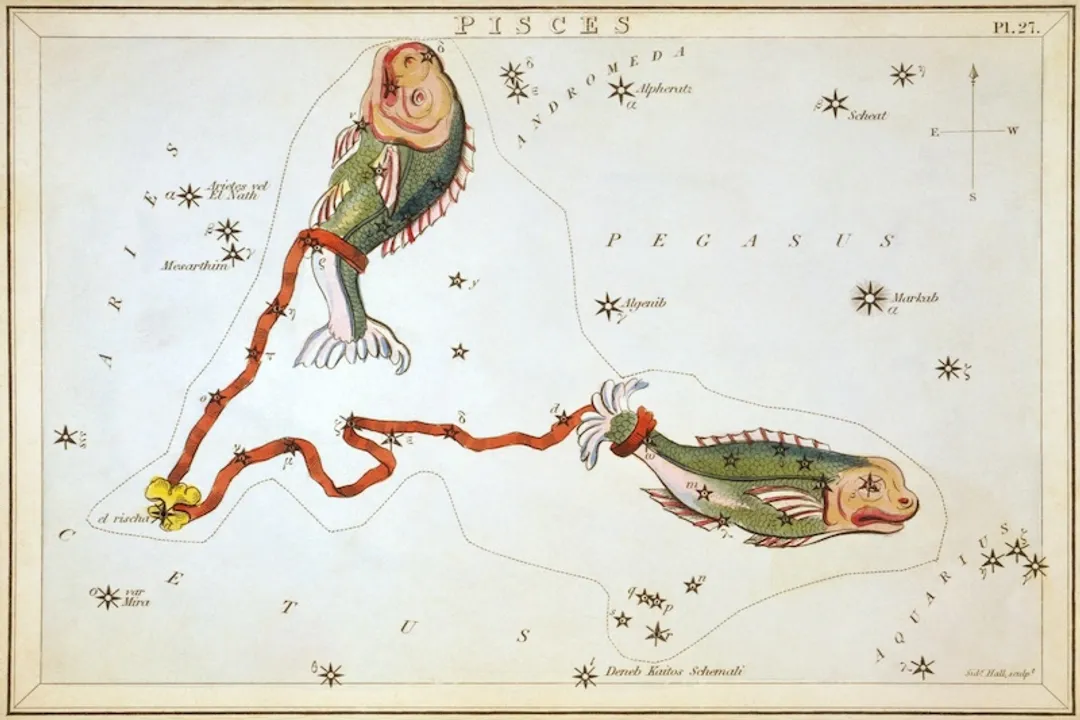
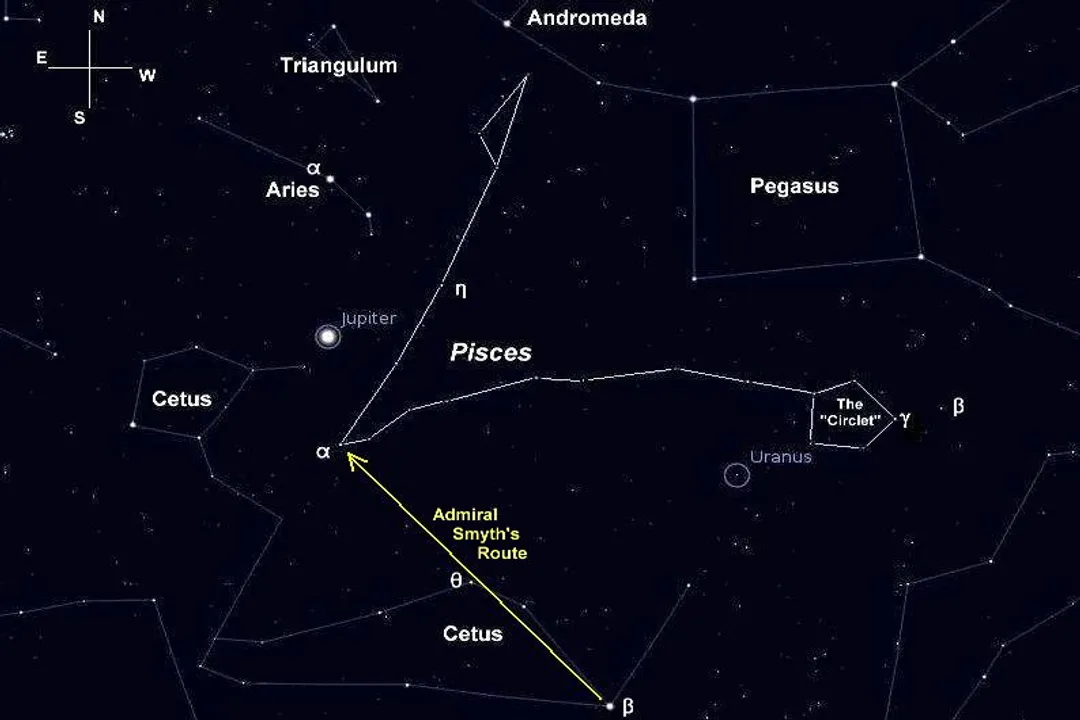
Alpha Piscium, almost universally known by its proper name Alrescha, sits at the bottom of the constellation Pisces. [1][2] While Bayer designations in astronomy often imply the brightest star in a constellation, Alrescha serves as a reminder that this rule of thumb is not universal. It is not actually the brightest star in its home constellation; that distinction belongs to Eta Piscium. [4] Despite this, Alrescha holds a special place in the night sky as a fascinating binary system that draws the attention of both amateur astronomers and those interested in celestial history.
# Name
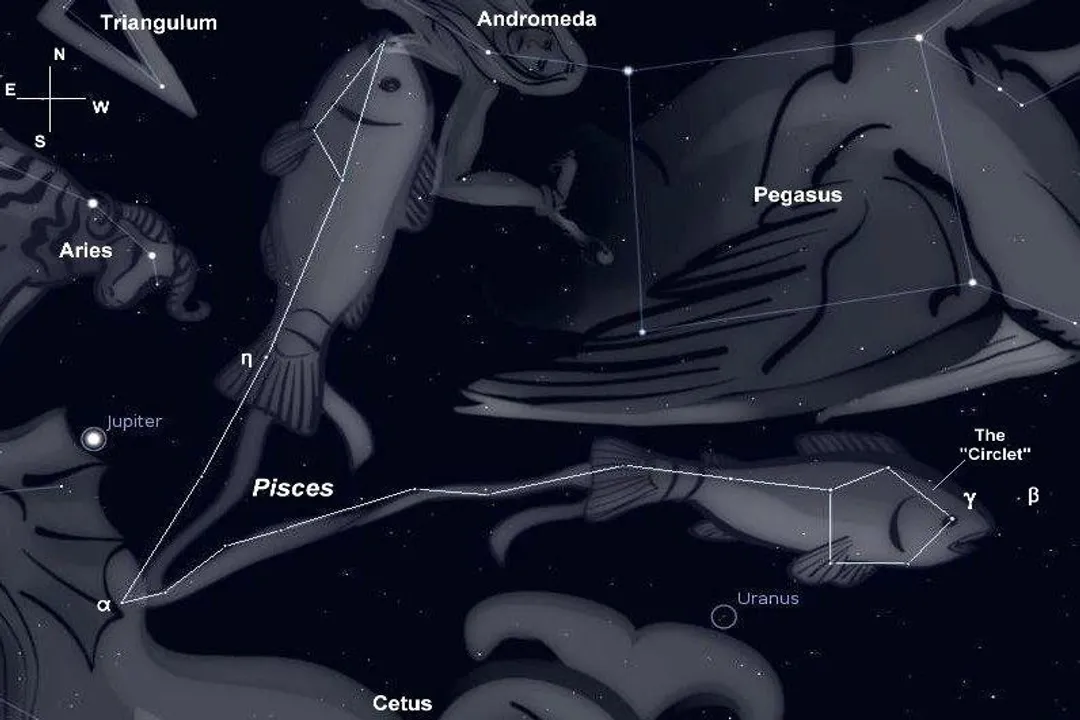
The name Alrescha comes from the Arabic Al-Risha, which translates to "the cord" or "the knot". [4][6] This name is fitting because of the star's position in the sky. In the traditional depiction of the constellation, Pisces is represented by two fish swimming in different directions, their tails connected by a long ribbon. [5] Alrescha serves as the knot that binds these two ribbons together, effectively acting as the anchor point for the constellation's geometric shape. [6]
Historical records also identify the star as Struve 202, a designation from the famous W. Struve double star catalog. [3] This highlights its character not as a singular point of light, but as a gravitationally bound pair of stars that appear as one to the naked eye.
# Binary
At its most basic level, Alrescha is a binary star system. [4] When viewed through a powerful enough telescope, it reveals itself as two distinct components orbiting a common center of mass. Astronomers classify these as Alpha Piscium A and Alpha Piscium B. [1][8]
Both components are hot, main-sequence stars, typically categorized as A-type stars. [4] These stars are generally hotter and more luminous than our own Sun, casting a white or slightly blue-white light into the void. Because they are gravitationally locked, they dance around each other in an orbit that takes centuries to complete. Current estimates place this system approximately 140 light-years away from Earth. [1][4]
To put the physical nature of this system into perspective, here is how the two components compare in terms of their observational traits:
| Feature | Alpha Piscium A | Alpha Piscium B |
|---|---|---|
| Spectral Class | A0 V | A3 V |
| Magnitude | ~4.3 | ~5.2 |
| Role | Primary component | Secondary component |
These values demonstrate that while the primary star is brighter, the secondary star is not significantly dimmer, which is why the system is such a compelling target for observers. [4]

# Observing

For those looking to find Alrescha in the night sky, it requires a bit of patience and, ideally, a dark location. Because of its relatively low apparent magnitude, it can be difficult to spot in urban areas plagued by light pollution. Under good conditions, it is visible to the naked eye as a modest point of light near the bottom of the "V" shape that forms the body of Pisces. [6][9]
The real challenge, and the reason many astronomers turn their telescopes toward it, is the attempt to "split" the double star. [7] Because the two stars orbit closely, they appear very near one another from our perspective on Earth.
If you are planning an evening of observation, consider these practical steps to improve your chances of resolving the pair:
- Preparation: Check your local astronomical twilight times. The stars are easier to distinguish when the background sky is truly dark.
- Magnification: Because the separation between the two components is quite tight, low-power eyepieces will likely show only a single, slightly elongated star. Use a higher magnification eyepiece to increase the angular separation visually.
- Atmospheric Stability: This is key. If the air is turbulent, the star image will "shimmer," making it nearly impossible to resolve the two components. Wait for a night with steady "seeing" conditions.
- Aperture: While you do not need a massive observatory-grade telescope, a medium-sized aperture—roughly 4 to 6 inches—is generally sufficient to clearly separate the primary from the secondary. [7]
It is worth noting that if you fail to split them, you are not alone. Even experienced observers often find that atmospheric conditions prevent a clean separation of the pair. [7]
# Myths
The mythology surrounding Alrescha is intimately tied to the origin of the Pisces constellation itself. In various traditions, the two fish represent Aphrodite and Eros, who transformed themselves into fish to escape the monster Typhon. [6]
The "cord" or "knot" (Alrescha) signifies the ribbon they used to tie themselves together so they would not be separated while swimming through the river. This narrative adds a human, story-driven layer to what is otherwise a cold, mechanical astrophysical object. When looking at Alrescha, you are essentially looking at the "safety knot" of a mythological escape. [5][6]

# Significance
While it may not be the brightest star in the sky, Alrescha serves as a perfect example of how names and designations can occasionally mislead the casual observer. It teaches us that "Alpha" does not always mean "brightest". [4] Instead, the designation often reflects the star's unique position or its role in the constellation's mythology.
Furthermore, it highlights the prevalence of binary systems in our galaxy. Most stars in the universe are not solitary like our Sun, but exist in pairs or even larger multiple-star systems. [4] Alrescha is a tangible example of this cosmic reality, easily accessible to anyone with a telescope and a bit of persistence. The next time you find yourself tracing the faint, V-shaped outline of Pisces, locate the bottom point of that V. You are looking at a system that has served as a navigational knot in our cultural and scientific view of the heavens for centuries.
Related Questions
#Citations
Alpha Piscium - Wikipedia
Alrescha - α Piscium (alpha Piscium) - Star in Pisces | TheSkyLive
In Search of the Big Catch: Alrescha, Better Known as Alpha (α ...
Alrescha - JIM KALER
It's Pisces season! Pisces is usually depicted as two fish and is a ...
Al Risha binds the Fishes of Pisces together - EarthSky
Alpha Piscium (Alrisha): A Binary to Test Your Scope and Eyesite
Alrescha – Alpha Pisces - Galactic Images