What does AU stand for and explain how big it is?
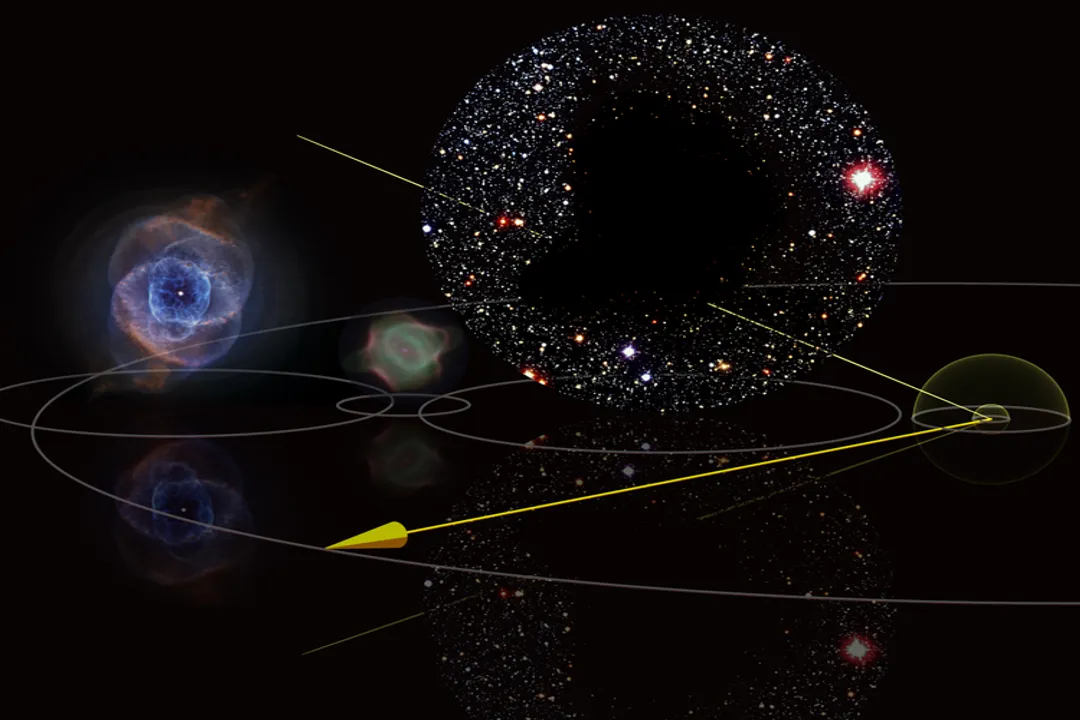
The abbreviation AU stands for the Astronomical Unit. [1][2][3][5][6][7] It is a fundamental unit of length employed extensively in astronomy, specifically for measuring distances within our own cosmic neighborhood, the Solar System. [1][3][6][7] While many people are familiar with miles or kilometers, the distances involved in planetary orbits are so immense that a more convenient standard was needed, and the AU fills that role perfectly. [6]
# Unit Definition
To grasp the necessity of the AU, consider the raw numbers involved in mapping the solar system. Using kilometers for distances between planets results in figures that are cumbersome to write and process repeatedly. [7] The Astronomical Unit serves as a handy yardstick, simplifying complex orbital mechanics calculations into manageable figures. [3][7] It represents the scale by which we talk about the separation between celestial bodies orbiting our star. [6]
# Orbital Basis
For a long time, the definition of the AU was intrinsically tied to Earth's own movement. It was originally understood as the semi-major axis of Earth's orbit around the Sun. [1][3][6][7] This meant the AU was derived from an observed measurement: the average distance between the center of Earth and the center of the Sun. [2][3] Because Earth’s orbit is not a perfect circle but slightly elliptical, using the semi-major axis—the longest radius of the ellipse—provided the most stable and representative distance. [1] This historical grounding gave the unit a direct, physical relevance to our position in space. [6]

# Fixed Standard
However, as astronomical precision increased, relying on a constantly observed and slightly variable value became problematic for the most accurate scientific work. [1] To introduce absolute consistency, the International Astronomical Union (IAU) made a significant decision in 2012. [1][6] They formally fixed the length of the Astronomical Unit, severing its direct, observational link to the Earth's instantaneous position. [1][7]
The modern, officially defined value for one Astronomical Unit is exactly $149,597,870,700$ meters. [1][3][6] This precise figure is defined based on the speed of light in a vacuum and the Julian year. [1] This standardization means that an AU now represents a fixed, unchanging standard, regardless of any minor perturbations or long-term shifts in Earth's orbit. [1][7]
When we look at this figure in more commonly understood terms, one AU is approximately 93 million miles or 150 million kilometers. [5][6] This number is significant not just as a unit, but as a reference point for understanding the scale of our immediate cosmic environment.
| Celestial Body | Average Distance from Sun (Approximate) | Distance in AU |
|---|---|---|
| Mercury | 58 million km | 0.39 AU |
| Earth | 150 million km | 1.00 AU |
| Jupiter | 778 million km | 5.20 AU |
| Neptune | 4.5 billion km | 30.10 AU |
This table illustrates how effectively the AU compresses vast distances. Expressing Jupiter's distance as 5.20 AU is far cleaner than writing out 778,000,000 kilometers, a clear demonstration of the unit's utility in planetary science. [7]
# Solar System Scale
The primary domain of the AU is mapping the distances between the planets and other objects gravitationally bound to the Sun. [3][6] For example, the asteroid belt lies roughly between 2.2 and 3.2 AU from the Sun. [7] The dwarf planet Pluto orbits at an average distance of about 39.5 AU from the Sun. [7] These figures allow scientists, educators, and space agencies to communicate positional data clearly and instantly across various projects and publications. [3]
When we move much farther out, past the major planets and into the Kuiper Belt, the AU remains useful, but the numbers start getting very large. For trans-Neptunian objects, you are dealing with distances in the tens or hundreds of AUs. [7]
It is interesting to note that while the AU is perfect for the inner and middle Solar System, it becomes less practical for interstellar distances. For objects outside our Sun's direct influence, such as stars in neighboring systems, units like the light-year or the parsec are preferred because an AU becomes too small a measurement unit. [7] A light-year, for instance, equates to roughly 63,241 AU. [1]
To put the scale into a more relatable context: if you could somehow travel at the speed of a modern commercial jet—say, 550 miles per hour—it would take you approximately 19.5 years just to cover the distance of one Astronomical Unit. [5][6] Considering that Neptune is 30 times that distance away, the sheer emptiness of space within our own system becomes apparent when measured by human standards of speed and travel time. The decision to fix the AU at a precise meter count, rather than tying it to Earth's actual instantaneous distance, is crucial for missions navigating across these vast, multi-AU gaps, ensuring the trajectory calculations are based on an unchanging constant, rather than a slightly fluctuating historical average. [1] This guarantees that data collected today aligns perfectly with data collected a century from now, regardless of minute changes in Earth's orbital eccentricity over deep time.
# Scaling Space
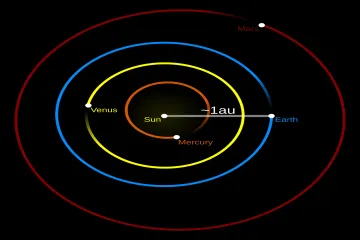
Thinking about the AU also helps us visualize the vastness between objects in a way that raw kilometer counts obscure. Imagine a simplified model of the solar system where the Sun is a basketball. In that scaled model, Earth would be a tiny grain of sand about 82 feet away from the basketball. [6] That 82-foot distance is one AU. Mars would be roughly 125 feet away, while Jupiter would be over 420 feet away, and Pluto would be over a half-mile distant. [6] This kind of conceptual scaling, derived directly from the AU measurement, makes the distribution of mass and space in the solar system much more intuitive for general understanding. The realization that the inner solar system is tightly packed, while the outer solar system stretches out dramatically further, is immediately evident when visualizing these distances in AU.
The precision established in 2012 has practical implications for automated probes. When mission control at NASA’s Jet Propulsion Laboratory (JPL) sends commands to a deep-space probe, they often calculate positions and trajectories using the fixed meter value derived from the IAU definition. [3] This method ensures that the onboard navigation systems—which rely on highly accurate orbital parameters—have a consistent reference point, which is vital when dealing with the slight time delays inherent in communicating across dozens of AUs. [3] The transition from an empirical measurement to a defined constant represents a maturation of our ability to map the heavens with high fidelity.
#Videos
What Does AU Mean In Astronomy? - Physics Frontier - YouTube
Related Questions
#Citations
Astronomical unit - Wikipedia
Astronomical unit (AU, or au) | Definition, Conversion, & Facts
au (Astronomical Unit) - Glossary
What Does AU Mean In Astronomy? - Physics Frontier - YouTube
Can you explain what AU stands for and how it is used for ... - Quora
What is an astronomical unit? - EarthSky
What is an Astronomical Unit? | Cool Cosmos
Astronomical Unit - an overview | ScienceDirect Topics