How much does NASA pay SpaceX per seat?
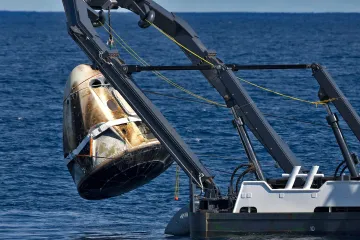
The cost for NASA to send an astronaut to the International Space Station (ISS) aboard a SpaceX Crew Dragon capsule is significantly lower than its competitors, representing a major shift in how the agency procures human space transportation. Initial reports, based on an assessment from NASA’s Office of Inspector General (OIG), placed the per-seat cost for a SpaceX trip at approximately $55 million. [1][4]
This figure is central to understanding the economic success of NASA’s Commercial Crew Program (CCP), which aimed to end U.S. reliance on Russian Soyuz vehicles and introduce private-sector innovation to reduce costs. [1]
# Cost Comparison
The cost comparison among the available crew transport options clearly illustrates the impact of SpaceX's entry into routine crewed flight services.
# SpaceX vs. Boeing
The primary domestic competitor to SpaceX in the CCP is Boeing, with its CST-100 Starliner capsule. NASA aimed to have two independent providers for resiliency, but the projected pricing reflected a significant disparity early on. [4]
The OIG report estimated that a seat on Boeing’s Starliner would cost NASA about $90 million. [1][4] This meant that, based on those initial estimates, Boeing’s vehicle would be roughly 60% more expensive per seat than SpaceX’s Crew Dragon, despite both vehicles being capable of carrying up to seven astronauts. [1] Boeing defended its higher estimate by noting that SpaceX built the Crew Dragon based on the pre-existing, already flying robotic Cargo Dragon, while Boeing had to develop Starliner "from scratch". [4]
When accounting for inflation, the estimated Boeing price rose to about $100 million per ticket in later years, compared to an implied SpaceX price that was also rising due to contract modifications. [5]
# SpaceX vs. Soyuz
Before the Crew Dragon began flying astronauts, NASA relied almost entirely on Russia's Soyuz spacecraft for crew transport after the Space Shuttle retired in 2011. [1] NASA was paying Russia a substantial amount for these rides, reported to be around 97 million. [5]
When comparing SpaceX’s original 22 million per ticket, or about **65 million, which would equate to savings of $128 million over the Soyuz price. [5]
The table below summarizes the initial, widely reported per-seat cost estimates derived from early NASA OIG assessments:
| Spacecraft | Estimated Per-Seat Cost (USD) | Primary Operator |
|---|---|---|
| Crew Dragon | ~$55 million | SpaceX |
| Soyuz | ~$86 million (Historical/2018) | Roscosmos |
| Starliner | ~$90 million | Boeing |
| Apollo Program | ~$390 million (Adjusted for inflation) | NASA |
| Space Shuttle | ~$170 million (Adjusted for inflation) | NASA |
| [4][5] |
# Contract Structure Influence
The sticker price for a seat is only one part of the financial equation; the underlying structure of the initial Commercial Crew Transportation Capability (CCtCap) contracts heavily influenced the initial figures.
The initial CCP contracts awarded in 2014 showed a large disparity: Boeing received 2.6 billion. [1][4] This difference was partially attributed to external factors not strictly related to the spacecraft design itself:
- Launch Vehicle Cost: SpaceX was slated to launch on its own Falcon 9, while Boeing was tied to the more expensive Atlas V 422 rocket configuration. Estimates suggested the Atlas V 422 could cost around $125 million more per launch than the Falcon 9, accounting for a significant portion of the initial billion-dollar disparity.
- Prior Funding: SpaceX development had already benefited from prior NASA funding under the Commercial Orbital Transportation Services (COTS) program, which essentially functioned as an unmanned prototype development for the Crew Dragon. [4] Boeing did not receive equivalent COTS funding, meaning more of its development costs were folded into the CCtCap award.
This reveals that the initial development and integration costs were heavily skewed by the launch vehicle choice mandated by NASA's desire for two different American systems, as well as prior government investment history. One analysis suggested the true disparity between the two contractors, accounting for launch vehicles and COTS funding, was closer to **1.6 billion difference in the headline contract values.
When NASA later awarded SpaceX three additional missions (Crew-7, Crew-8, and Crew-9) by adding **300 million, leading to a per-seat cost of about **55 million, reflecting a mix of development amortization, new requirements, and the specific structure of those follow-on missions. [5]
# Original Insights on Cost Structure
The way NASA purchased seats fundamentally changed the economics, moving away from historical models. The older approach, relying on Soyuz, often involved bartering for power usage on the ISS or trading cargo, meaning the "check" for a seat was not always a straightforward cash transaction for Roscosmos. [6]
With the CCP vehicles, the arrangement is clearer. While the Dragon capsule can hold up to seven, NASA has consistently flown four-person crews for its missions, filling the remaining capacity with cargo, which is highly valuable to the station. [6] If a SpaceX flight carries four crew and significant cargo, calculating the cost solely on crew seats may underestimate the value NASA receives per dollar spent, as the operational cost for the flight covers both crew transport and cargo delivery that would otherwise require a separate, dedicated cargo flight. This added cargo benefit means the effective price per crew seat, when factoring in deferred cargo costs, could be considerably lower than the stated $55–$75 million, making the economic case even stronger than the headline numbers suggest.
Furthermore, the inclusion of reusability is a game-changer that isn't perfectly captured in the initial contract figures. While the initial Crew Dragon flights required new capsules, NASA later permitted the reuse of previously flown capsules, with expectations for up to five uses per capsule. [6] This reuse capability drives down the marginal cost of subsequent flights dramatically. Once the development overhead is paid, the recurring cost per launch is heavily weighted toward fuel and operations, which is where SpaceX's efficient launch system (Falcon 9) provides inherent, long-term savings compared to legacy systems or even Boeing's Starliner, which was based on the Atlas V expendable architecture. [1][6] The true, long-term operational cost per seat is likely decreasing with every successful reuse, a factor that the initial fixed-price development contracts couldn't fully account for.
# Program Resilience
The program's structure, which intentionally included two providers, proved its worth when Boeing experienced significant technical delays. [6] Had NASA relied on a single provider, the ISS crew rotation schedule would have faced serious jeopardy during Starliner’s extended development period. [1][6] The existence of SpaceX’s reliable service, even at a slightly higher post-initial contract price, ensured the station remained fully staffed and operational. [5] This dual-provider strategy, even with the cost imbalance, provided NASA with schedule resiliency, which officials suggested justified some of the contract modifications made to keep Boeing engaged. [4] The competition itself, even if one competitor is underperforming, helps keep the dominant provider’s costs in check, securing long-term savings for the taxpayer. [5]
For NASA, the shift to contracting for seats rather than owning and operating the vehicles—a lesson learned after the Space Shuttle program—has clearly succeeded in driving down LEO access costs while regaining domestic launch capability. [6]
Related Questions
#Citations
Here's How Much NASA Is Paying Per Seat on SpaceX's Crew ...
How SpaceX Saves NASA $100 Million Per Flight | The Motley Fool
What is the cost comparison between NASA using SpaceX's Crew ...
Why SpaceX Is A Game Changer For NASA | Statista
SpaceX fulfilled their plan to reduce the cost of spaceflight - tesmanian
Commercial Crew Cost Analyses & Discussion