What is the purpose of SPHEREx?
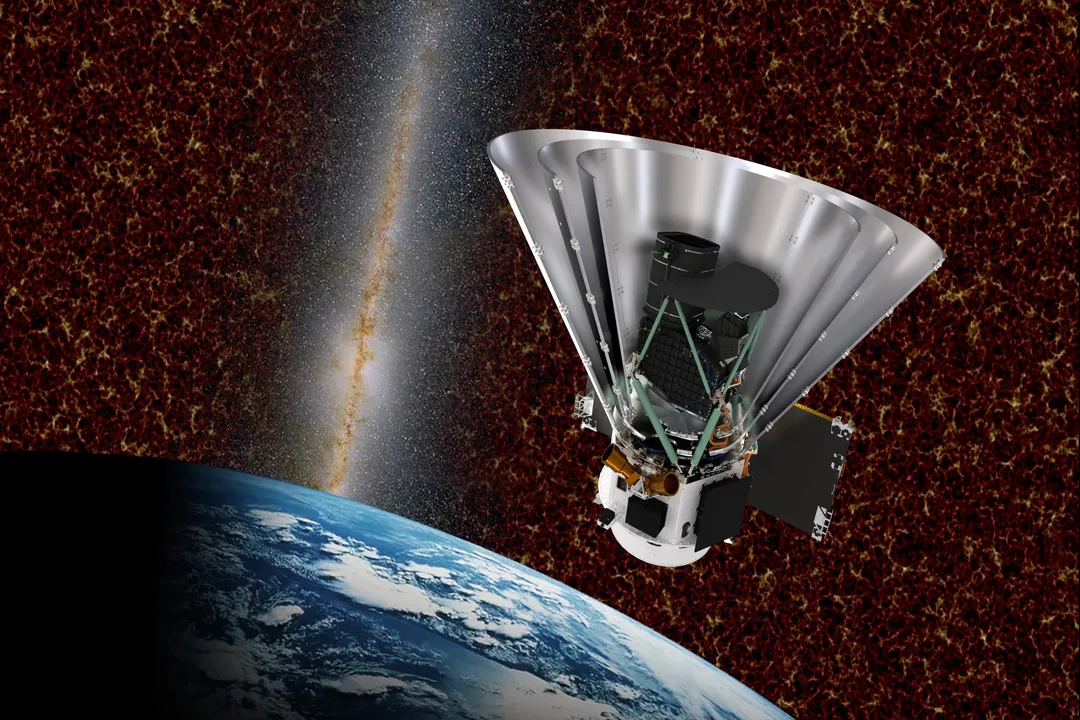
NASA’s SPHEREx mission, an acronym for the Spectro-Photometer for the History of the Universe, Epoch of Reionization and Ices Explorer, functions as a high-precision sky mapping project. [1][2] Unlike traditional telescopes that target specific, narrow points in the sky, this mission acts as an all-sky observer, systematically scanning the entire celestial sphere to provide a new class of data for astronomers. [3][6] By collecting light in over 100 spectral bands, the spacecraft enables scientists to analyze the composition and history of the cosmos in ways previously impossible. [4][7]
# Mission Goals
The mission serves three primary scientific objectives, each designed to answer different questions about our universe. [7] These goals range from the earliest moments after the Big Bang to the chemical makeup of our own galaxy. [1]
- Cosmic Inflation: Scientists aim to measure the physics of inflation, a period of rapid expansion that occurred less than a trillionth of a second after the universe began. [1][5] By mapping the distribution of galaxies across the sky, SPHEREx will look for subtle patterns that contain information about this initial burst of expansion. [7]
- Galaxy Assembly: The project seeks to understand how galaxies formed and grew over time. [1] It will track the history of galaxy formation by observing the collective light from all galaxies across cosmic time, effectively creating a 3D map of the universe. [4]
- Interstellar Ices: The final goal focuses on the ingredients for life. [1] By analyzing the chemical makeup of interstellar ices, the mission will identify water, carbon dioxide, and other molecules within our own galaxy, helping researchers understand how these materials are distributed and how they might eventually end up on planets. [7]
# Cosmic Inflation
Understanding inflation remains a significant challenge in modern cosmology. [5] While theory suggests the universe expanded exponentially in an instant, proving this requires observing the distribution of matter on an massive scale. [1] The mission uses the positions of hundreds of millions of galaxies to act as tracers. [6] If the universe underwent inflation, these galaxies should show specific, large-scale patterns in how they are clustered together. [2] By detecting these patterns, researchers can distinguish between different theories of how the early universe began. [7]

# Galaxy Evolution
Beyond the early universe, this mission provides a map of galaxy assembly. [2] Astronomers have long studied individual galaxies, but observing the entire sky allows them to look at the "cosmic web" as a whole. [5] By measuring the light from galaxies at different distances—and therefore different times in the past—the team can chart how the universe went from a hot, dense state to the structured cosmos we see today. [6] This data helps quantify the history of star formation and the growth of large-scale structures. [1]
# Interstellar Ices
The search for water is a common theme in space science, but SPHEREx takes a unique approach to this. [2] Instead of searching for liquid water on distant exoplanets, it maps the distribution of frozen ices throughout the Milky Way. [4] These ices, often found on tiny dust grains in cold molecular clouds, contain the building blocks for stars, planets, and potentially life. [7] Mapping these ices tells astronomers how raw materials are distributed throughout the galaxy, providing insight into the reservoirs available for planetary formation. [1]

# Technical Design
To achieve these goals, the spacecraft uses a spectrometer that operates in the near-infrared range. [3] This allows it to see through the dense dust clouds of the Milky Way that often block visible light. [6] The instrument collects light across more than 100 different spectral bands. [4]
| Feature | Description |
|---|---|
| Spectral Coverage | Near-infrared (0.75 to 5.0 micrometers) |
| Mapping Area | Entire sky (All-Sky) |
| Data Format | Spectral data cube (spatial + spectral info) |
| Primary Instrument | Linear variable filter spectrometer |
This approach creates a "data cube" for every point in the sky. [2] Instead of a single flat color, each pixel contains a spectrum, showing how the brightness changes across various wavelengths. [4] This spectral information acts like a barcode, revealing the composition of the objects being observed. [10]
# The Mapping Difference
It is helpful to consider how this differs from traditional imaging. Most iconic space images, such as those from the Hubble or James Webb Space Telescopes, function like high-resolution photography. [6] They provide stunning visual detail of specific, tiny patches of the sky. In contrast, this mission operates more like a cartographer creating an atlas. [3]
While it lacks the deep-zoom resolution of Webb, it gains something else: context. By covering the entire sky, it avoids the "soda straw" effect, where observers see only a small sliver of the universe. This wide-angle spectral view allows researchers to see the big picture of how matter is distributed, which is essential for studying phenomena like cosmic inflation that occur on the largest possible scales. [1][5]
# Analyzing Data
The primary value of the mission comes from its speed and breadth. [9] Because it performs an all-sky survey every six months, it provides a consistent, high-quality data set for the entire celestial sphere. [3] This means astronomers do not have to rely on stitched-together data from different telescopes with different calibration standards. [6] Instead, they use a single, uniform dataset.
This uniformity makes it easier to compare distant regions of the sky and ensures that trends observed by researchers are physical realities rather than artifacts of mismatched telescope settings. [10] The data gathered will allow the scientific community to create a catalog of hundreds of millions of objects, which will serve as a resource for decades of follow-up studies. [4]
# Implementation
Preparing for such a mission requires rigorous testing. [10] The spacecraft must withstand the vibration of launch and the harsh vacuum of space. [10] Teams at the Jet Propulsion Laboratory and various industry partners have subjected the hardware to intense thermal and acoustic tests. [9][10] This testing ensures the sensitive detectors and optical components maintain their alignment even after the violent stresses of leaving Earth's atmosphere. [10] Once in orbit, the spacecraft will rotate in a specific pattern, covering the whole sky in a relatively short period, ensuring a steady stream of information flows back to Earth for analysis. [3]
Related Questions
#Citations
SPHEREx
About the Mission | SPHEREx
SPHEREx
How NASA's SPHEREx Mission Will Map the Cosmos
SPHEREx Mission: Mapping the Universe in Unprecedented ...
How NASA Will Observe the Universe with SPHEREx
SPHEREx