What is Elon Musk's vision for Mars?

The grand ambition driving Elon Musk’s engineering efforts is deceptively simple in its statement but monumentally complex in its execution: ensuring the long-term survival of consciousness by making humanity a multi-planetary species. [9][5] This is not merely about planting a flag or establishing a temporary outpost; the vision centers on creating a self-sustaining, permanent civilization on Mars—Earth’s next frontier and humanity’s second home. [9] It is a goal rooted in existential risk mitigation, positioning Mars as an insurance policy against potential catastrophes on Earth, whether natural, environmental, or self-inflicted. [6][5]
# Backup Earth

Musk views the establishment of a Martian colony not as a luxury but as a necessary safeguard for the continuity of human civilization. [5] The underlying anxiety driving this urgency is the fragility of confining all human life to a single planet. If some catastrophic event—a pandemic, nuclear war, or asteroid impact—were to strike Earth, having an independent foothold on Mars would ensure that human knowledge, culture, and existence would survive. [5][6] This mirrors the historical impulse to settle new continents, but with the added stakes of planetary survival. [4]
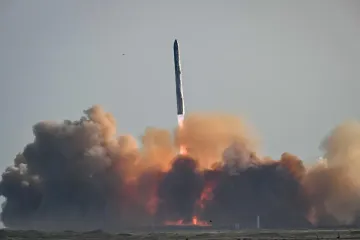
The scale of this endeavor necessitates a complete overhaul of space travel economics, which is why the development of Starship is central to the entire vision. [1] Musk frequently emphasizes that current launch costs and vehicle reusability are inadequate for the necessary scale of migration and resource movement. The ability to transport massive payloads—perhaps a hundred tons or more—reliably and affordably to Mars is the technological linchpin upon which the entire colonization concept rests. [1] Without full, rapid reusability, the sustained flow of materials, hardware, and people required to build a city becomes economically and logistically impossible. [1]
# Martian City

The ultimate goal moves well past a research base toward establishing a true city, one capable of thriving independently. [3] Musk has spoken about the need to reach a population threshold on Mars, often citing a figure around one million people, to ensure genetic diversity and societal stability. [3] Achieving this requires a constant, heavy stream of traffic between the planets.
Life in this initial city, as imagined, will be arduous, particularly in the early decades. Settlers will face considerable hardship, reminiscent of the first pioneers in any difficult frontier environment. [4] The challenges are immense: creating breathable air, developing closed-loop life support systems, generating power, and mastering in-situ resource utilization (ISRU) to process Martian soil and atmosphere for necessary materials. [1]
When considering the requirements to support even a modest initial settlement, one must grasp the sheer magnitude of material transfer. If we assume a fully crewed Starship can carry perhaps 100 people and 100 tons of critical dry cargo per launch window, and a sustainable city requires several thousand tons of initial infrastructure per person to become self-sufficient (accounting for reactors, atmospheric processors, heavy machinery, and habitat modules), the math becomes staggering. Given that launch windows occur only every 26 months, the pressure on Starship’s reliability and frequency is absolute. A single failure during a critical cargo window could set back habitat construction by over two years. [1] This sheer volume of required orbital mass transfer, measured in millions of tons over decades, underscores why Musk insists that previous approaches to space travel are fundamentally incompatible with the Mars vision. [4]
# Settlement Economics
The economic model supporting this massive undertaking has also been a point of discussion. The financial sustainability of the first colony, or at least the initial transport system, involves complex variables. Musk has discussed the possibility of life insurance policies related to the Martian endeavor, suggesting a sober acknowledgment of the inherent dangers. [3] Furthermore, one insight into the planning involves contrasting it with historical Earth-based settlements, such as Jamestown. Unlike Jamestown, which relied heavily on continuous, costly supply lines from England for survival, the Mars settlement must rapidly transition to local resource production to avoid collapsing when Earth’s support inevitably becomes logistically strained or politically interrupted. [4]
This necessity drives the technical focus toward creating a closed-loop economy. The initial years will involve importing energy systems, heavy manufacturing tools, and perhaps specialized biological materials, but the long-term viability hinges on Mars being able to produce its own fuel, construction materials, food, and eventually, its own complex electronics. [1]
# Predicting Timelines
Musk has a reputation for aggressive timelines, often setting ambitious predictions for when the first humans might land and when a self-sustaining city might emerge. [2] These predictions, while frequently missed by traditional aerospace standards, serve to concentrate effort and set a high bar for development. [6] The goal is to have the initial infrastructure built and people living there within a timeframe that minimizes the risk of humanity remaining solely on Earth for too long. [2] The timeline is intrinsically linked to the pace of Starship development and the operational success rate of refueling in Earth orbit—a necessary precursor for any trip to Mars. [1]
The urgency stems from the realization that technological capability alone is insufficient; the socio-political will and the economic window must align. If humanity misses this opportunity window—this alignment of cheap, heavy-lift access and the global appetite for such a venture—the chance to become multi-planetary might not reappear for a very long time. [6]
# Societal Implications
The establishment of a distinct Martian society raises profound questions that extend beyond rocketry and life support. How will a government form? What laws will apply? The vision hints at a society built on principles of necessity and ingenuity, free from some of the legacy political structures of Earth. [3] The settlers, whether volunteers or early arrivals, will be defining a new branch of human civilization.
This leads to a fascinating secondary consideration: the psychology of the first generation versus the second. The original colonists will operate with the singular, overwhelming purpose of survival and establishing the colony, maintaining a deep, functional reliance on Earth's technological input. However, the generation born on Mars—those who have never experienced Earth’s gravity, its open atmosphere, or its history—will likely develop a distinct cultural and political identity. [3] This emerging Martian identity could eventually lead to demands for autonomy or independence from Earth-based oversight. The foundational laws established by Musk’s vision must account for the inevitability of this second generation demanding self-determination, something that historically happens whenever a frontier develops its own capabilities. [3]
# Critical Viewpoints
It is important to balance the ambitious engineering goals with the inherent risks and ethical considerations. Critics often point to the sheer difficulty and the monumental cost, questioning whether those resources might be better spent solving immediate, critical problems on Earth. [8] Furthermore, there is the complex issue of planetary protection—both ensuring we do not contaminate Mars with Earth microbes and managing the environmental impact of large-scale human arrival on the Martian environment itself. [8]
Musk’s counterargument is that a catastrophic failure on Earth renders all current spending on Earth problems moot for the human species; therefore, establishing a Martian foothold is the ultimate problem-solving activity for human longevity. [5] The critics often see the Mars plan as a distraction or an escape fantasy, while proponents see it as the only logical long-term plan for any future, regardless of Earth's fate. [8]
# Scaling to Self-Sufficiency
The path from a small, dependent outpost to a truly self-sufficient city involves mastering Martian industry. This means not just mining water ice for propellant and life support, but building foundries, manufacturing plastics, growing food in pressurized domes, and crucially, building the next generation of Starships on Mars using Martian resources. [1] This last point—local production of the transport system—is the true metric of success. Until a ship built entirely from Martian-derived materials can launch from Mars and safely travel to Earth (or vice-versa), the colony remains fundamentally tethered to, and dependent upon, Earth’s industrial base. [1]
The vision is therefore a sequence of dependencies that must be systematically eliminated:
- Dependency on Earth Launch: Solved by Starship reusability.
- Dependency on Earth Supplies: Solved by ISRU for basic survival (air, water, propellant).
- Dependency on Earth Industry: Solved by local manufacturing of complex machinery and, critically, new spacecraft.
This stepwise approach emphasizes that the initial phase is about survival and construction, while the subsequent phase is about autonomy and growth. [9] The timeline for this shift is likely to span decades, with the initial decade or two focused almost entirely on establishing the fundamental infrastructure that allows true manufacturing to begin. [2] The entire exercise is a testament to an engineering philosophy where the hardest problems—those that seem impossible today—are simply the next steps in the sequence, requiring only the right vehicle and enough dedicated effort. [6]
#Videos
Elon Musk's 66 Trillion Dollar Plan For Mars - YouTube
Related Questions
#Citations
Mission: Mars - SpaceX
Elon Musk makes another Mars prediction: Mars will be ... - The ...
Musk says SpaceX vision for Mars will save humanity as he ...
'You Didn't Want to Be in Jamestown': Elon Musk Warns Mars Won't ...
Elon Musk shares vision of Mars as 'life insurance' for humanity
Updated Mars Vision From Elon Musk, SpaceX Hits Different Now ...
Elon Musk's 66 Trillion Dollar Plan For Mars - YouTube
Mars Attacks: How Elon Musk's plans to colonize Mars threaten Earth
Elon Musk's boldest vision yet — turning Mars into humanity's ...