What caused Elon Musk's rocket to explode?
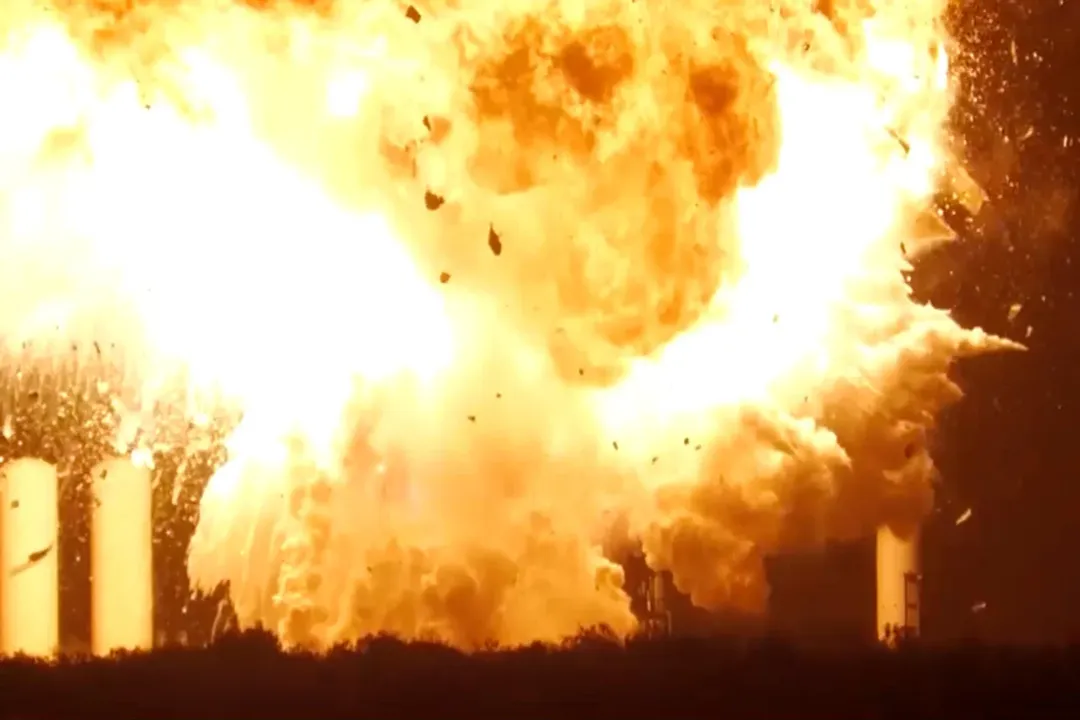
The spectacular failure of a SpaceX Starship upper stage during a ground test on the Texas Gulf coast in June 2025 immediately sparked intense technical scrutiny, focused not on a flight anomaly, but on a critical pre-test countdown event. This incident, which occurred late on Wednesday, June 18, involved a major anomaly roughly 10 to 15 minutes before engineers anticipated a planned test firing of the vehicle's six Raptor engines. The resulting detonation painted a dramatic scene, characterized by a huge fireball and arcs of flaming debris resembling lava shooting out from the vehicle.
# Anomaly Details
The Starship upper stage was fully loaded with liquid oxygen and contained a partial quantity of the high-energy methane fuel when the incident struck. Video evidence captured by ground monitors showed what appeared to be a sequence of two major explosions: an initial detonation near the nose, immediately followed by a second eruption of flame and debris concentrated on the left side of the spacecraft. The whole setup was enveloped in an orange fireball that rose into the night sky. While the test was scheduled just prior to what would have been the tenth integrated flight test of the massive rocket, the company confirmed that safety parameters were maintained, and all personnel were accounted for and safe. This test was a routine step, intended to verify performance and upgrades before committing the vehicle to a full-stack flight atop the Super Heavy booster.
# Initial Cause Pinpointed
SpaceX founder Elon Musk quickly provided an initial assessment via his social media platform, X, based on preliminary telemetry data. The primary hypothesis centered on a failure within the vehicle’s support systems rather than the main propulsion train. Musk suggested that a nitrogen COPV (Composite Overwrapped Pressure Vessel) located within the payload bay had failed below its specified proof pressure. Such a failure, if confirmed by the ongoing investigation, would mark the first time this specific design had experienced an issue, suggesting a novel single-point failure for that component.
This focus on a high-pressure gas tank presents an interesting divergence from typical rocket ascent failures. For instance, a dramatic 2016 Falcon 9 explosion during fueling was attributed to the rupture of a helium COPV. However, SpaceX explicitly stated that there is "no commonality" between the pressure vessels used on the Falcon series and those integrated into the Starship design. The nitrogen system, in this context, would have been related to pressurization or other non-propellant functions during the ground hold, rather than the primary cryogenic propellant feed itself, though its failure clearly led to catastrophic results fueled by the vehicle’s stored propellants.
# Leak and Termination System
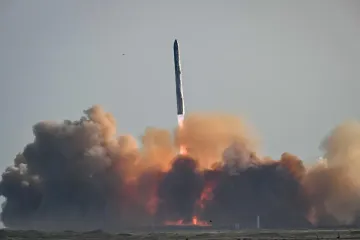
While the nitrogen COPV was posited as the initiating event, community analysis of the available video footage suggested another contributing factor that might link the initial failure to the ultimate destruction of the vehicle. Observers noted what looked like small flames issuing from the hinge area on the bottom right of the ship in the final moments before the primary blast. This visual cue raised the possibility of a propellant leak preceding the main event.
A significant analytical thread suggested a chain reaction: the leak caused a fire, which in turn disabled the Raptor engines, causing the vehicle to lose control and deviate from its planned ascent corridor. In orbital-class rocket testing, deviation from the predicted trajectory often triggers the Automated Flight Termination System (FTS). If the FTS activation was the mechanism of destruction, the nitrogen tank failure might have caused the initial loss of engine control, putting the rocket into a state where the safety system executed its final command. This scenario shifts the direct cause from the tank rupture itself to the FTS intervention, though both trace back to the initial anomaly.
The fact that the vehicle was loaded with propellants, which then ignited upon failure, meant that any initiating event—whether the COPV rupture or a separate leak—would rapidly escalate to an explosion. The difference between the initial cause being the COPV failing and the FTS being the trigger is not merely semantic; it dictates where the engineering effort will focus for redesign and verification.
# Historical Context and Design Philosophy
Understanding this specific failure requires stepping back to appreciate SpaceX's developmental approach to Starship. Since its initial integrated flight tests began in April 2023, the program has seen numerous flight outcomes, with early flights ending in the destruction of both stages. Success is measured in iterative learning; even failures provide data necessary for hardening the next iteration.
It is important to contextualize this event against the backdrop of developmental testing. Unlike traditional aerospace programs where failures on customer-carrying missions are catastrophic for schedules and reputations, Starship operates on a rapid prototyping model where prototype destruction is an expected, if regrettable, cost of rapidly moving toward a flight-ready system. This method demands transparency, even when reporting initial, potentially incomplete findings, which Elon Musk provided almost immediately via social media.
One can observe a pattern in the public reaction: when failure occurs, there is a natural tendency to scrutinize the messenger as much as the message, especially given the CEO's public persona. However, in this case, Musk was relaying what appeared to be immediate telemetry findings from a dedicated engineering team, not a personal guess. The difference between this test anomaly and a failure on a crewed Artemis mission is vast, yet the underlying engineering process remains the same: push the hardware until it reveals its weaknesses, then correct those weaknesses before human hardware flies. For instance, the required ability to conduct multiple in-orbit refueling operations for the Artemis missions—transferring thousands of gallons of super-cold propellants autonomously—adds an enormous layer of complexity that makes ground testing of every system segment, even failure modes like this one, absolutely mandatory.
If we consider the design pedigree, the difference between the nitrogen COPV and a propellant system failure is crucial. A COPV is a standard piece of high-pressure hardware, and if this specific design failed below proof pressure, it points toward a materials flaw, a manufacturing inconsistency, or a ground support interaction (like unexpected thermal or pressure loading during countdown). Had the failure originated in the methalox propellant feed system, it would suggest deeper, perhaps more systemic issues with the unique plumbing or injector design of the Raptor engines themselves. The former is a component replacement or procedural fix; the latter potentially requires extensive redesign of the engine interface.

# Iterative Path Forward
The immediate focus following the June 18 anomaly shifted to the investigation team working to secure the site and analyze the data. For the program, the primary takeaway involves hardening the upper stage against non-propellant-related over-pressurization events during the critical tanking and hold phases. This failure illuminates a requirement for increased safety margins in ancillary systems, even when the core propulsion (the Raptor engines) hasn't even fired yet.
When considering the next steps for Flight 10, NASA, which relies heavily on Starship for its Human Landing System (HLS) for the Artemis program, expressed continued confidence in SpaceX's process. NASA acknowledged that testing is indispensable and supports the company's commitment to investigating and fixing the issue. The Artemis lander variant will differ from the developmental version tested, but mastering the reliability of the base vehicle is the foundational prerequisite.
An interesting point of comparison emerges when viewing this event through the lens of hardware maturity. For many years, Starship prototypes experienced failures primarily during terminal events: the boost-back burn, atmospheric reentry, or landing attempts. This June incident, however, points to a failure happening before the main event sequence, during propellant loading and pre-test checks. This suggests that the design is evolving to a point where ground operations and staging procedures are becoming the next major hurdle to master, separate from the stresses of flight dynamics. Successfully mitigating this type of early anomaly is essential, not just for the immediate Flight 10 goal, but for the sheer volume of launches needed to refuel the lunar lander in orbit—estimates suggest a high teens number of propellant deliveries. Every single launch needs maximum reliability, which means the ground phase must be as predictable as the in-space maneuvers.
The very nature of this test, involving venting and loading cryogenics before ignition, means engineers must account for thermal stress and pressure fluctuations that are difficult to replicate perfectly on the ground. While simulations are invaluable, they cannot fully capture the real-world interaction of extreme cold on metal structures combined with high-pressure nitrogen lines. The experience gained here—identifying that a seemingly benign ground system component like a nitrogen COPV can lead to a full vehicle breakup—is precisely why these tests are conducted, even if the resulting fireball is jarring. The next iteration will likely incorporate enhanced inspection criteria or structural redesigns specifically around that payload bay pressure vessel mounting area, ensuring that such a localized component failure cannot cascade into a total loss of vehicle integrity. This iterative cycle, though expensive in hardware, is the mechanism by which they aim to achieve the safety required for crewed lunar missions.
Related Questions
#Citations
SpaceX Starship explosion likely caused by propellant leak, Elon ...
SpaceX Starship upper stage explodes during countdown to engine ...