What is an example of the ecliptic?

The most straightforward example of the ecliptic isn't a single object, but rather the specific, predictable track that the Sun appears to follow across our sky over the course of one year. [1][3][7] Imagine standing outside and marking the exact position of the Sun at noon every day. If you connected all those daily noon points on a grand celestial sphere surrounding Earth, the resulting line would trace the ecliptic. [1][7] It is fundamentally the projection of Earth's orbital plane onto the celestial sphere. [1][4][7]
# Apparent Path
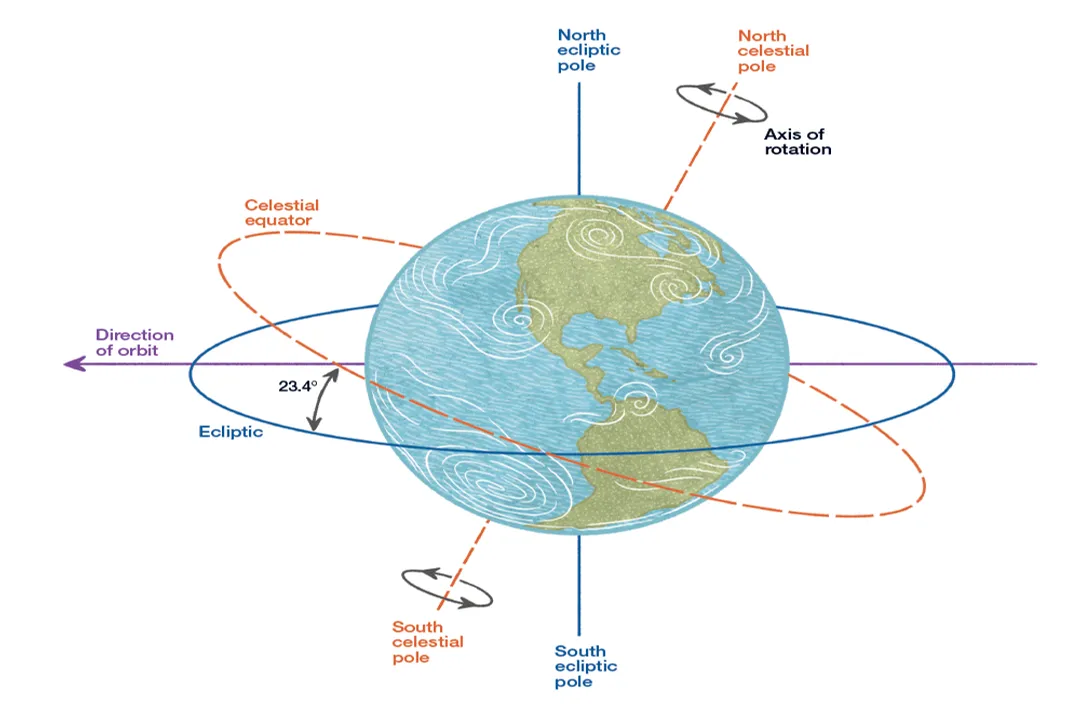
The Sun doesn't actually drift across the background stars; the appearance of movement is due entirely to Earth revolving around the Sun. [9] Because Earth is orbiting, from our perspective, the Sun seems to drift eastward relative to the fixed stars, completing one full circuit annually. [1][9] This annual journey is precisely what we call the ecliptic line in the sky. [3] This great circle on the celestial sphere is essential for understanding basic celestial mechanics. [1][8]
The physical reality behind this path is the ecliptic plane, which is the plane containing Earth’s orbit around the Sun. [1][3][7] Everything orbiting the Sun—planets, asteroids, and comets—tends to orbit roughly within this same plane, which is why the ecliptic serves as a crucial reference line in our solar system model. [1][3]
# Zodiac Alignment
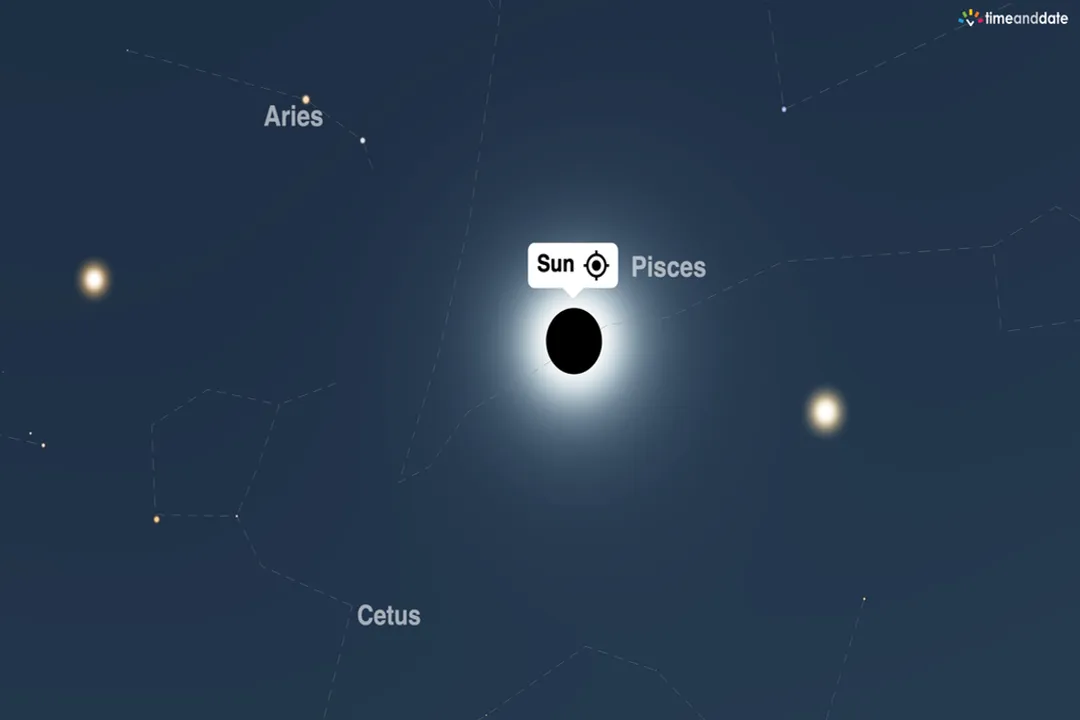
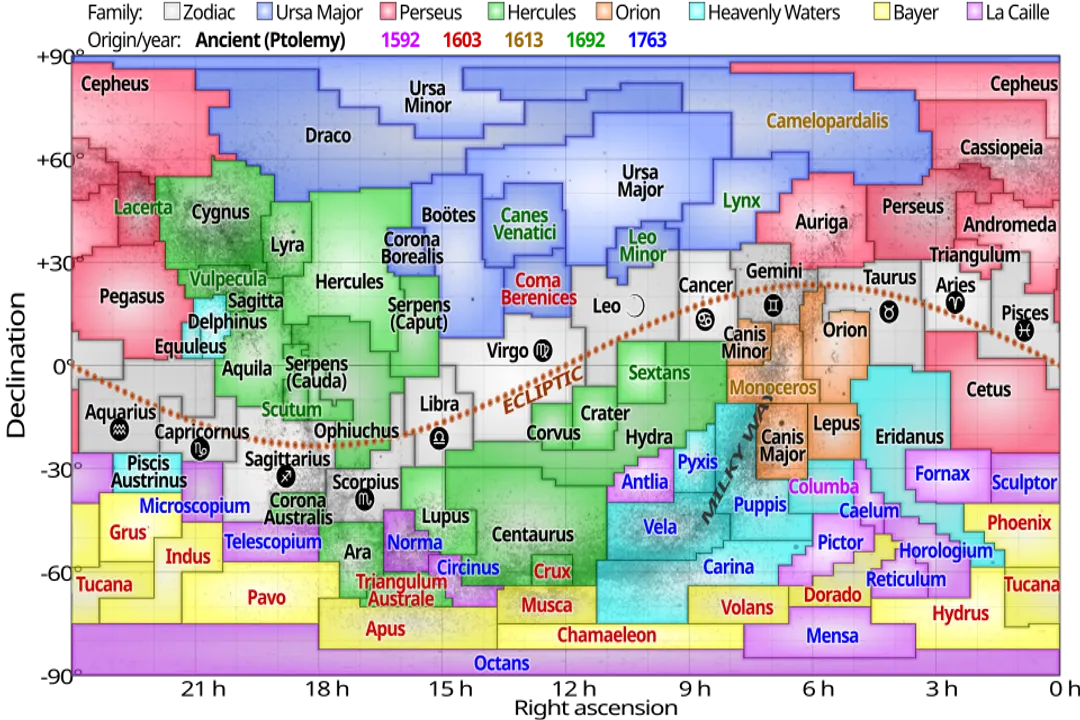
One of the most enduring examples tied to the ecliptic is the collection of constellations known as the Zodiac. [1][3][6] Since the ecliptic is the path the Sun traces, the constellations whose stars the Sun appears to pass through during the year form the Zodiacal band. [6] Historically, these constellations were significant because they provided a celestial calendar against which to track the Sun's position and mark the changing seasons. [3][6]
If you were to look up at the sky on the day of the Vernal Equinox (around March 20th), the Sun would be crossing the boundary from Pisces into Aries, right on the ecliptic line. [6] Twelve major constellations officially lie along or very close to this path, though the true path the Sun follows doesn't perfectly align with the boundaries set by modern astronomy, which can sometimes cause confusion when tracking an object's exact "Zodiac sign". [1][6]
# Planetary Example
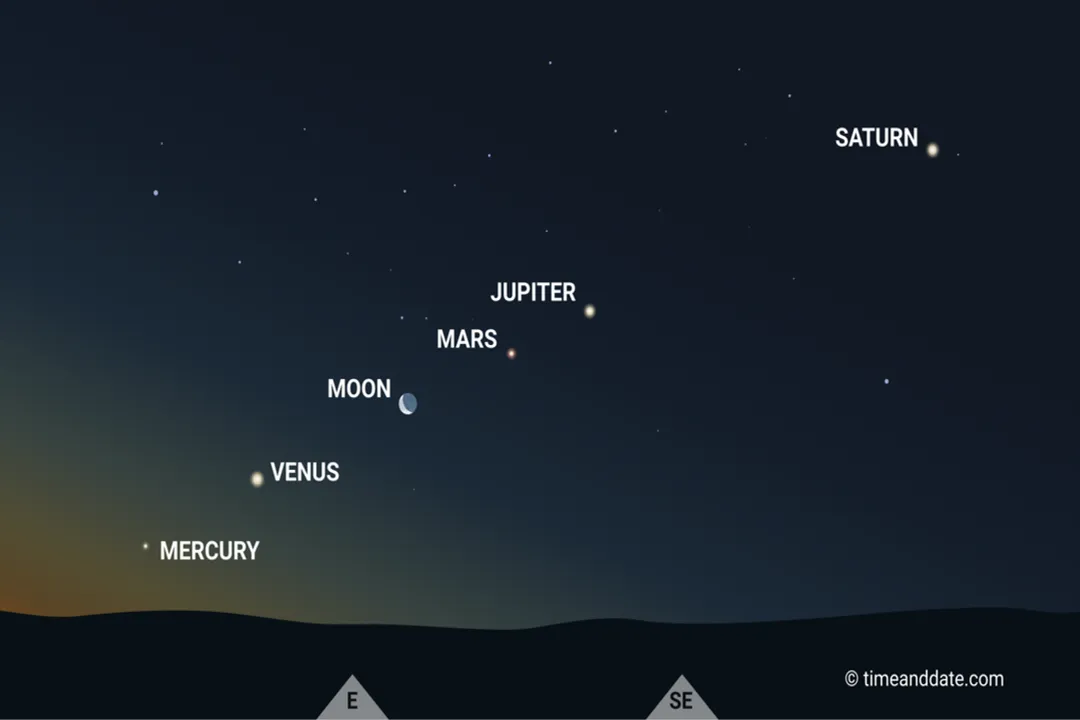
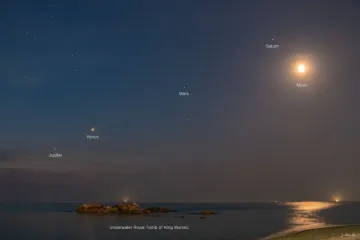
The solar system's architecture provides another excellent example. While Earth’s path defines the primary ecliptic plane, every planet orbits the Sun within a plane that is very close to this fundamental plane. [1][3] Therefore, if you track Mars, Jupiter, or Saturn over several months, you will notice that they, too, move across the sky along a path very near to the Sun's apparent track. [1][3]
For instance, a planet might be found only a degree or two north or south of the ecliptic at any given time. [1] This closeness is a direct consequence of the solar system forming from a rotating disk of material, where most bodies settled into similar orbital inclinations. [4] When a celestial body deviates significantly, it becomes immediately noticeable. If an amateur sky-watcher plots the positions of, say, Uranus and Neptune over a few weeks, they will invariably find their paths tracing arcs nearly parallel to the Sun’s annual ecliptic track, illustrating that the ecliptic is not just an Earth-centric concept but a solar system-wide organizing principle. [3]
# Celestial Tilt
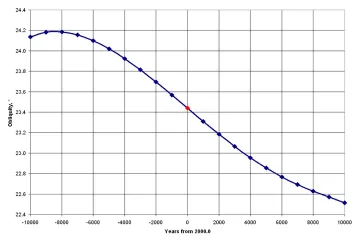
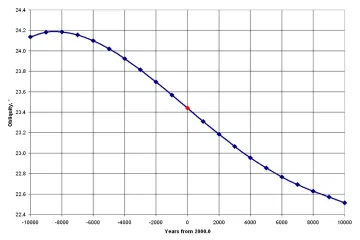
A key aspect of the ecliptic is its relationship to Earth’s rotational axis and the resulting seasons. [1][3] The ecliptic plane is tilted relative to the celestial equator—the projection of Earth's equator onto the sky—by approximately . [1][3][7] This angle is known as the obliquity of the ecliptic. [1]
This tilt is the direct cause of the seasons. [3][7] When the Northern Hemisphere is tilted toward the Sun, it experiences summer. At this time, the Sun reaches its northernmost point relative to the celestial equator on the ecliptic, marking the Summer Solstice. [1] Six months later, during the Winter Solstice, the Sun is at its southernmost point on the ecliptic, resulting in the shortest day. [1]
Here is a way to visualize the impact of this tilt: if you live at a latitude like North (roughly the latitude of Philadelphia or Beijing), the Sun at the spring equinox passes directly overhead at the equator, meaning its noon altitude is above your southern horizon. At the summer solstice, however, the Sun is higher in the sky than it was at the equinox because of the ecliptic's tilt relative to the equator. This means the noon altitude jumps to . [1] That nearly 23-degree difference in the Sun's highest point in the sky throughout the year is a direct, observable example of the ecliptic's angle to our local horizon system. Conversely, during the winter solstice, the noon altitude drops by that same amount to . [3] This range of altitudes defines our temperate climate zones.
# Eclipses Defined
The term "ecliptic" is intimately linked to eclipses, which are powerful, visible examples of celestial alignments relative to this plane. [2][3] An eclipse happens when one celestial body moves into the shadow of another, or blocks the view of another. [2]
For a solar or lunar eclipse to occur, the Moon must be positioned near the plane of the ecliptic, specifically crossing it. [3] The Moon’s orbit is itself inclined by about relative to the ecliptic plane. [1] Because of this slight tilt, the Moon usually passes slightly above or below the Sun from our perspective on Earth. [3]
For an eclipse to happen, the alignment must be perfect enough for the Earth, Sun, and Moon to line up along the plane of the ecliptic, or very close to it. [2]
- Solar Eclipse: Occurs when the Moon passes directly between the Sun and Earth, blocking the Sun’s light. [2] This requires the Moon to be near a node—the point where the Moon's orbit intersects the ecliptic plane—during the New Moon phase. [3]
- Lunar Eclipse: Occurs when the Earth passes directly between the Sun and Moon, casting Earth’s shadow onto the Moon. [2] This requires the Moon to be near a node during the Full Moon phase. [3]
The fact that eclipses are relatively rare events, happening only a few times a year when conditions are right, serves as a direct illustration of the separation between the Moon's orbital plane and the Earth's orbital plane (the ecliptic plane). [3] If the Moon orbited in the exact same plane as the Earth orbits the Sun, we would have a solar and lunar eclipse every single month. [1]
# Reference Frame Utility
The ecliptic provides a stable, predictable coordinate system for astronomical measurement that is far more useful than one based on the observer's immediate horizon. [8] Since the ecliptic is fixed relative to the Sun’s apparent motion, it acts as a fundamental reference plane for the entire Solar System. [1][8]
Astronomers define the ecliptic coordinate system based on this path, using the ecliptic plane as the fundamental reference plane, similar to how the celestial equator is used for the equatorial system. [8] In this system, an object's position is defined by its celestial longitude (distance along the ecliptic from a reference point, the vernal equinox) and its celestial latitude (how far north or south of the ecliptic it is). [8]
This stability is invaluable for predictive work. Consider deep-sky object tracking: when using an older telescope mount that tracks the sky based on the North Star (using the equatorial system), the mechanics are quite straightforward. However, for missions or calculations relating to objects moving across the solar system, defining positions relative to the ecliptic plane simplifies calculations of gravitational interactions and trajectories immensely, because nearly all the large masses involved are already moving within that plane. [4] For an engineer designing a probe to reach Mars, using the ecliptic plane as latitude makes the initial trajectory estimates much cleaner than trying to calculate everything relative to an observer's local noon line. [4]
# Observational Difference
While the ecliptic is a line on the celestial sphere, its appearance changes throughout the year relative to the local horizon, which is an observable "example" of its motion interacting with our geography. [7] This is why the position of the Sun at sunset changes daily.
For someone living in the Northern Hemisphere, the Sun appears highest in the sky during the summer when it traces a high arc across the southern sky following the ecliptic. In the winter, the same ecliptic path appears much lower in the sky, never rising very high above the southern horizon. [7] This apparent arc height difference, dictated by the tilt of the ecliptic relative to the equator, governs how long the Sun is visible above the horizon for any given latitude. [1][7]
If you were to watch the path of the Sun across the sky in the Northern Hemisphere, you'd notice it rises in the northeast and sets in the northwest during the summer months, tracing a high, long arc. In contrast, during winter, it rises in the southeast and sets in the southwest, tracing a low, short arc. [7] Both the high summer arc and the low winter arc are simply different segments of the same underlying great circle—the ecliptic—as seen from a fixed point on Earth. [1] The example here is that the apparent shape of the ecliptic's daily path relative to your local horizon changes seasonally, even though the ecliptic itself is a fixed great circle on the celestial sphere. [1][7]
# Summary of Examples
To distill the concept, the ecliptic is best illustrated through its manifestations:
- The Sun's Annual Path: The primary observational example, tracing the background stars over 365.25 days. [9]
- The Zodiac Band: The familiar strip of constellations lying near this path. [6]
- Planetary Proximity: The near-alignment of all major planets in the sky with this path. [3]
- The Solstice Separation: The seasonal difference in the Sun’s maximum noon altitude, driven by the tilt of the ecliptic relative to the celestial equator. [1]
- Eclipse Geometry: The requirement that the Moon cross this plane (at its nodes) for solar or lunar eclipses to occur. [2][3]
The ecliptic is not a physical object one can point a telescope at in isolation; it is the geometric shadow cast by the architecture of our solar system onto the dome of the heavens. [4][7] Understanding this line is the first step in charting any movement within our local cosmic neighborhood, whether tracking a distant asteroid or simply predicting when the longest day of the year will arrive. [1][9]
#Videos
The Ecliptic: Crash Course Kids #37.2 - YouTube
Related Questions
#Citations
Ecliptic - Wikipedia
The Ecliptic: Crash Course Kids #37.2 - YouTube
Ecliptic | Definition, Facts, Obliquity, & Zodiac - Britannica
Orbits and the Ecliptic Plane - HyperPhysics Concepts
Ecliptic Facts For Kids | AstroSafe Search - DIY.ORG
What Is the Ecliptic? - Time and Date
What Is the Ecliptic? - Sky & Telescope
Glossary term: Ecliptic - IAU Office of Astronomy for Education
The Ecliptic: the Sun's Annual Path on the Celestial Sphere