red shift articles - Page: 2
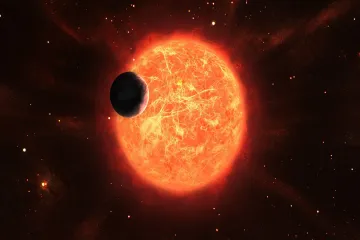
What is the descriptive observation that defines a galaxy as a "red galaxy" in astronomy?
When stellar aging causes a galaxy to appear red, what kind of stellar population dominates the system?
What is the primary physical cause for the extreme redness observed in very distant galaxies?
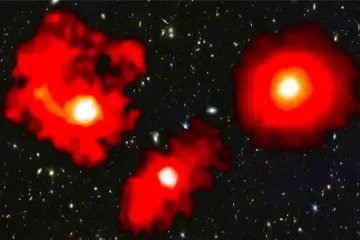
What is the defining characteristic of galaxies referred to as "red and dead"?
What physical mechanism explains why massive red and dead galaxies in the Virgo Cluster appear unable to form new stars?
In the context of extremely red galaxies not explained solely by redshift, what component is strongly implicated in causing the redness?
How do instruments like the James Webb Space Telescope (JWST) aid in studying "red monsters" whose redness is caused by obscuration?
What does the observed color of a nearby red galaxy typically reveal, compared to a very distant one?
What do "red nugget galaxies" found at high redshifts suggest about early cosmic structure formation?
When calculating a galaxy's color index to determine its intrinsic temperature, what must always be corrected for?
What two fundamental forces maintain equilibrium during a star's main sequence phase?
What event signals the definitive end of a star's main sequence reign?
When core hydrogen fusion ceases, which force immediately takes control?
What process ignites in the layers surrounding the contracting inert helium core?
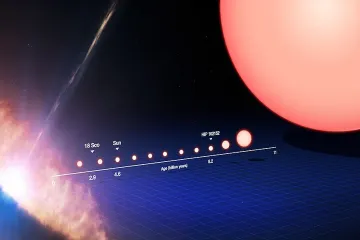
What physical change causes a star transitioning into a red giant to appear distinctly red?
Compared to its main sequence phase, how does the luminosity of a red giant generally compare?
Approximately how long does a star similar to the Sun spend on the main sequence?
What is the approximate upper mass limit distinguishing low-mass stars from high-mass stars post-MS?
What is the rapid ignition event called when a solar-mass star begins fusing helium in its core?
When plotted on an H-R diagram, how does a star move when transitioning from the main sequence to a red giant?
What fundamental observation about light from distant galaxies is a core piece of evidence in modern cosmology?
What is the relationship between light wavelength and perceived color?
What phenomenon is caused if an object emitting light is moving toward an observer?
What are the two fundamentally different ways light can become redshifted when observed from Earth?
What term describes the actual movement of a galaxy relative to its neighbors, often caused by local gravitational interactions?
What causes cosmological redshift, the primary factor for the most distant objects?
According to Hubble’s Law, what is the systematic relationship between the distance of distant galaxies and their observed redshift?
Why does light from a farther galaxy experience a greater accumulation of redshift than light from a nearer one?
What mechanism dominates the observed light shift for nearby galaxies like those in the Local Group?
What astronomical instrument spreads incoming light into a detailed spectrum to precisely measure the displacement of spectral lines?
If galaxies were moving within static space like shrapnel from an explosion centered on us, what key observational fact would be missing?
PreviousPage 2 of 2