What is the origin of planetesimals?
The earliest solid objects in the solar system, the building blocks that aggregated into the Sun’s planets, are known as planetesimals. These were not the microscopic specks of dust orbiting the young Sun, nor were they the fully formed planets we see today; rather, they occupied a critical middle ground. A planetesimal is generally defined as a body ranging in size from about a kilometer up to several hundred kilometers across. [1][2] Their origin story is essentially the origin story of our entire planetary system, involving a long, complex process of accumulation and gravitational restructuring within the primordial solar nebula. [5]
# Building Blocks Defined
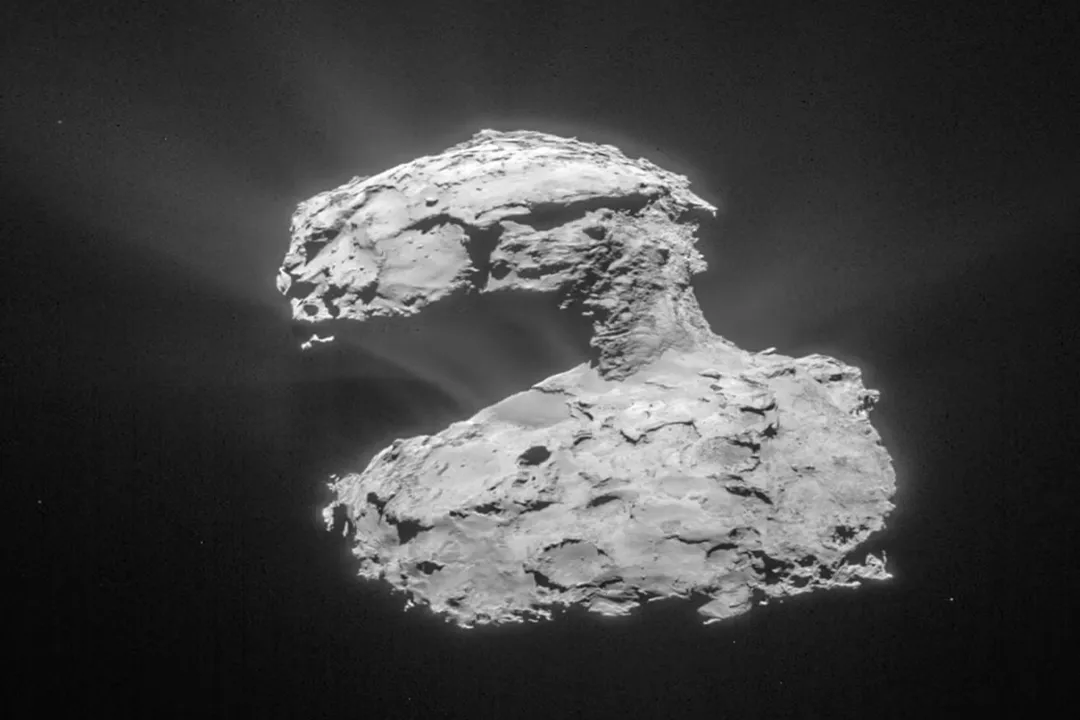
Understanding planetesimals requires appreciating their role as the necessary intermediate step between fine dust and terrestrial worlds. Once solid bodies reached a certain mass, their growth transitioned from gentle, surface-level sticking mechanisms to the powerful dominance of gravity. Before they became large enough to be called planetesimals, the solid components of the disk were significantly smaller, often referred to as pebbles or macroscopic particles. [5] The term itself, planetesimal, means "very small planet," highlighting their status as the fundamental, accretion-ready units of planetary construction. [2] The surviving remnants of this population are what we observe today as asteroids and comets, providing tangible evidence of this formative era. [1][2]
# Nebula Birthplace
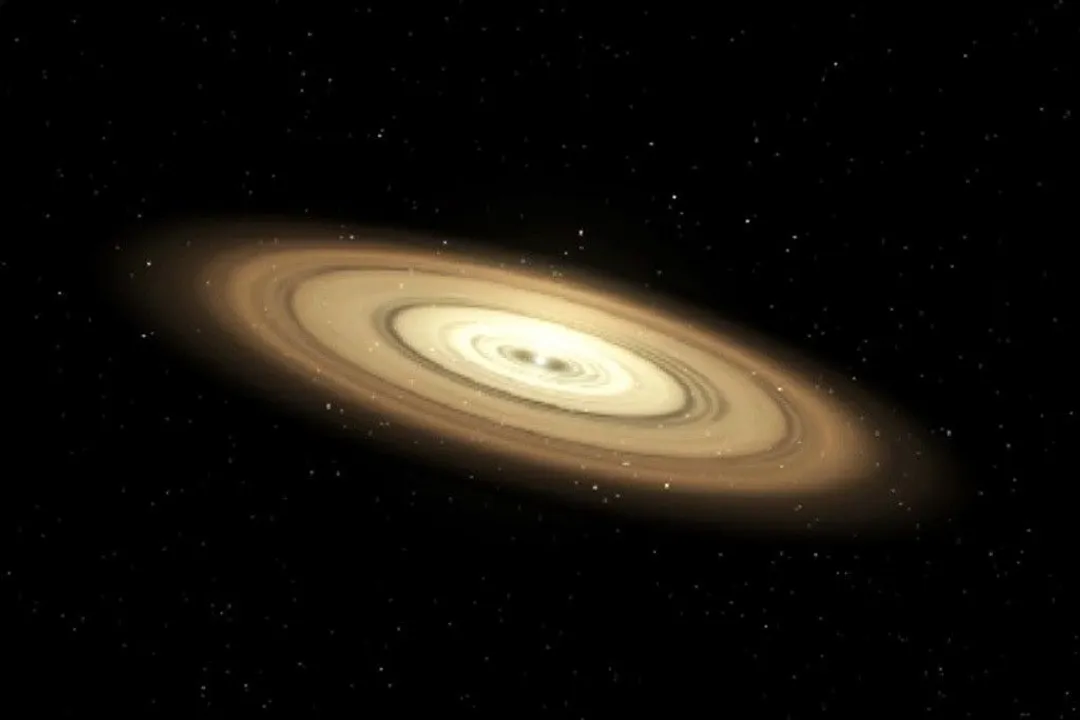
The stage for this grand construction project was the protoplanetary disk, a vast, rotating pancake of gas and dust surrounding the newly forming Sun approximately 4.6 billion years ago. [2][5] This disk was rich in the raw materials—silicates, metals, and ices—that would ultimately form all solar system bodies. [5] For planetesimals to form, the diffuse solid material needed to condense and aggregate. The initial condensation of solid material occurred as the solar nebula cooled. [5]
The location within this disk was crucial. Close to the proto-Sun, temperatures were high, meaning that only refractory materials like iron and rock could remain solid. [2][5] Further out, past the distance where water could condense into ice—a boundary often termed the snow line—there was far more solid material available because ice was plentiful. [2][5] The availability of ice in the outer regions meant that solid material could vastly outweigh the gaseous component much sooner than in the inner system. [2]
# Dust Clumping First
The very first step in building these kilometer-sized masses involved particles growing from micron-sized dust grains to centimeter-sized objects. This initial growth was governed by soft, non-gravitational forces. [3][5] As these tiny particles drifted in the gas, they collided and stuck together, much like static cling on a larger scale. [3][5] This process, known as coagulation, is relatively gentle and efficient for creating small aggregates.
However, this gentle process hits a significant wall when objects reach about one meter in size. Once objects reached this approximate diameter, they entered a highly dangerous phase known as the meter barrier problem. [5] The gas in the protoplanetary disk, which was still quite dense, exerted a strong aerodynamic drag force on these meter-sized objects. [5][6] This drag was so powerful that it caused the objects to rapidly lose orbital velocity and spiral inward toward the Sun at timescales as short as a few hundred years. [5] If planetesimal formation relied solely on this slow sticking mechanism, almost all the inner disk material would have been lost to the Sun before it could aggregate into kilometer-scale planetesimals.
# Instability Growth
To bypass this rapid depletion, scientists propose mechanisms that allow pebble-sized objects to jump quickly over the meter barrier, often by clumping gravitationally rather than relying on slow sticking collisions. [5][6] One key idea involves turbulence within the disk. Turbulence creates eddies and vortices that can trap particles. [5] If enough solid material concentrates within one of these pressure maxima, the relative speed between the solids and the gas changes, potentially allowing the solids to decouple from the gas flow and begin clumping together gravitationally. [5]
A more dramatic pathway is the streaming instability. This occurs when the fraction of solid material within the gas disk becomes sufficiently high—perhaps around 1% or more. [5][6] At this density, the collective gravity of the solid particles begins to overcome the gas drag, causing the swarm of pebbles to collapse rapidly under its own gravity. [5] This gravitational collapse forms clumps that can reach planetesimal sizes—kilometers across—in mere orbital periods, effectively bypassing the slow, meter-sized drag phase entirely. [6] This instability is so powerful that it represents a massive acceleration in the building process, transforming the disk from a collection of widely dispersed pebbles into numerous planetesimal embryos quite suddenly. [5]
The transition from slow, surface-force-driven growth (dust to pebbles) to rapid, gravity-driven growth (pebbles to planetesimals) highlights a fundamental timescale challenge in planetary science. The electrostatic sticking phase might take millions of years to build millimeter-sized dust to meter-sized pebbles, but once the streaming instability threshold is reached, the formation of kilometer-scale planetesimals can happen hundreds of times faster. The presence of robust, planet-forming systems like our own strongly implies that one of these fast mechanisms, like streaming instability or turbulence-enhanced concentration, must have been effective in the early nebula. [7]
# Gravity Takes Over
Once a body surpassed the meter scale and grew into a few kilometers in diameter, the dynamics shifted dramatically. At this size, the object's inertia and gravitational pull began to outweigh the aerodynamic influence of the surrounding gas disk. [5] Aerodynamic drag, which was so destructive to meter-sized objects, now became a helpful force, slowing down the planetesimal slightly relative to its neighbors and increasing the likelihood of collisions rather than high-speed grazes. [1]
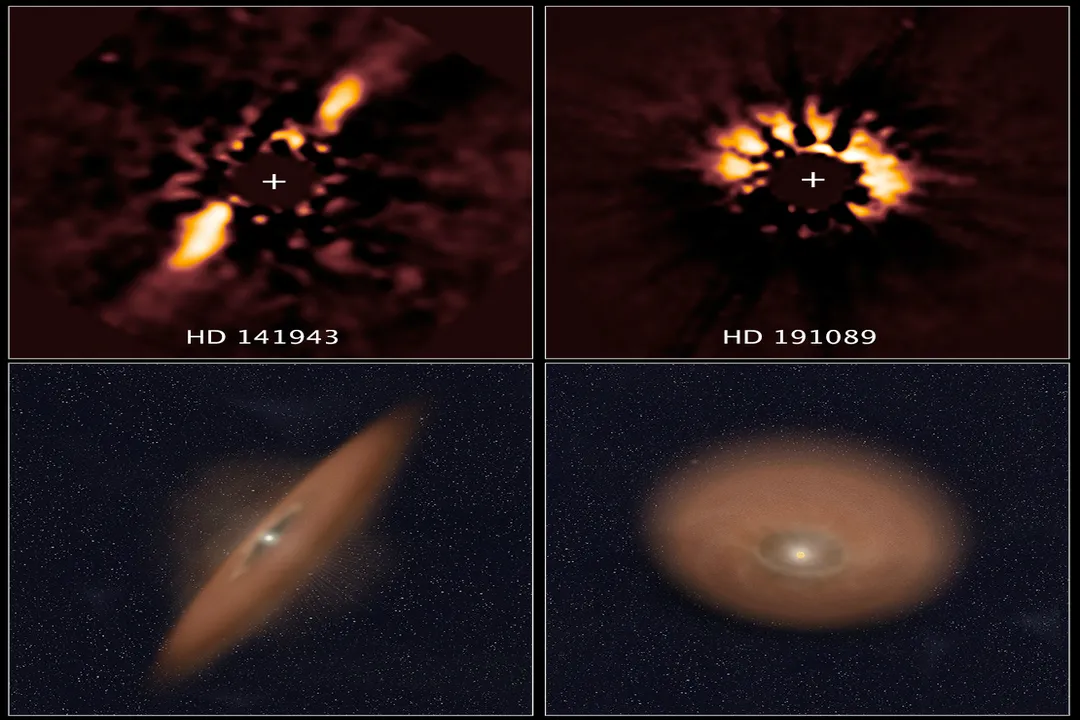
From this point onward, growth was dominated by gravitational focusing. Larger planetesimals exerted greater gravitational influence, drawing in smaller neighbors like asteroids and comets. [1][2] This run-away process meant that the largest planetesimals grew the fastest, sweeping up vast amounts of mass over millions of years to become the cores of the giant planets or the foundational material for terrestrial worlds. [1] Observations of protoplanetary disks around other stars, for instance, show gaps and rings which are thought to be carved out by these larger, gravitationally dominant objects as they clear paths through the dust and gas. [8][9]
# Compositional Zones
The chemical makeup of the planetesimals was determined entirely by where they formed relative to the snow line in the protoplanetary disk. [2][5] This distinction is crucial because it set the stage for the two main classes of planets we see in our solar system.
Inner disk planetesimals, forming inside the snow line, accreted material made only of silicates (rock) and metals. [2] These eventually collided and merged to form Mercury, Venus, Earth, and Mars. [5] They were fundamentally limited in mass because the solid material budget was relatively small—just the rock and metal fraction of the nebula.
Outer disk planetesimals, forming beyond the snow line, had access to water ice, methane ice, and ammonia ice, in addition to rock and metal. [2][5] This meant they contained significantly more solid material available for growth. These icy/rocky conglomerates grew much larger, potentially reaching masses ten times that of Earth. Once they reached this critical mass, their gravity was strong enough to pull in the vast quantities of hydrogen and helium gas still present in the nebula, leading to the formation of the gas giants like Jupiter and Saturn. [2][5] The smaller icy planetesimals beyond Neptune became the icy giants, Uranus and Neptune, or the distant Kuiper Belt objects. [2]
The material science of this early accretion process is fascinating; studies suggest that the stickiness of particles can change based on temperature and ice composition, affecting how easily they form initial bonds. [3] For example, silicate dust in the inner system sticks well when dry, but the introduction of even small amounts of water vapor can drastically change the surface properties and thus the collision outcome, sometimes aiding sticking and sometimes causing shatter fractures. [3]
# Evidence and Modeling
Because the primary period of planetesimal formation occurred billions of years ago, direct observation is impossible. Scientists rely heavily on sophisticated computer simulations and modern astronomical observation to reconstruct this history. [7] Simulations allow researchers to test the different formation scenarios, such as streaming instability versus slow accretion, by varying initial gas density, turbulence levels, and particle sizes. [5][6]
Current observational evidence, such as the discovery of complex substructures like dust rings and spiral arms in distant protoplanetary disks, provides circumstantial proof that processes leading to rapid mass accumulation are indeed active in other star systems today. [8][9] These observations confirm that the raw materials are still organizing themselves into larger structures, validating the general accretion model even if the exact physics of the meter barrier crossing remains an area of intense research. [7] The fact that we see fully formed, massive planets orbiting other stars further confirms that the planetesimal pathway, however challenging, must have succeeded across the galaxy. [7]

Related Questions
#Citations
Planetesimal - Wikipedia
Planetesimal | Astronomy, Solar System & Planet Formation
Planetesimals - Universe Today
Planetesimal Hypothesis - Science | HowStuffWorks
Planetesimal Formation - The Stephen W. Hawking Center for ...
How Do Planets Form? - NASA Science
The origin of the planetesimal theory | Discover Life - Springer Link
From Planetesimals to Planets (Formation of Terrestrial Planets)
Recurrent planetesimal formation in an outer part of the early solar ...