How does astrometry detect exoplanets?
The detection of worlds orbiting stars far beyond our Sun relies on several ingenious techniques, and among the most fundamental is astrometry. This method probes the subtle dance between a star and its unseen companions, not by observing the light blocked by a planet or the star's color shift, but by charting the star's precise path across the sky. [4][5] At its heart, astrometry is the astronomical practice of measuring the positions and motions of stars. [1] When a planet orbits a star, the planet’s gravity tugs on the star, causing the star to wobble slightly around the system's common center of mass. [1][5] Astrometry is the technique used to spot this minute, positional shift—the star’s apparent movement against the backdrop of much more distant, fixed stars. [1]
# Measuring Position
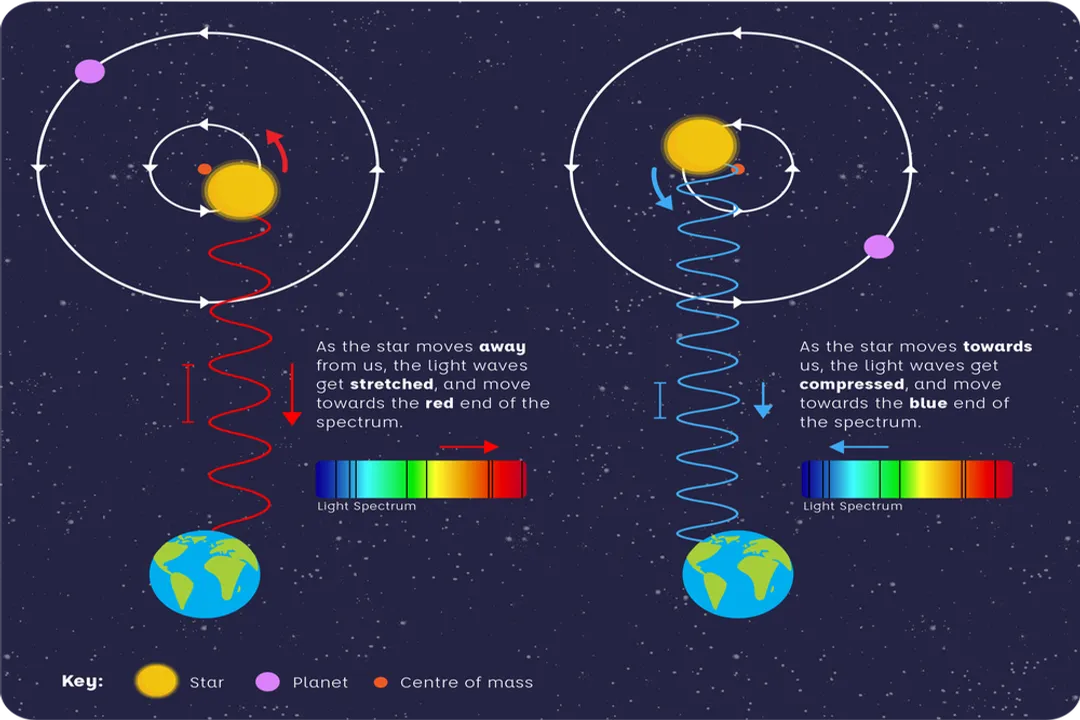
To understand how this works, consider the mechanics of measurement. An exoplanet system is gravitationally bound, meaning both the star and the planet orbit a barycenter, or center of mass. [1] Because the star is vastly more massive than any known planet, this barycenter is usually located very close to, or even inside, the star itself. [1] However, the star does not remain perfectly still; it follows a small, elliptical path dictated by the orbiting planet. [1] Astrometry seeks to measure this displacement in the star’s sidereal position over time. [6] This positional measurement is recorded in angular terms, specifically using units of arcseconds, milliarcseconds, or even microarcseconds. [1][7]
This level of precision is staggering. A whole circle contains $360$ degrees; one degree contains $60$ arcminutes; and one arcminute contains $60$ arcseconds. To put a microarcsecond into perspective: if you held a US dime on the surface of the Moon, its apparent size from Earth would be about one arcsecond. [1] To detect an Earth-mass planet orbiting a Sun-like star at the distance of Jupiter, the star's apparent swing across the sky would be around $9$ microarcseconds. [1][7] Detecting such a tiny movement requires instruments capable of measuring differences in angle that are tens of thousands of times smaller than what the naked eye can perceive. [1] It is akin to watching a single grain of sand shift its position from a distance of several miles. [1]
# Technology Advancements
Historically, astrometry was incredibly challenging due to instrumental limitations and the inherent noise from Earth’s atmosphere, which blurs stellar images. [4] Early attempts, such as those by Louis Bessel in the 1840s who looked for an unseen companion to Sirius, struggled to achieve the necessary precision or were complicated by stellar activity mistaken for planetary signals. [4]
The modern era of high-precision astrometry is largely defined by dedicated space missions designed to avoid atmospheric distortion. The most significant current endeavor is the European Space Agency’s Gaia mission. [3][7] Gaia is a sophisticated astrometric satellite designed to map the positions, motions, and distances of billions of stars in the Milky Way with unprecedented accuracy. [1][3] This mission aims to achieve position measurements down to a few microarcseconds for its brightest stars. [1][7]
Gaia acts as a massive, highly stable measuring device in space. It continuously scans the entire sky, observing each star multiple times over its operational lifetime. [3] By repeatedly measuring a star's position relative to a catalog of extremely distant, background quasars (which are assumed to be essentially stationary), Gaia can map the slight parallax (the apparent shift due to Earth's orbit) and, crucially, the proper motion (the star's actual movement across the celestial sphere). [3][7] When a celestial body is detected via astrometry, the measured wiggle is the combination of the star's natural motion plus the induced orbital motion. [1] By having an incredibly precise model of the star's expected motion without a planet, the residual deviation reveals the planetary companion. [1] The high accuracy of the Gaia data catalog is essential because the presence of an accurate reference frame directly influences the ability to isolate the tiny signal caused by an orbiting exoplanet. [3]

# Key Advantages
Astrometry offers distinct advantages over the two most common detection methods: the transit method and the radial velocity method. [2][5]
# True Mass Determination
The primary scientific benefit of astrometry lies in its ability to yield fundamental, unambiguous parameters about the orbiting world. [5][6] Both the radial velocity method (which measures the star’s Doppler shift) and the transit method (which measures light dips) generally provide a lower limit on the planet's mass () because they depend on the inclination () of the orbital plane relative to our line of sight. [1][5] If the orbit is edge-on (), the measured signal is close to the true orbital velocity or size. If the orbit is face-on (), the measured signal is near zero, and the planet remains undetected or its mass underestimated. [6]
Astrometry, however, measures the angular separation and the positional change directly in the plane of the sky. [5] By combining this measurement with the star's radial velocity (which can be determined through complementary spectroscopic observations) or by observing the full three-dimensional space motion derived from the astrometric data over time, astronomers can solve for the inclination angle directly. [5][6] Once inclination is known, the mass calculated from the radial velocity signal can be converted to the planet's true mass. [1][6] This is indispensable for determining if a world is rocky, gaseous, or an icy giant, as density depends on true mass and radius (the latter often found via transit method). [5]
# Wide Orbits
Another significant edge for astrometry is its sensitivity to planets orbiting at large distances from their host stars. [4] Transit surveys favor close-in planets because a planet with a long orbital period requires a massive amount of time to produce multiple observable transits. [4] Similarly, long-period planets produce very slow, long-term wobbles that are difficult to isolate from the star's natural, long-term motion using ground-based observations alone. [1]
Because space missions like Gaia track stars over many years, they are uniquely suited to detecting these long-period companions. [4] Imagine a system like our own: Jupiter orbits the Sun over nearly 12 Earth years. Detecting such a world around a distant star requires patience and instruments capable of tracking a signal that evolves slowly over decades. [4] This makes astrometry a key tool for finding analogs of our outer Solar System giants. [4] While the precision requirement remains steep, the observation time itself works in astrometry's favor for these wider orbits.
# Challenges and Constraints
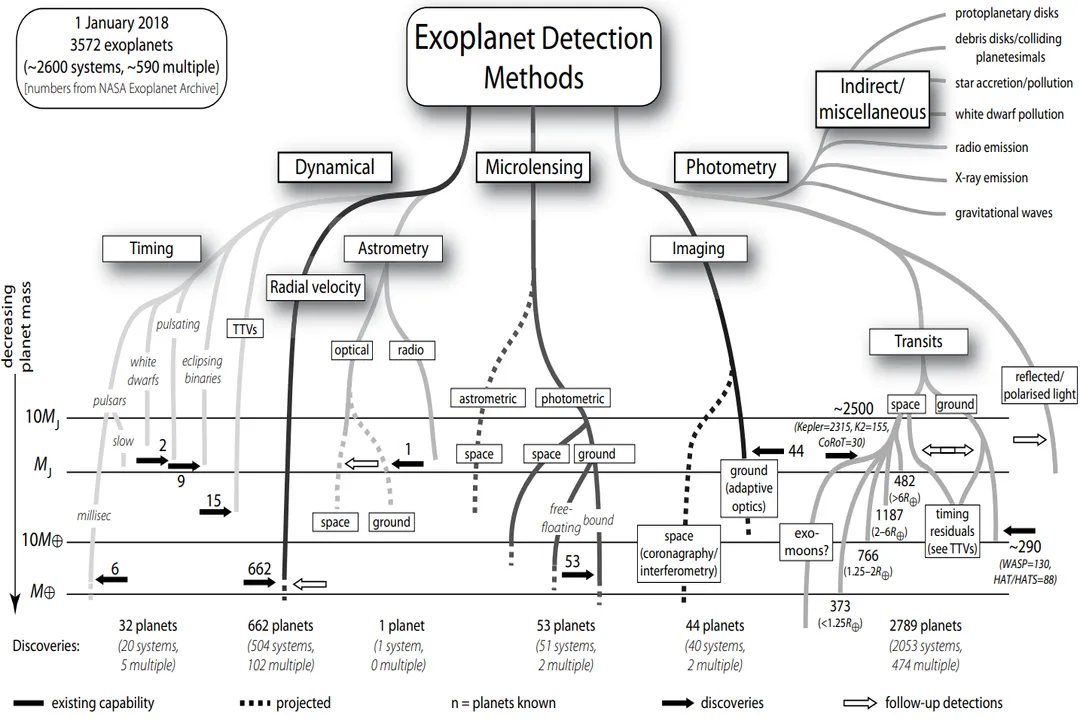
Despite its potential, astrometry is not the leading method for exoplanet discovery today, primarily due to the extreme technical hurdles involved. [4][7] The comparison of precision required versus what can currently be achieved explains its lower discovery count relative to radial velocity and transit methods. [2]
# Stellar Activity Noise
One major difficulty stems from the star itself. [1] The gravitational tug is not the only thing causing the star to move slightly. Stellar phenomena—such as starspots, flares, or convective granules bubbling on the surface—can cause the star's visible light center (the photocenter) to shift relative to its true center of mass. [1][4] This stellar activity creates a "noise floor" that mimics the signal of a planetary companion, often leading to false positives or obscuring the true planetary signature. [4] While these effects are usually periodic on timescales related to the star's rotation (days to weeks), they can complicate the long-term, multi-year monitoring required for wide-orbit planets. [1] Separating the true orbital wobble from the magnetic or convective surface wobble demands sophisticated modeling and long observational baselines. [4]
# Reference Frame Accuracy
As mentioned, astrometry relies on measuring a star's position against background objects. [3] For maximum precision, these reference objects need to be effectively motionless over the observation period. [3] In space, this means utilizing very distant quasars, whose light travels billions of light-years and whose own movement is negligible on human timescales. [3] However, creating an absolutely perfect, noise-free reference frame covering the entire sky is a monumental task, especially when trying to achieve microarcsecond precision. [3][7] Any error in the assumed position or motion of the background stars directly translates into an error in the detected stellar wobble. [3]
# Orbital Period and Detection Time
The time needed to confirm a detection places a practical constraint on the method. [1] For a planet orbiting at 1 Astronomical Unit (AU) around a Sun-like star, the orbital period is one year. [1] To confidently confirm an orbital signature, astronomers typically need to observe at least one full period, often two or three, to rule out noise sources and confirm the periodicity. [1] This translates to waiting two to three years for the first confirmation of a potentially Earth-like planet in a habitable zone orbit via astrometry alone. [4] For planets further out, this wait extends to many years or even decades, which tests the patience of funding agencies and mission planners. [4]
# Astrometry Versus Other Methods
Comparing astrometry to its main rivals helps contextualize its specific role in exoplanet science. [2][5]
| Method | Observable Effect | Primary Measurement | Best Suited For | Information Gained |
|---|---|---|---|---|
| Astrometry | Star’s positional shift in the sky | Angular displacement () | Long-period, wide-orbit planets | True mass, orbital inclination [1][6] |
| Radial Velocity | Star’s color shift (Doppler) | Change in line-of-sight velocity | Massive planets close to stars | Minimum mass () [6] |
| Transit | Star’s apparent brightness dip | Change in stellar flux | Planets with short periods, large radii | Radius, orbital inclination (if combined with RV) [5] |
One area where astrometry clearly outperforms the others is in finding low-mass planets in wide orbits. [4] A Jupiter-sized planet orbiting at $5$ AU might have a radial velocity signal too small to easily distinguish from stellar noise, and it would take over $20$ years to complete one orbit for a transit signal. [4] Astrometry, given the right instrument like Gaia, can track that $5$ AU companion by measuring its steady, predictable positional shift over the mission's operational lifetime. [4]
However, the high technological barrier means that while astrometry is the ideal way to get true mass, it is not currently the easiest way to get any planet detection. [7] Many successful astrometric detections have been confirmed by combining the positional data with high-precision radial velocity measurements, such as those gathered by instruments like the High Accuracy Radial velocity Planet Searcher (HARPS) or the Habitable-zone Planet Finder (HPF). [6] This complementary approach effectively cancels out the dependencies on inclination, allowing the precise mass to be determined much faster than relying on astrometry alone. [6] It’s a marriage of precision in the plane of the sky (Gaia) and precision along the line of sight (spectroscopy). [6]
When considering future prospects, the precision needed for finding an Earth analog orbiting a Sun-like star is currently pushing the limits of even Gaia. [1] To truly find a population of Earth-mass planets in the habitable zones of Sun-like stars using astrometry alone, instrument stability better than a few microarcseconds is required, which points toward future, dedicated astrometric observatories optimized for this specific task, possibly utilizing interferometry concepts or next-generation space telescopes. [7]
# The Long View of Observation
The patience required for astrometric confirmation presents an interesting constraint from an observational science perspective. Unlike transient events or rapid photometric surveys, astrometry is fundamentally a long-term commitment. If a team is hunting for a planet with a 10-year period, they must commit resources—telescope time, data processing personnel, and instrument calibration—for at least that duration, often longer to ensure statistical confidence. [1][4] This contrasts sharply with transit surveys, where a signal can sometimes be identified within a single year's worth of data. [4] This characteristic means that astrometry naturally favors the study of stable, mature systems that have been gravitationally settled for billions of years, rather than highly energetic, young systems exhibiting chaotic behavior. The results it provides—true mass and inclination—are the definitive characterization data points, making the long wait scientifically worthwhile when those parameters are the goal.
If we think about the sensitivity improvement over time, consider this hypothetical scenario: If a first-generation astrometric telescope (perhaps achieving precision) detects a Jupiter orbiting a star at $2$ AU, a next-generation instrument achieving precision, observing the same system over the same period, would not just confirm the Jupiter; it would likely reveal the presence of a second, smaller planet closer in, perhaps a Neptune-sized world, whose signal was completely washed out by the Jupiter noise in the earlier data set. [1] The capability of next-generation astrometry, therefore, isn't just about finding new worlds; it's about characterizing entire systems with a depth previously impossible, allowing for detailed orbital mechanics studies that reveal subtle interactions missed by other techniques. [7] This ability to resolve systems rather than just find single points of light makes astrometry an essential technique for understanding planetary architecture.
The scientific community has recognized the necessity of this approach, leading to proposals and concepts for dedicated astrometry missions that surpass Gaia's capability by orders of magnitude, aiming specifically at detecting terrestrial planets around Sun-like stars. [7] These future concepts often rely on advanced optical interferometry or highly stable spacecraft configurations to keep the instrument baseline incredibly precise over vast distances, demonstrating that this "old" method remains at the cutting edge of detection goals. [7]
# Data Processing and Analysis
The sheer volume and precision of data collected by modern astrometric instruments present their own set of processing challenges. [3] The Gaia mission, for example, produces petabytes of raw data which must be processed through complex pipelines to yield the final astrometric catalog. [3] This processing must account for gravitational lensing effects, minute thermal variations in the instrument, and the precise calibration of the reference frame against millions of background sources. [3]
The core analytical step involves fitting the observed positional changes over time to a model that includes the star's expected path and the perturbation caused by the planet(s). [1] This is often modeled as a general Keplerian orbit, defined by parameters like semi-major axis, eccentricity, period, and inclination. [1] The analysis is iterative: an initial fit is made, the residuals (the difference between the model and the actual observation) are checked, and if they still show significant, non-random structure, a second, third, or fourth planet might be inferred, requiring an expanded multi-body model to be fitted against the entire dataset. [1][4] When done successfully, this process yields a complete map of the gravitational architecture affecting the host star, making the astrometric solution one of the most complete descriptions of an exoplanet system available, provided the signal is strong enough to pull out of the background noise. [6]
#Videos
How Does Astrometry Detect Exoplanets?
Related Questions
#Citations
Wobbly Stars: The Astrometry Method
Methods of detecting exoplanets
Exoplanet detection methods - ESA Science & Technology
How We Find and Classify Exoplanets
Finding Exoplanets
Exoplanet Detection by Astrometric Method
Chapter: Appendix C: Exoplanet Detection Methods
The Underrated Powerhouse of Exoplanet Detection
Exoplanet Detection : A Detailed Analysis
How Does Astrometry Detect Exoplanets?