spaceanswers.net
Home
/
Tags A-Z
/
T
/
tonight
tonight articles
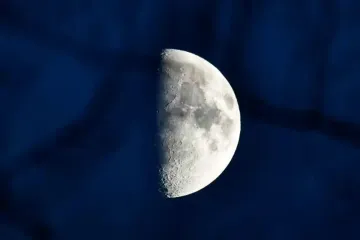
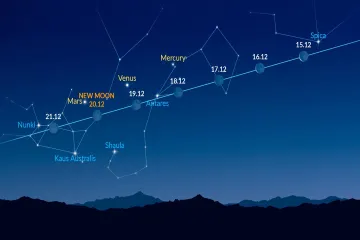
What is the star planet near the Moon tonight?
What is the glow around the Moon tonight?
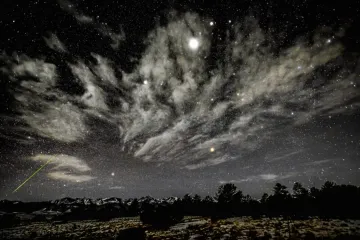
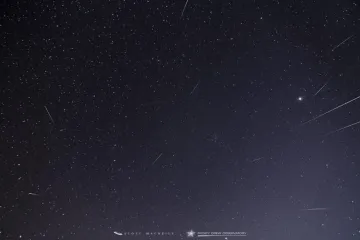
What is the best time to view the Geminid meteor shower tonight?
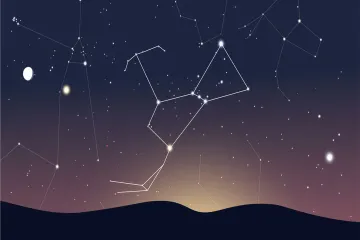
What is the technical definition of a conjunction in astronomy?
Approximately how often does the Moon orbit the Earth, causing it to encounter planets in the zodiac?
Which planets require optical aid, such as binoculars or a small telescope, to be readily seen?
What distinguishes a planet's steady light from a star's twinkling when observed from Earth?
During mid-to-late December 2025, what event regarding the Moon occurred on December 20th?
What characteristic hue is associated with Jupiter in the identification guide?
Why was Venus effectively invisible in early December 2025?
What event describes the Moon passing directly in front of a planet, temporarily hiding it from view?
Which conjunction in late December 2025 was described as far more rewarding for the casual observer because the Moon was partially illuminated?
What is the primary reason a close approach involving Mercury or Venus requires checking local rise/set times relative to sunset or sunrise?
What optical phenomenon causes the luminous ring known as a lunar halo?
What precise minimum angle reflects light refraction by common hexagonal ice crystals in a lunar halo?
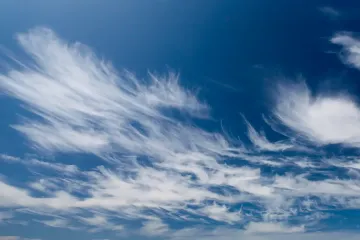
Which specific types of high-level clouds produce the ice crystals necessary for a lunar halo?
Approximately how many times the Moon's diameter must be stacked to span the $22^ ext{o}$ circle outward to the ring?
What inherent geometric property of ice dictates the $22^ ext{o}$ minimum deviation angle for the halo?
In mid-latitude areas, what weather condition often follows the appearance of a high-level lunar halo?
For the $22^ ext{o}$ halo to form, what specific angle must the exit face be relative to the entry face of the hexagonal ice crystal?
What observation suggests turbulence within the high cloud layer when viewing a lunar halo?
Besides the $22^ ext{o}$ halo, what other, larger halo is sometimes produced by moonlight interacting with ice crystals?
What angular span, measured by a fully stretched hand at arm's length, can help an observer estimate the $22^ ext{o}$ halo?
What is the ideal time window for catching the most brilliant streaks of the Geminid meteor shower?
What celestial body is the parent source of the Geminid meteor shower debris?
How long does it take for an observer's eyes to achieve full dark adaptation?
When observing a meteor shower, where should one generally look to see the longest, most dramatic streaks?
If the peak is stated as 06:00 UTC and you live in Eastern Standard Time (UTC-5), what is your local peak viewing time?
What common mistake should observers avoid regarding light exposure during a viewing session indoors?
What visual effect do meteors produce when the radiant is near the horizon, leading to slower streaks?
Why are the Geminids generally more dependable year-to-year than cometary showers?
Which part of the human eye is generally more sensitive to the low light levels required to spot fainter meteors?
What item is specifically suggested to mitigate the cold when sitting or lying still for hours during post-midnight viewing?