rate of expansion articles
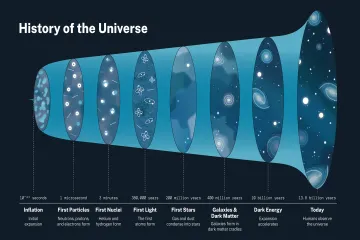
What mysterious, pervasive repulsive force is attributed to the accelerating expansion of the universe?

What mysterious, pervasive repulsive force is attributed to the accelerating expansion of the universe?

What was the prevailing expectation regarding the expansion initiated by the Big Bang before 1998 observations?

What was the prevailing expectation regarding the expansion initiated by the Big Bang before 1998 observations?

How is the observation that distant galaxies recede faster than light reconciled?

How is the observation that distant galaxies recede faster than light reconciled?

What happens to light emitted *now* by a galaxy whose recession velocity exceeds the speed of light due to expansion?

What happens to light emitted *now* by a galaxy whose recession velocity exceeds the speed of light due to expansion?

What astronomical objects act as dependable "standard candles" for measuring vast cosmic distances?

What astronomical objects act as dependable "standard candles" for measuring vast cosmic distances?

What concept quantifies the disagreement between two primary ways of measuring the current expansion rate?

What concept quantifies the disagreement between two primary ways of measuring the current expansion rate?

Which observation allows physicists to predict the Hubble constant based on the very early universe within the $\Lambda$CDM model?

Which observation allows physicists to predict the Hubble constant based on the very early universe within the $\Lambda$CDM model?

If a supernova in a distant, rapidly receding galaxy should take time $T$ to fade, how long do observers see it take?

If a supernova in a distant, rapidly receding galaxy should take time $T$ to fade, how long do observers see it take?

What is the predicted fate of the universe if dark energy causes expansion but does not become overwhelmingly powerful?

What is the predicted fate of the universe if dark energy causes expansion but does not become overwhelmingly powerful?

In the catastrophic Big Rip scenario, what is the final structure to be torn apart by infinite expansion?

In the catastrophic Big Rip scenario, what is the final structure to be torn apart by infinite expansion?

Why does the faster-than-predicted cosmic expansion not immediately affect the distances within our solar system?
Why does the faster-than-predicted cosmic expansion not immediately affect the distances within our solar system?

What primary measurement technique allows astrophysicists to calculate a galaxy's spin rate?

What primary measurement technique allows astrophysicists to calculate a galaxy's spin rate?

When observing the near side of a spiral galaxy moving towards the observer, how are the spectral lines shifted?

When observing the near side of a spiral galaxy moving towards the observer, how are the spectral lines shifted?

What consequence results from observing light emitted by material on the far side of a rotating galaxy moving away from us?

What consequence results from observing light emitted by material on the far side of a rotating galaxy moving away from us?

What specific spectral line is famously measured in rest frame to determine radial velocity?

What specific spectral line is famously measured in rest frame to determine radial velocity?

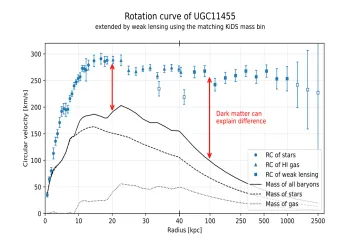
What is the resulting graph called when measured orbital velocities are spatially mapped against distance from the galactic center?

What is the resulting graph called when measured orbital velocities are spatially mapped against distance from the galactic center?

If a galaxy's inclination ($i$) is known, how is the observed radial velocity ($v_{obs}$) converted to the true circular velocity ($v_{circ}$)?

If a galaxy's inclination ($i$) is known, how is the observed radial velocity ($v_{obs}$) converted to the true circular velocity ($v_{circ}$)?

According to Newtonian mechanics for a spherical mass distribution, what equation relates the orbital velocity ($v$) to the enclosed mass ($M(r)$) at radius ($r$)?

According to Newtonian mechanics for a spherical mass distribution, what equation relates the orbital velocity ($v$) to the enclosed mass ($M(r)$) at radius ($r$)?

How does the idealized Keplerian prediction suggest orbital velocity should change as radius increases past where visible mass ends?

How does the idealized Keplerian prediction suggest orbital velocity should change as radius increases past where visible mass ends?

What is the key observational contradiction between inferred gravitational mass and observed visible mass in spiral galaxies?

What is the key observational contradiction between inferred gravitational mass and observed visible mass in spiral galaxies?

For systems like elliptical galaxies, what measurement is used instead of rotation curves to estimate total mass?

For systems like elliptical galaxies, what measurement is used instead of rotation curves to estimate total mass?

What theorem is used to estimate the total mass in elliptical galaxies by relating kinetic energy derived from dispersion to potential energy?
What theorem is used to estimate the total mass in elliptical galaxies by relating kinetic energy derived from dispersion to potential energy?

What is the fundamental raw material required for a galaxy to manufacture new stars?

What is the fundamental raw material required for a galaxy to manufacture new stars?

What two opposing forces are fundamentally engaged in a tug-of-war governing the star formation rate?

What two opposing forces are fundamentally engaged in a tug-of-war governing the star formation rate?

What concept dictates the minimum mass and size a gas cloud must possess to overcome pressure and begin gravitational collapse?

What concept dictates the minimum mass and size a gas cloud must possess to overcome pressure and begin gravitational collapse?

What dictates the *efficiency* of turning supplied gas into stars at the scale of individual Giant Molecular Clouds (GMCs)?

What dictates the *efficiency* of turning supplied gas into stars at the scale of individual Giant Molecular Clouds (GMCs)?

How does turbulence simultaneously affect star formation within the interstellar medium?

How does turbulence simultaneously affect star formation within the interstellar medium?

When a galaxy moves into a dense cluster, what mechanism physically removes its cold gas reservoir, leading to quenching?

When a galaxy moves into a dense cluster, what mechanism physically removes its cold gas reservoir, leading to quenching?

Compared to smaller, actively growing galaxies, what trend is observed for more massive galaxies regarding their star formation rate?

Compared to smaller, actively growing galaxies, what trend is observed for more massive galaxies regarding their star formation rate?

How do supernovae primarily act as a negative feedback mechanism on star formation?

How do supernovae primarily act as a negative feedback mechanism on star formation?

What role do metals (elements heavier than hydrogen and helium) play in the star formation process?

What role do metals (elements heavier than hydrogen and helium) play in the star formation process?

What empirical law relates the observed surface density of star formation ($\Sigma_{SFR}$) to the surface density of cold gas ($\Sigma_{gas}$) in a galaxy disk?

What empirical law relates the observed surface density of star formation ($\Sigma_{SFR}$) to the surface density of cold gas ($\Sigma_{gas}$) in a galaxy disk?