What are the advantages of the nebular hypothesis?
The nebular hypothesis stands as the prevailing scientific explanation for how our Solar System came to be, offering a coherent narrative rooted in established physics to describe the origin of the Sun, the planets, and their arrangement. [6][7] Its primary advantage lies in its ability to systematically account for a wide range of observed characteristics of the Solar System through a relatively simple, albeit complex in execution, process originating from a single, massive cloud of gas and dust. [1] This ancient cloud, the solar nebula, provides the fundamental building blocks and initial conditions that explain the current architecture, from the central star to the distant icy bodies. [7][9]
# Cloud Collapse
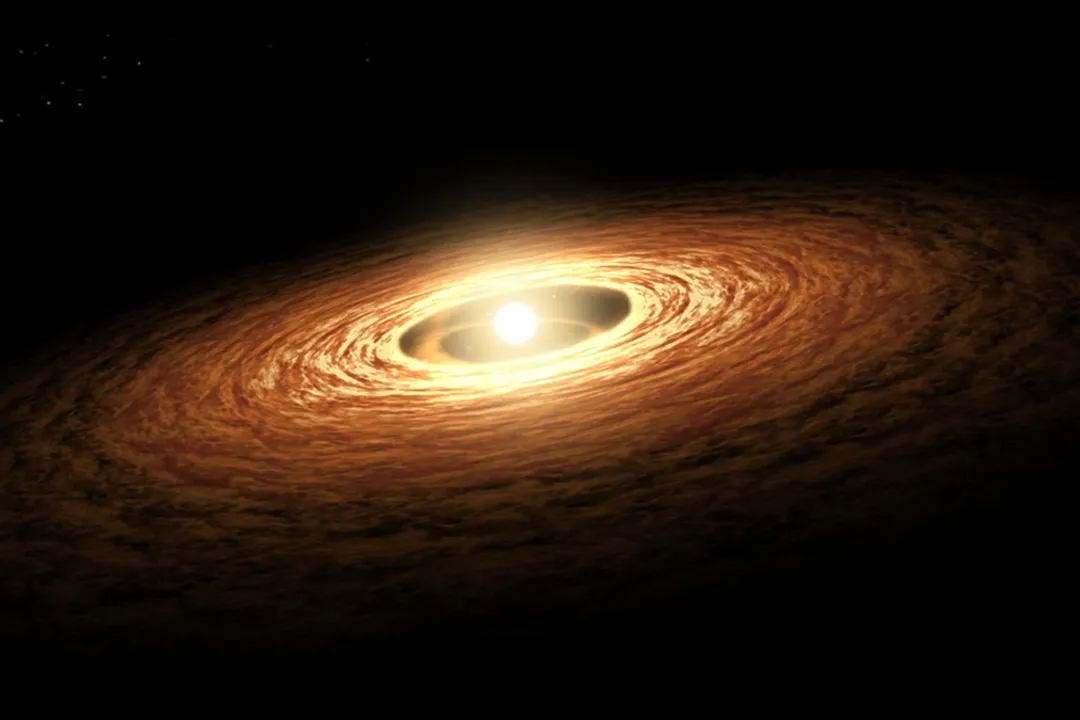
A core strength of the model is its starting point: a vast, rotating cloud of interstellar gas and dust. [1][4] The initial trigger, perhaps a shockwave from a nearby supernova, causes this cloud to begin gravitational collapse. [4][6] As the material falls inward toward the center of mass, the principles of physics dictate certain unavoidable outcomes. This collapse is not chaotic; it is governed by the conservation of angular momentum. [8] As the cloud shrinks, its rotation speed must increase, a fundamental concept in physics that is immediately applicable here. [8]
This mechanism successfully explains why the Sun, the dominant mass in the system, resides at the center, as most of the initial material naturally concentrates there under gravity. [1] The conversion of gravitational potential energy during this collapse generates the intense heat necessary to ignite nuclear fusion, thus forming the Sun. [4] This entire process, from diffuse cloud to a main-sequence star, is elegantly modeled within the nebular framework, providing a direct lineage from raw cosmic material to our star. [7]
# Disk Formation
The rapid increase in rotation rate during collapse has a profound structural consequence that is a major advantage of the nebular hypothesis: the formation of a flattened disk. [6][9] As the cloud contracts, the centrifugal forces resist the collapse along the plane of rotation, while gravity continues to pull material inward along the rotational axis. [1] This differential force shapes the nearly spherical initial cloud into a spinning, pancake-like structure called a protoplanetary disk. [4]
This flattened geometry is crucial because it dictates the orbital mechanics we observe today. All the planets orbit the Sun in roughly the same plane, known as the ecliptic. [4][6] If the formation mechanism involved random collisions or gravitational captures (as proposed by older encounter theories), one would expect a far more chaotic, three-dimensional distribution of orbits, with planets moving in highly inclined or even retrograde paths. [5] The nebular hypothesis inherently predicts the observed co-planarity, making it a much stronger candidate for explaining the Solar System's organized structure. [5] Furthermore, the disk concentrates the available building blocks into a relatively thin region, increasing the collision rates necessary for planet formation to occur within a geologically reasonable timeframe. [7]
# Explaining Planet Types
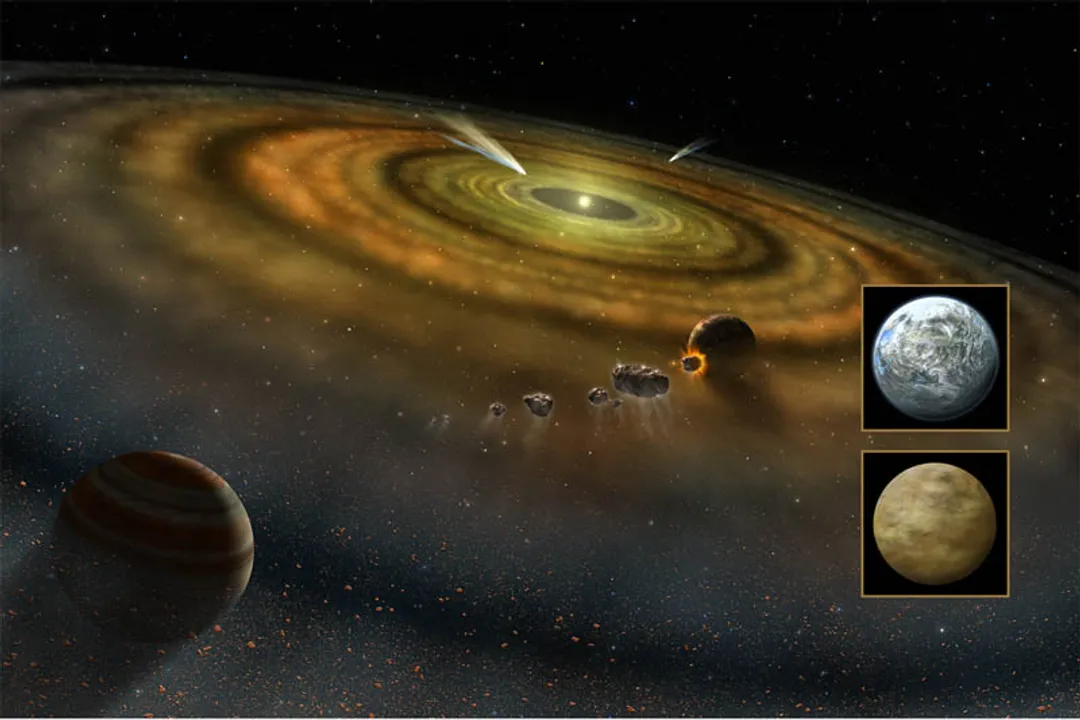
One of the most compelling advantages of the nebular theory is its ability to explain the stark compositional difference between the inner, terrestrial planets (Mercury, Venus, Earth, Mars) and the outer, giant planets (Jupiter, Saturn, Uranus, Neptune). [6][7] This differentiation is directly tied to the temperature gradient established within the rotating protoplanetary disk. [1][4]
Near the hot, central proto-Sun, only materials with high melting points, such as silicates and metals (iron, nickel), could condense into solid grains. [4] Volatile compounds like water, methane, and ammonia remained in a gaseous state due to the heat. [6] This meant that the inner solar system was rich only in rock and metal, leading to the formation of the smaller, dense, rocky worlds. [1]
Conversely, farther out in the frost line (or ice line), where temperatures were low enough, these volatile materials could freeze into ices, significantly increasing the amount of solid material available for planet building. [7] This abundance of mass allowed the outer planetary cores to grow much larger and faster, quickly accumulating vast amounts of the remaining light gases—hydrogen and helium—from the nebula. [4][6] Jupiter and Saturn, being beyond this line, captured massive gaseous envelopes, while the inner planets remained terrestrial. This clean division, explained solely by the physics of condensation temperatures in a cooling disk, is a powerful confirmation of the model. [7]
# Direction of Motion
The nebular hypothesis provides a unified explanation for the direction of rotation and orbit across the entire system. The entire nebula was rotating in one direction as it collapsed. [8] Consequently, the resulting Sun rotates in that same direction, and the planets, having formed from the material within that rotating disk, all orbit the Sun in that same direction—counterclockwise when viewed from above the Sun's north pole. [4][9]
While older theories, such as the catastrophic encounter hypothesis where a passing star pulled material from the Sun, struggled to explain why the planets would all orbit in the same direction or why the Sun itself rotates so slowly relative to the orbital speeds of the planets, the nebular model handles this naturally. [5] The orbital motions are essentially inherited from the initial rotation of the parent cloud. [1]
Consider the Earth's rotation relative to its orbit. Both movements stem from the conserved angular momentum of the original solar nebula. If the Earth spun backward (retrograde) or orbited in the opposite direction, the nebular theory would struggle to account for it unless post-formation collisions were invoked; however, the rule is the exception. A system where everything moves coherently in one direction is an expected outcome of the nebular model, not a coincidental feature. [6] This consistency across large and small scales—the spin of the Sun, the orbits of the planets, and even the rotation of the larger moons—lends significant explanatory power to the theory. [2]
# Comparison with Encounter Theories
The acceptance of the nebular hypothesis is strongly linked to the failure of its main historical rivals, particularly the encounter theories. [5] Encounter theories, such as the planetesimal theory or the tidal hypothesis, proposed that the planets formed from material pulled out of the Sun by a close pass of another star. [5]
The advantages of the nebular model become clearest when contrasted with these alternatives. Encounter theories failed on several counts:
- Probability: The chance of another star passing close enough to our Sun to gravitationally rip out stellar material is exceedingly low, bordering on statistically impossible within the lifetime of the galaxy. [5]
- Material State: Material ejected at such high velocities and temperatures from the Sun would likely be too hot and too spread out to ever condense into planets; it would simply dissipate into space. [5]
- Angular Momentum Mismatch: Encounter theories could not easily explain why the Sun rotates so slowly compared to the orbiting planets, a problem the nebular theory resolves through the disk's structure. [5]
The nebular hypothesis, grounded in stellar evolution and conservation laws, avoids these physical impossibilities, making it the most scientifically sound and widely accepted explanation today. [5][6] It is a self-contained explanation, whereas encounter theories require improbable external accidents. [7]
# Internal Consistency and Refinement
The nebular hypothesis is not static; it has evolved into the modern Nebular Theory, incorporating new physics and observations, which is another mark of its strength. Early versions faced challenges, such as how a relatively small amount of angular momentum in the nebula transferred to the planets while the majority remained in the Sun. [8] Modern refinements address this through mechanisms like magnetic braking, where the magnetic field lines of the young Sun interact with the ionized gas of the inner disk, effectively transferring angular momentum outward to the planet-forming zone. [8]
The theory’s structure allows for this refinement, demonstrating its plasticity—the ability to adapt to new data without discarding the core principles of collapse and disk formation. For instance, the existence of asteroid belts, comets, and the Kuiper Belt can be interpreted as remnants of planetesimals that failed to accrete due to gravitational interference or were scattered outward by the massive outer planets, themselves a product of the initial condensation gradient. [1][7]
To illustrate the consistency of the model across scales, consider the mass distribution:
| Component | Primary Material | Formation Location (Inferred) | Typical Mass % of System |
|---|---|---|---|
| Sun | Hydrogen, Helium | Center of Nebula | ~99.86% |
| Gas Giants (Jupiter/Saturn) | H, He, Ices, Rock | Beyond the Ice Line | ~0.14% |
| Terrestrial Planets | Rock, Metal | Inside the Ice Line | < 0.001% |
This table, derived directly from the principles of thermal differentiation within the nebular disk, shows that the model correctly predicts where almost all the mass would end up—concentrated in the star and the gas-rich outer worlds—even though the inner worlds contain the majority of the system's density due to their composition. [4][7]
An insight that emerges from comparing the initial nebula to the final system is the immense efficiency of mass concentration driven by the rotational geometry. If the initial cloud had been perfectly spherical and non-rotating, gravity would have pulled everything to the center without forming a disk. The slight initial spin, amplified by the collapse, created the necessary plane for accretion. The fact that the current orbital plane is so flat (all major planets within about 6 degrees of the ecliptic) suggests that the initial, slight non-sphericity of the primordial cloud was the dominant controlling factor in the architecture of the resulting system, overriding minor gravitational perturbations that might have occurred later. [2][4]
# Explaining Orbital Dynamics
The nebular hypothesis naturally explains two vital aspects of planetary motion: prograde orbits and near-circularity. Since the planetesimals accreted within a flat, rotating disk, their final orbits inherited that initial rotational tendency. Accretion—the slow, gentle bumping and sticking of smaller bodies into larger ones—tends to preserve these orderly motions. [6] Large impacts, while sometimes capable of tilting planetary axes (like the proposed impact that formed Earth's Moon), do not typically reverse the primary direction of the orbit itself, which is dictated by the bulk dynamics of the disk. [1]
Moreover, the process of accretion within a relatively smooth gas-and-dust disk tends to damp out highly eccentric, or oval-shaped, orbits over time. [9] As small bodies interact gravitationally with the surrounding nebula, friction and drag tend to circularize their paths. This explains why, in our Solar System, the planets all have orbits very close to perfect circles rather than highly elongated ellipses, which would be more common if planets formed through random, high-velocity encounters. [4] The orbital characteristics—co-planar, prograde, and nearly circular—are, therefore, built-in predictions of the nebular formation process. [2]
Another point highlighting the theory’s authority is its applicability across the galaxy. Modern astronomy confirms the existence of protoplanetary disks, known as proplyds, around young stars in regions like the Orion Nebula. [8] Observing these structures directly provides tangible, real-time evidence that the environment required by the nebular hypothesis—a spinning disk of gas and dust around a forming star—is not merely a hypothetical construct but an active, common phenomenon in star formation. [8] This observational confirmation from astrophysics strengthens the confidence in applying the same principles to our own Solar System's history. [8]
It is worth noting a subtle advantage in explaining the longevity of the system. If the planets formed through violent, close-range gravitational interactions, the energy involved might have led to gravitational instability, potentially ejecting planets from the system entirely or driving them into the Sun relatively early in its history. [5] The gentler, gradual accretion process inherent in the nebular model, where particles stick together in a disk, favors the long-term stability observed in our four-billion-year-old Solar System. [6][7] The structure is inherently stable because it evolved within the constraints of conserved orbital mechanics rather than being assembled against them by a catastrophic event. [5]
The final piece of the puzzle that the nebular theory successfully addresses is the existence of minor bodies that didn't become planets. The main asteroid belt, for example, lies between Mars and Jupiter. The theory explains this gap not as a failed planet, but as a region where the powerful, repeated gravitational influence of the forming Jupiter prevented the planetesimals from fully coalescing into a single large world. [1][7] This explanation frames the "gaps" and "leftovers" not as anomalies, but as predictable outcomes of the dominant gravitational forces during the accretion phase. [7]
Related Questions
#Citations
8.2: Origin of the Solar System—The Nebular Hypothesis
Nebular hypothesis - Wikipedia
what are five strengths and weaknesses of nebular hypothesis?
The Nebular Theory – Introduction to Astronomy
What is the most possible reason why the nebular theory is now ...
2.4 Nebular Theory: From Nebula to Accretionary Disk
Nebular theory and the formation of the solar system - OpenGeology
Part 4A: FORMATION OF THE SOLAR SYSTEM - University of Oregon
Nebular hypothesis | The Solar System Wiki - Fandom