Astronaut definition articles - Page: 2
What advantage does microgravity on the ISS offer scientists studying protein crystals?
How is the cost of spaceflight sometimes conceptually framed when considering its long-term economic impact?
What fundamental capability distinguishes human astronauts from robotic probes in unforeseen situations?
What societal benefit is directly correlated with the public viewing the accomplishments of human space missions?
What is the ultimate safeguard for the continuation of the human species mentioned in relation to space activities?
What term describes the technologies originally developed for space operations that find wide application back on Earth?
How do studies of human physiology in space provide benefits to people on Earth?
What role do astronauts play concerning complex external hardware on orbiting platforms?
What cognitive shift, often reported by astronauts seeing Earth from orbit, helps galvanize global cooperation?
What specific engineering advances translate directly from spacecraft life support systems to terrestrial sustainability?
How is the numerical classification index for an elliptical galaxy calculated using its observed major axis (a) and minor axis (b)?
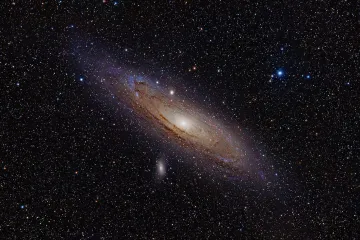
What viewing orientation would cause an intrinsically spherical E0 galaxy to potentially be misclassified as an elongated type like E5 or E6?
Which range of elliptical classifications (E0-E7) is increasingly suspected by modern astronomers to consist of misclassified lenticular galaxies (S0)?
What is the current dominant model describing the three-dimensional shape of most bright elliptical galaxies?
What dynamical property, related to stellar motion, is responsible for maintaining the shape of a triaxial elliptical galaxy?
What phenomenon occurs when the orientation or elongation of a galaxy's isophotes changes as the measurement moves outward from the core?
What feature suggests the presence of a supermassive black hole or dense stellar remnants in the core of massive ellipticals like M87?
How does the central surface brightness profile of most ellipticals typically deviate from the prediction of the de Vaucouleurs' law near the very center?
In terms of scale, how much larger are dwarf elliptical galaxies physically compared to the most massive globular clusters?
If astronomers assume isotropy (equal random stellar motions in all directions), what critical uncertainty remains when trying to constrain the exact 3D shape of an elliptical galaxy from observed velocity data?
What is the leading scientific explanation for the formation of our solar system architecture?
Approximately how long ago did the Sun and planets begin coalescing from the solar nebula?
What two elements made up roughly 98% of the mass in the original solar nebula?
What event is cited as the most common mechanism for disturbing the nebula's equilibrium and initiating gravitational collapse?
Which physical principle caused the cloud to spin faster as it contracted, leading to its flattening?
What is the term for the vast, thin, spinning structure that the spherical nebula transformed into?
What was the dense, hot concentration of matter at the center of the disk called before nuclear fusion ignited?
What is the process through which microscopic dust grains in the disk built up into larger bodies?
What were the kilometer-sized objects that acted as the primary builders of the major planets?
What phenomenon causes the inner terrestrial planets to be composed mainly of rock and metal?
What compositional feature defines the region where temperatures were low enough for water, methane, and ammonia to condense into solids?
PreviousPage 2 of 2