Which is bigger, AU or parsec?
When grappling with the immense scales of the cosmos, astronomers rely on specialized units of measurement to keep the numbers manageable. Two fundamental units encountered when discussing celestial distances are the Astronomical Unit () and the parsec (). The immediate answer to which is bigger is definitive: the parsec dwarfs the Astronomical Unit by a staggering margin. Understanding their relationship requires diving into how each unit originated, as one is fundamentally built upon the other, even though they serve very different mapping purposes across the universe.
# Solar System Anchor
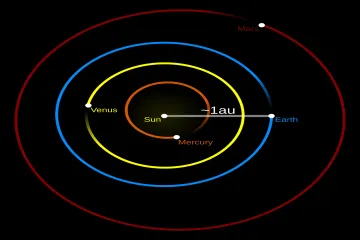
The Astronomical Unit, symbolized as , is the baseline measurement for distances within our immediate neighborhood—the Solar System. This unit is defined by the average distance separating the Earth and the Sun. While the has provided an exact definition in meters (), it is most readily understood as approximately or .
The is perfectly suited for describing the scale of our own planetary domain. For instance, Jupiter orbits at about from the Sun, and even the distant dwarf planet Pluto sits roughly out. Trying to describe the distance to the nearest star, Proxima Centauri, in would involve a number so large it becomes impractical for everyday astronomical work—it would require nearly . This is where the limitations of using the become clear; it is too small a yardstick for interstellar navigation.
# Geometric Definition
The parsec, on the other hand, is a unit specifically tailored for measuring the distances to objects outside the Solar System, relying on a method called stellar parallax. The name itself is a contraction derived from the concept of parallax and the angular measure of one second of arc.
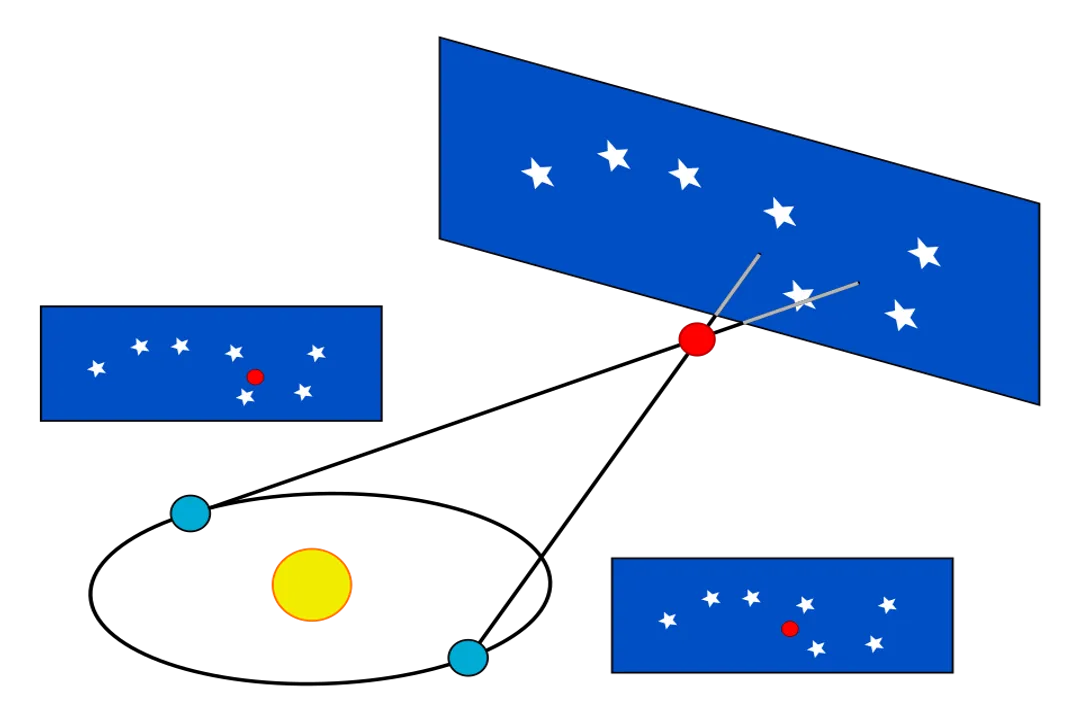
A parsec is formally defined as the distance from the Sun to an astronomical object whose apparent shift (parallax) against the background stars, as viewed from Earth at opposite ends of its orbit, subtends an angle of exactly one arcsecond (), which is of a degree. Imagine a gigantic, elongated right triangle in space: the short leg is (the Earth-Sun distance), and the angle opposite that leg, at the distant star, is . The parsec is the length of the long leg of that triangle. This geometric derivation is why professional astronomers favor it, as the distance in parsecs becomes the reciprocal of the measured parallax angle in arcseconds (). This relationship makes the calculation exceptionally direct once the parallax angle is known.
# Vast Difference
The enormous difference in scale between and stems directly from the tiny angular measurement used to define the parsec (). Since the parallax angle is so small, the resulting distance must be correspondingly large.
The numerical conversion makes the disparity apparent:
This means that represents a distance over times greater than the distance from the Earth to the Sun. To put this in perspective, light travels for only about minutes to cover the distance of . If we consider the light-year (), which is the distance light travels in one Earth year (), we find that the parsec is also larger than a light-year:
The nearest star system to us, Proxima Centauri, lies about away, translating to roughly light-years. If we were forced to use for this measurement, the number would be over , a figure much less convenient than the simple .
This mathematical relationship highlights an inherent hierarchy in astronomical distance measurement. The anchors our solar system, establishing the baseline radius for that local sphere. The parsec is the first interstellar distance marker, defined by scaling that local anchor by a factor necessary to bridge the gap to the nearest stars.
# Usage Context
The choice between these units is a matter of context and the scale of the structure being described. The general rule of thumb is: for the Solar System, for the stars.
For mapping objects within a single star system, remains the standard, offering intuitive numbers for planetary distances. Conversely, when measuring the separation between nearby stars, or stars within our local spiral arm of the Milky Way, parsecs are essential. For example, the Pleiades star cluster is located at approximately away.
As distances increase toward the rest of the galaxy and beyond, astronomers introduce multiples of the parsec to avoid the ever-growing string of zeros:
- Kiloparsec (): . Used to measure distances within the Milky Way, such as the distance to the galactic center.
- Megaparsec (): . This unit is the standard for intergalactic distances. The Andromeda Galaxy, our nearest large neighbor, is approximately away.
- Gigaparsec (): . This is reserved for the largest known structures, like the massive filaments and voids that map the cosmic web.
It is a point of interest that while professionals favor the parsec due to its direct link to observational trigonometry (parallax), the light-year often remains more prominent in popular science communication. While the parsec is mathematically superior for the professional astronomer calculating stellar distances from observational data, the light-year, representing the distance light travels in a year, often carries more intuitive weight for general readers. The fact that is close to means that while defined differently—one by geometry based on Earth’s orbit, the other by the speed of light over time—they are fortunately close enough in magnitude that they serve similar roles when describing distances to nearby stars. However, when discussing distances across the galaxy, the or becomes necessary, making the parsec an indispensable stepping stone in the cosmic distance ladder.
#Videos
PARSECS, Light Years, or AU? (Astronomy) - YouTube
Related Questions
#Citations
Parsec - Wikipedia
This is the relationship between a Parsec, an Astronomical Unit (AU ...
Units for Distance and Size in the Universe
PARSECS, Light Years, or AU? (Astronomy) - YouTube
Ast 110: Class 9 - Astronomy in Hawaii
[Solved] Which is the largest unit to measure distance? - Testbook
Convert Parsec to Astronomical Unit