What is the most powerful aerospace engine?

The simple question of what constitutes the "most powerful" aerospace engine quickly branches into a discussion of current service champions versus technological benchmarks. In the world of massive commercial jet propulsion, power is measured in thrust, and for many years, one engine stood unchallenged as the titan of the skies: the General Electric GE90 series. [2] However, the aerospace industry rarely rests, and a newer, even more formidable engine has claimed the record books, even if it is just beginning its operational life.
# Current Champion

For quite some time, the reigning monarch of thrust output has been the GE90 engine family. [2][6] These colossal powerplants were purpose-built to move the enormous twin-engine Boeing 777 aircraft, a jet renowned for its long-range capabilities and its ability to fly transoceanic routes previously reserved for three- or four-engine jets. [2] The engine’s immense size, particularly its fan diameter, is immediately apparent, often becoming the subject of awe for aviation enthusiasts witnessing its scale up close. [6]
The sheer physical dimensions of the GE90 are difficult to overstate. Fan diameters on some variants approach the width of a small regional jet fuselage. [2][6] This size directly translates to the massive amount of air it can ingest and accelerate, which is the fundamental source of its impressive thrust rating in service. [6] The GE90 family provided the performance necessary to allow twinjets like the 777-300ER to achieve unparalleled range and payload performance, effectively changing global airline route structures. [2]
# Record Breaker
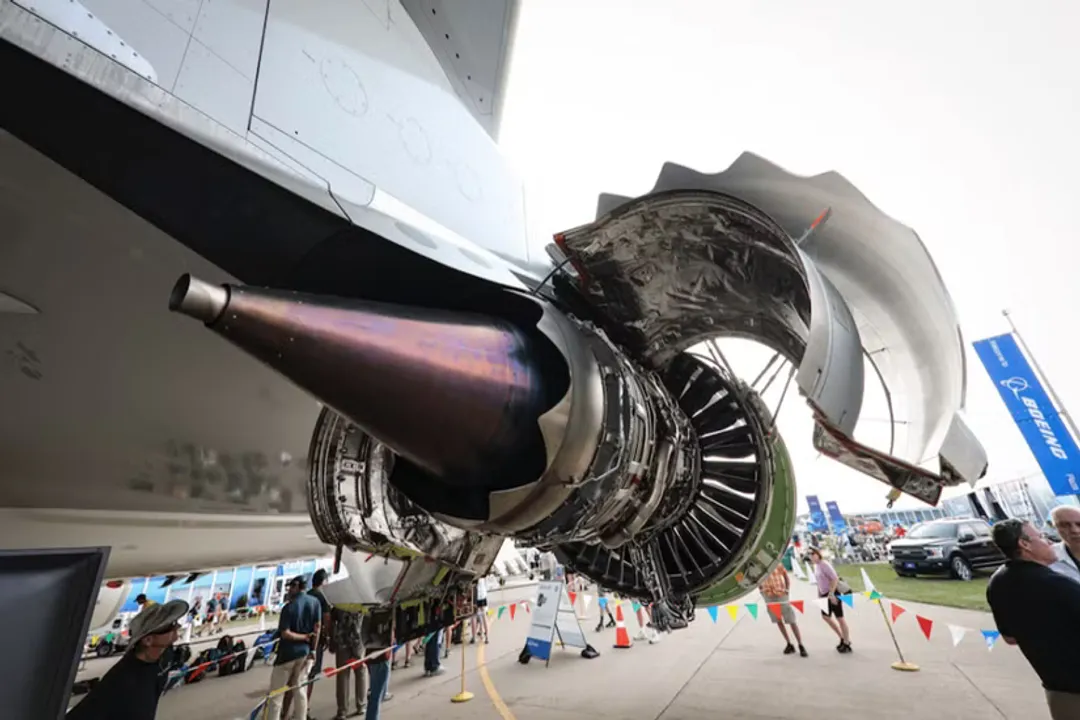
While the GE90 remains a powerhouse in active global service, the baton for raw, recorded power has passed to its successor: the GE9X. [1][3] This new engine, developed for the newer Boeing 777X family of aircraft, was specifically engineered to push the boundaries of thrust while simultaneously improving on the efficiency of the GE90. [1]
The GE9X officially cemented its place in history during ground testing by achieving a world-record thrust of 134,300 pounds. [4][6] This figure represents the highest thrust ever recorded by a commercial aircraft engine, comfortably surpassing the existing records held by previous GE90 models. [4][6] This record was achieved during testing aboard a dedicated 747-400 flying testbed aircraft, demonstrating its capability before entering the 777X fleet. [5]
It is worth noting the distinction between "most powerful in service" and "most powerful ever recorded." The GE90 is the current workhorse that defines the capability of in-service twinjets today, [2] whereas the GE9X holds the ultimate, documented thrust milestone, signaling the next generation of extreme thrust capabilities. [4]
# Size Comparison
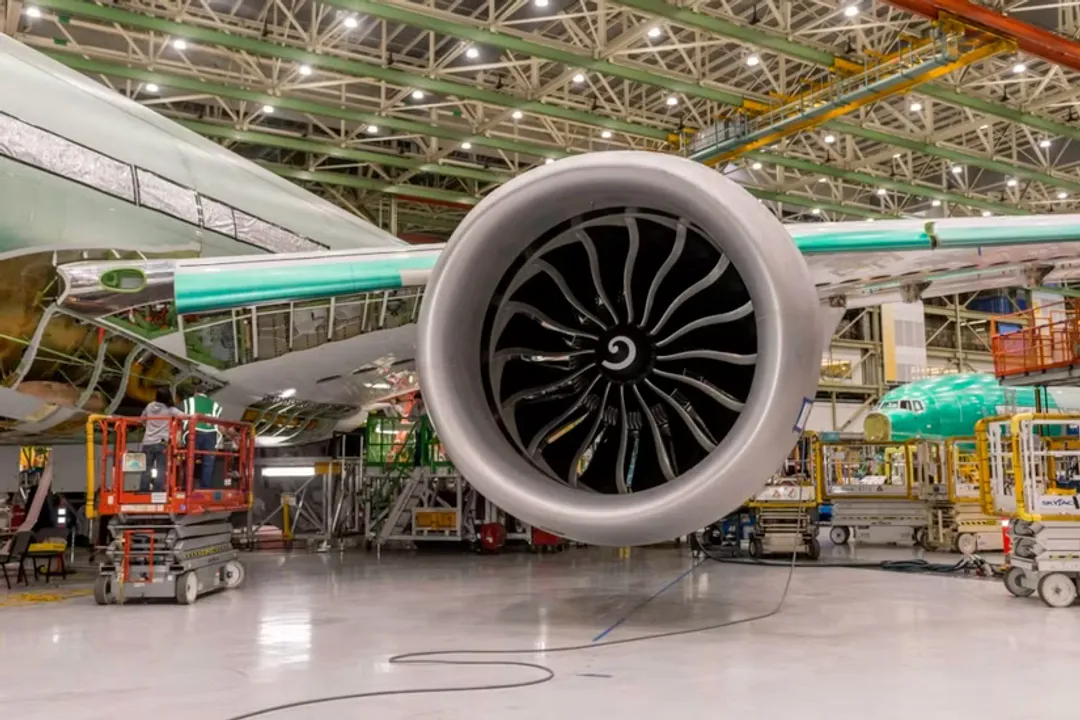
When looking at these two giants side-by-side, the evolution in design philosophy becomes clear, even if both share the common lineage of massive thrust output. The GE9X, designed to power the 777X, maintains a characteristic high bypass ratio, meaning a large portion of the air it moves bypasses the core of the engine, contributing to both thrust and fuel savings. [1]
| Engine Model | Primary Aircraft | Record Thrust (Pounds) | Status |
|---|---|---|---|
| GE90 | Boeing 777 | Up to ~115,300 | In-Service Leader |
| GE9X | Boeing 777X | 134,300 | Record Holder/Entering Service |
The GE9X features a fan diameter that is substantially larger than the GE90's, incorporating advanced materials like ceramic matrix composites (CMCs) in its hot section. [1] These CMCs allow the engine to run hotter and more efficiently than previous designs, which is a critical factor in managing the immense energy generated by that record thrust level. [1]
The continuous drive toward larger fan diameters is not just for generating more thrust; it directly correlates with improved efficiency. A larger fan can move a greater volume of air at a lower velocity relative to the core exhaust, which significantly reduces noise pollution and fuel burn for a given thrust output. [2][1] This engineering trade-off is fascinating: to make the engine more powerful, designers must often first make it more efficient in its air movement architecture.
# Engineering Demands

Building an engine capable of producing over 134,000 pounds of thrust introduces unique engineering challenges that go far beyond simply bolting larger components together. One of the immediate practical implications for ground crews working with the GE90, and which will be even more pronounced with the GE9X, is the sheer ground clearance required. Imagine an engine so large that the lowest point of its intake might be only slightly higher than a standard human standing next to it. [6] This scale necessitates specialized ground support equipment and careful ramp operations to prevent foreign object damage (FOD) to the massive fan blades, which are themselves technological marvels composed of advanced, lightweight materials. [2]
Furthermore, managing the heat and stress within the core of an engine operating at these extreme limits requires material science breakthroughs. The GE9X’s incorporation of advanced materials like CMCs is a direct response to the thermal limits of traditional nickel alloys. By allowing turbine temperatures to increase without compromising structural integrity, these materials unlock higher thermodynamic efficiency, meaning the engine gets more work out of every drop of fuel it consumes. [1]

# Defining Power
When assessing which engine is truly the "most powerful," one must decide the metric. If the metric is maximum recorded static thrust achieved in a test environment, the GE9X is the undisputed winner at 134,300 pounds. [4] If the metric is most powerful engine currently flying and powering a major airline fleet, the GE90 still holds that title due to the ongoing entry-into-service phase of the 777X. [2]
A deeper look reveals that the GE9X is designed to offer a significant improvement in fuel burn—approximately 10% better than the already highly efficient GE90. [1] This fact provides an interesting perspective: the pursuit of power in modern commercial aviation is inextricably linked to sustainability and economics. The most powerful engine today is not just the one that pushes the most air, but the one that does so with the least environmental and operational cost per pound of thrust delivered. The ongoing success of these massive engines on twin-engine aircraft continues to validate the regulatory and engineering confidence in high-thrust twinjet operations over traditional four-engine designs for long-haul travel. [2]
#Videos
World's Biggest Jet Engine Begun Rolling Off the Production Line for ...
How The World's Most Powerful Fighter Jet Engine Is Made - YouTube
Related Questions
#Citations
GE9X Engine | GE Aerospace
General Electric GE90 - Wikipedia
The GE90 is currently the largest and most powerful commercial ...
World's Biggest Jet Engine Begun Rolling Off the Production Line for ...
What are the top 10 most powerful jet engines? - Facebook
World's Most Powerful Engine Completes Flights On Special Test ...
Top 10: A Brief Guide To The World's Largest Jet Engines