What is Kepler's law of binaries?
Kepler’s laws, first formulated in the early 17th century, describe the motion of objects orbiting a central mass, most famously applied to the planets in our Solar System. [3][7] When astronomers turned their attention to binary star systems—two stars gravitationally bound and orbiting a common center of mass—these foundational laws needed subtle but critical adjustments to remain accurate. [2][9] The application of Kepler’s work to these systems is what we refer to as Kepler’s law of binaries, which fundamentally allows us to calculate the total mass of the stellar pair based on their observed orbits. [1]
# Kepler's Original Concepts
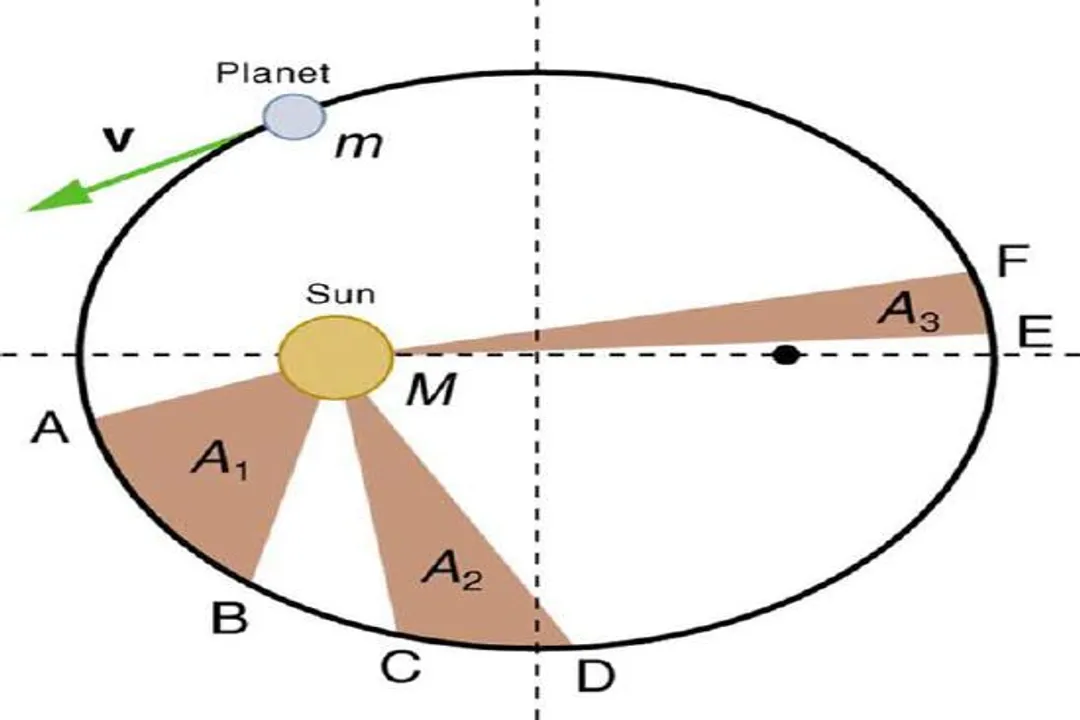
Johannes Kepler established three distinct laws governing orbital motion based on the detailed observations made by Tycho Brahe. [3][4] The first law states that the orbit of any planet is an ellipse, with the central body situated at one of the two foci of that ellipse. [4][7] The second law, sometimes called the law of areas, dictates that a line segment joining a planet and the Sun sweeps out equal areas during equal intervals of time. [3][4][7] This means the orbiting body moves faster when it is closer to the central object and slower when it is farther away. [4]
The third law, the most mathematically potent for calculating masses, relates the orbital period () to the size of the orbit, specifically the semi-major axis (). [3][6] In its simplest form, Kepler found that the square of the period is directly proportional to the cube of the semi-major axis: . [3][6][8] For objects orbiting our Sun, this proportionality constant () is the same for all planets. [8]
# Modifying The Third Law
The standard relationship works exceptionally well for planets because the Sun’s mass is overwhelmingly larger than any individual planet’s mass. In this scenario, the Sun can be treated as essentially stationary, and the planet orbits it. [6] However, in a binary star system, both stars possess significant mass, and they both orbit a common center of mass, called the barycenter. [1][2] Neither star is stationary, and the simple proportionality derived for the Solar System breaks down. [2]
To accurately describe the motion of two bodies orbiting each other, Kepler’s Third Law must be modified using Newtonian mechanics. [1][9] Isaac Newton incorporated the gravitational law into Kepler’s geometrical findings, resulting in a relationship where the proportionality constant now explicitly includes the masses of both objects. [1][9] The generalized mathematical expression is often written as:
Here, is the universal gravitational constant, and are the masses of the two stars, is the orbital period, and is the sum of the semi-major axes of the two individual orbits (which equals the total separation between the stars at their farthest point). [1][9] This shows that the square of the period is proportional to the cube of the total separation, scaled by the inverse of the total mass of the system. [1]
When astronomers observe a binary system, they measure (the time it takes for the system to complete one orbit) and (the total separation, which must be derived from orbital velocities and geometry). [1] Since and are known constants, measuring and allows for a direct calculation of the combined mass, . [1][9]
If we were to compare the Solar System's behavior to a binary pair, the constant of proportionality for the Sun-Earth system is roughly when using solar mass units. [1] If a newly observed binary pair has a significantly shorter period for a comparable separation distance, it immediately signals that the total mass contained within that separation must be substantially greater than one solar mass. [9]
# Isolating Individual Masses
Calculating the total mass is the first major step, but often the scientific goal is to determine the individual masses of the constituent stars, and . [5] While the modified Kepler's law gives the sum, we need another relationship to split that total mass. This second piece of information comes from the relative motion of the two stars around their common barycenter. [1]
The barycenter itself does not move, and the two stars orbit it such that the distances from the barycenter ( and ) are inversely proportional to their masses: [1]
If an astronomer can measure the orbital path of both stars relative to the barycenter—perhaps by observing both stars visually or detecting radial velocity curves for both components—they can establish the mass ratio (). [1] Once the ratio is known, and the total mass () is known from the modified Third Law, the individual masses can be solved simultaneously.
# The Mass Function Constraint
In many binary systems, especially those involving faint or invisible companions (like a white dwarf or a neutron star), observing the orbit of both stars is impossible. [5] We might only be able to measure the spectral shifts of the visible star, which allows us to determine its orbital velocity and, consequently, the minimum mass of its companion. This challenge leads to the Binary Mass Function, . [5]
The mass function is a relation derived from Kepler's laws that incorporates the observable quantities—the period (), the eccentricity (), and, most critically, the inclination () of the orbit relative to our line of sight. [5] It provides a lower limit for the mass of the unseen star, assuming the mass of the visible star () is known:
Where is related to the measured radial velocity amplitude. [5] The mass function itself is directly calculable from the period and velocity data, but it only yields a term involving . [5]
This inclination term presents a significant hurdle in achieving high-precision mass determination. If the system is viewed perfectly edge-on (so that we see one star pass directly in front of the other), the inclination is , and . In this ideal case, the mass function yields the true mass of the unseen star. [5] However, if the orbit is tilted even slightly, will be less than one, meaning the calculated mass, , is always a minimum estimate. [5] For most binaries, unless we can detect an eclipse or use more advanced techniques to constrain the inclination, the laws of motion only establish a boundary condition for the star’s true heft. A system where is unknown must be treated as having a mass anywhere between and . [5]

# Beyond Period and Separation
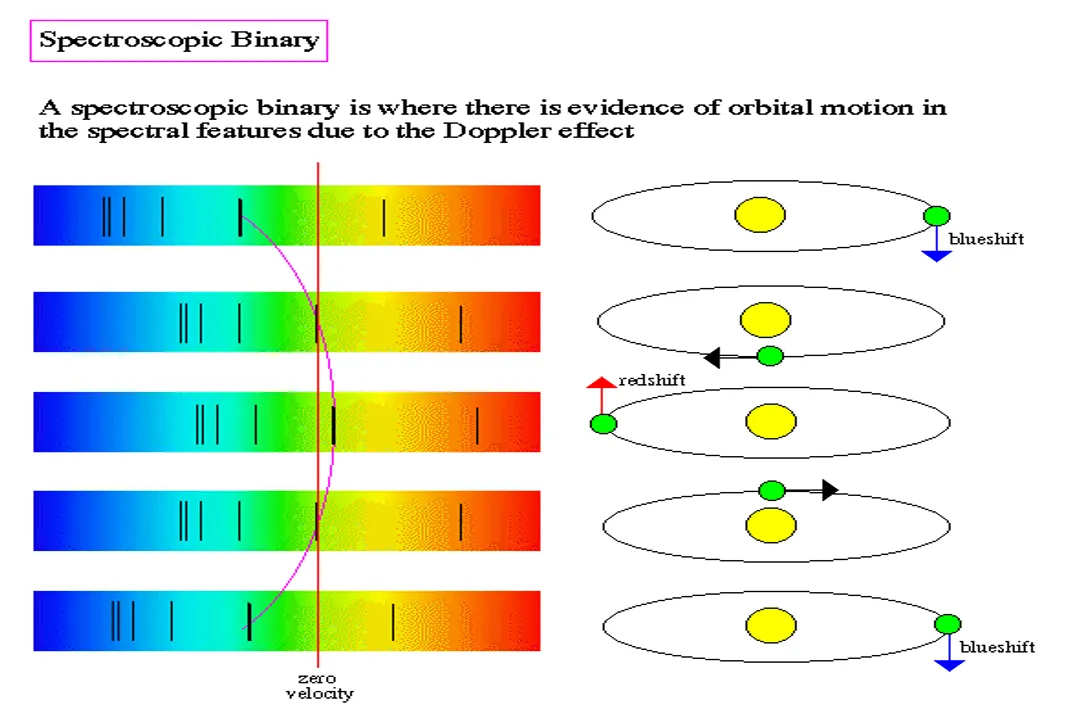
Kepler’s laws, even in their modified Newtonian form, are indispensable tools for stellar astrophysics because they connect timing measurements to fundamental physical properties. [3][9] The shape described by the first law—the ellipse—is quantified by the eccentricity (). [4] In binary systems, eccentricity dictates how much the orbital speed changes. [3] A highly eccentric orbit means the stars swing from very slow speeds at apoastron to very high speeds at periastron, creating large, easily measurable Doppler shifts if the system is observed spectroscopically. [1]
In essence, Kepler’s laws provide the blueprint for translating observed motion into intrinsic gravitational properties. Astronomers use the period to scale the size of the orbit, and the combined mass to scale the gravitational force required to maintain that orbit. [6][8] Without this structure, the vast distances and long time scales involved in stellar orbits would yield little more than confusing fluctuations in starlight, rather than concrete measurements of stellar mass, a key ingredient in understanding stellar evolution. [1]
Related Questions
#Citations
Deriving Kepler's Formula for Binary Stars
Kepler's 3rd law applied to binary systems: How can the ...
Developing Kepler's Law of Orbits
5.6: Kepler's Laws
Binary mass function
Kepler's Three Laws
Keplers laws
Lecture 10: How Massive is a Star?
Binary Stars