What can a magnetar do?

Magnetars are among the most extreme objects in the known universe, representing a fascinating, albeit terrifying, endpoint in the life cycle of certain massive stars. These exotic celestial bodies are a specific type of neutron star, but their defining feature—a magnetic field so potent it defies easy comparison—sets them apart from their more common, less flamboyant cousins. [3][4] They are essentially cosmic dynamos, spinning rapidly and possessing magnetic fields that can reach strengths up to a quadrillion times stronger than Earth's own magnetic field. [3][4] To grasp this scale, imagine a magnetic field so powerful it could rearrange the atomic structure of matter itself. [4]
# Stellar Death
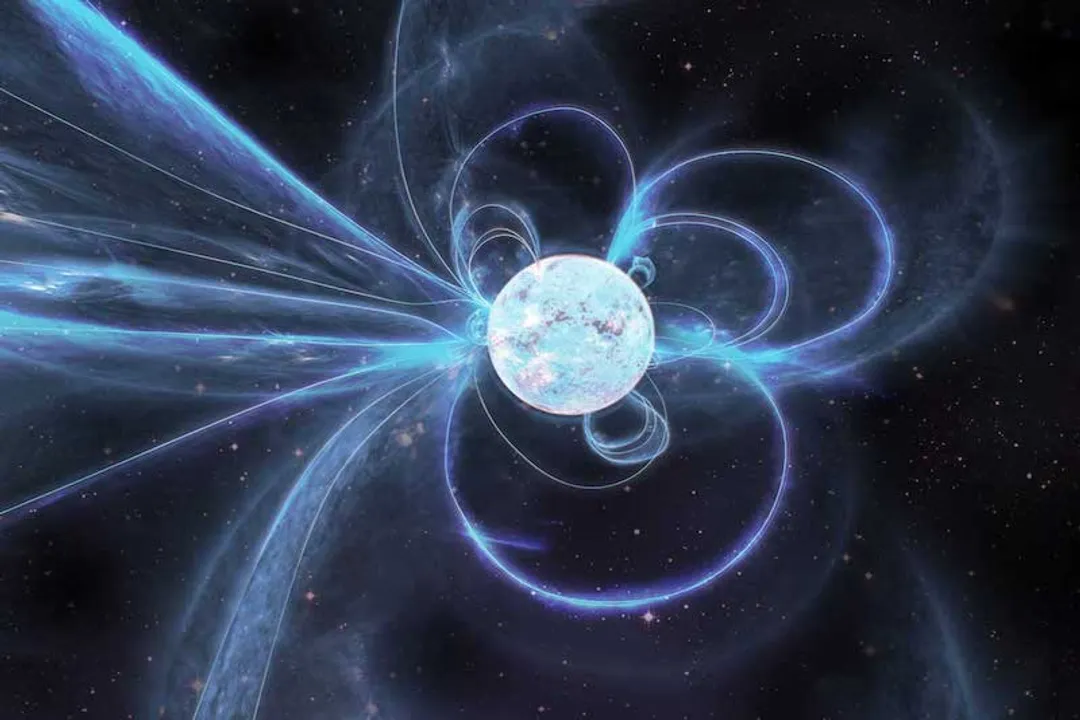
The birth of a magnetar follows a dramatic path reserved for the most gargantuan stars. When a star with an initial mass significantly greater than the Sun exhausts its fuel, gravity overwhelms the internal pressure, causing a catastrophic collapse. [3] This collapse results in a supernova explosion, leaving behind an incredibly dense core. If this remnant core is between about $1.4$ and $3$ times the mass of our Sun, it compresses down into a neutron star. [3] A magnetar is a neutron star that happened to be born with an exceptionally strong initial magnetic field, or whose field was somehow concentrated during the collapse process. [3] Unlike normal neutron stars, the decay of this monstrous magnetic field is the primary source of the magnetar's observable activity, rather than its rotation alone. [1]
# Field Strength
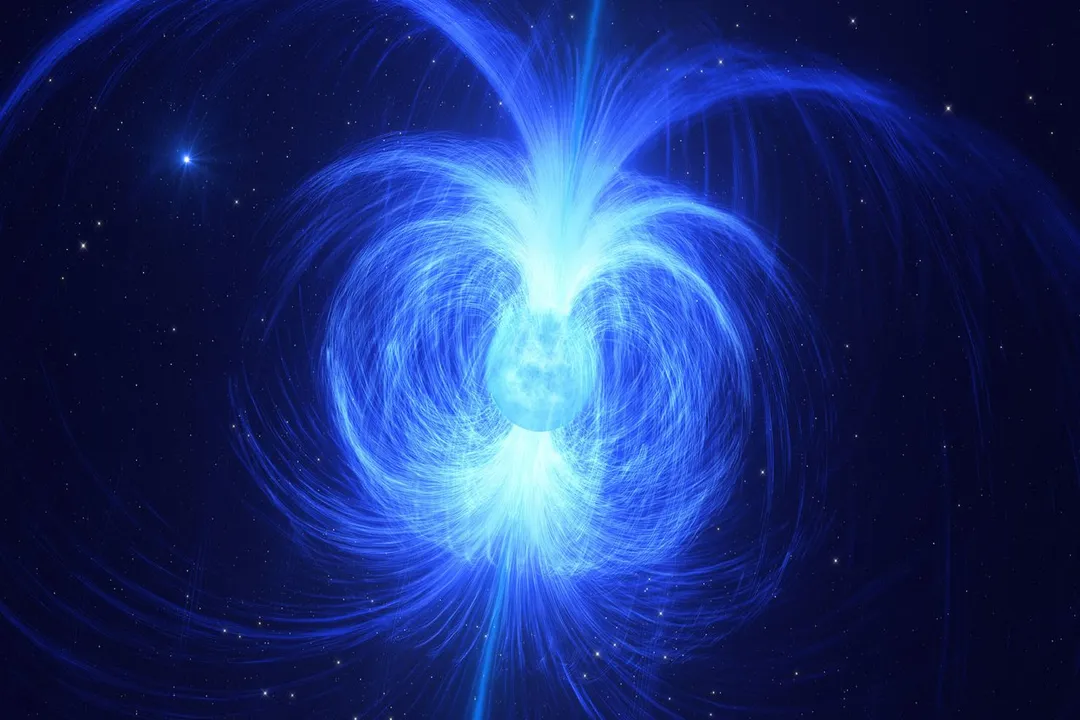
The sheer magnitude of a magnetar's magnetic field is what earns it such a fearsome reputation. These fields are measured in the range of to Gauss. [3] For context, the magnetic field on the surface of the Sun is about $1$ Gauss, while a strong medical MRI machine might produce a field around $30,000$ Gauss. [4] The magnetic field of a magnetar is thus orders of magnitude stronger than anything we can generate or easily comprehend on Earth. [4] This intensity is so great that if a magnetar were to pass within a few hundred miles of Earth, its magnetic field alone would wipe out all electronic data and significantly alter the structure of our planet’s atoms. [9] It is worth noting that while the field strength is immense, the object itself is tiny—a sphere only about $12$ miles across. [3]
The magnetic field is not uniform across the magnetar’s surface. The immense stress caused by this field can lead to ruptures in the star's crust, which is thought to be the source of its most energetic outbursts. [1] Furthermore, because the magnetic field lines are so powerful, they penetrate the star’s crust, influencing the flow of material and energy within the star, essentially acting as a cage or conduit for the star's internal dynamics. [1]

# Energetic Outbursts
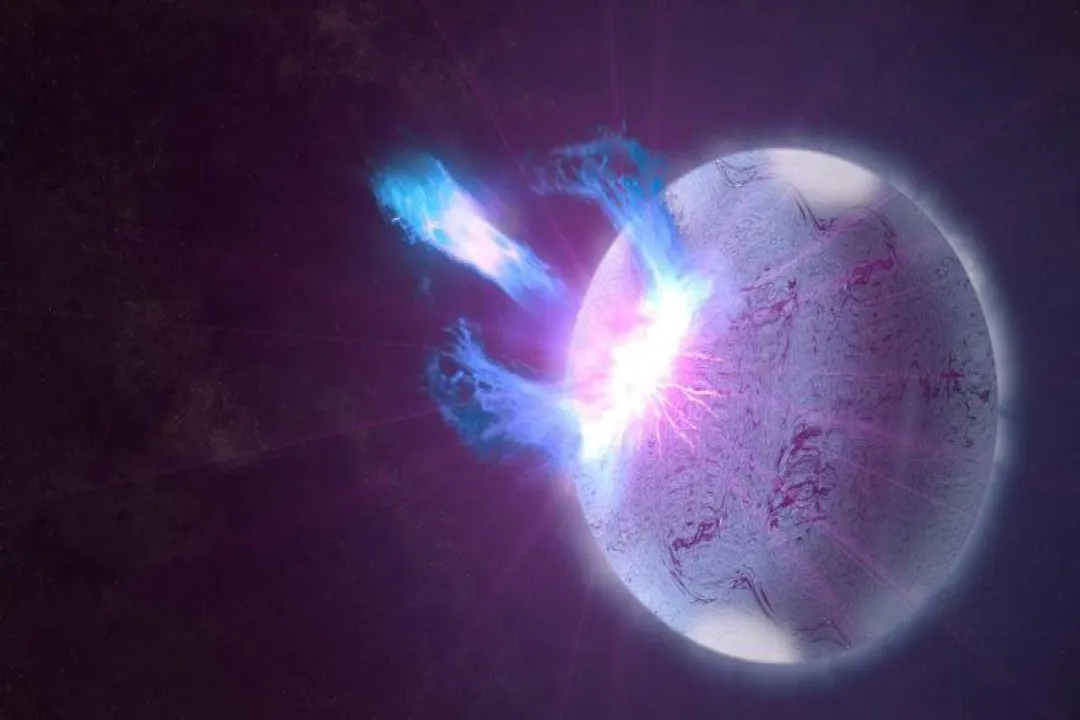
Magnetars are distinguished by their highly erratic and intense behavior, characterized by sporadic, colossal flares and bursts of X-rays and gamma rays. [1] These events are far more energetic than those produced by typical pulsars. [3] The most dramatic events are known as giant flares, which can release more energy in a fraction of a second than our Sun produces in a century. [1] These flares are thought to originate from instabilities in the magnetic field lines, causing them to snap, reconnect, and release vast quantities of stored magnetic energy suddenly. [1][3]
One notable way scientists detect these phenomena is through Soft Gamma Repeaters (SGRs) and Anomalous X-ray Pulsars (AXPs), which are generally considered to be types of magnetars. [3] These objects periodically emit intense bursts of radiation. A significant flare can temporarily outshine entire galaxies, despite originating from a compact object millions of light-years away. [6] For example, in the early hours of April 2023, a major burst was detected by multiple space-based observatories. [6] This specific event was so powerful it registered on equipment designed to monitor solar activity, despite the source star being far outside our solar system. [6] These bursts are not just brief flashes; the energy unleashed can cause a "ringing" or oscillation in the magnetar’s crust, which astronomers can detect as the radiation fades, much like listening to a bell after it has been struck. [1][7]
Observing these events provides direct evidence of the extreme physics at play. The fact that we detect these flares across vast interstellar distances confirms the incredible efficiency with which magnetars convert magnetic energy into electromagnetic radiation. [1][7]
This leads to an interesting point of comparison: while a magnetar's steady rotation generates radio waves like a lighthouse (the pulsar mechanism), its flares are driven by magnetic stress alone. [3] A typical neutron star's luminosity is powered by rotational slowdown, but for a magnetar, the magnetic energy reservoir is so large that its magnetic field decay dictates its observable signature for much longer periods. [1]
# Cosmic Reach
The destructive potential of a magnetar's magnetic field is primarily a concern for objects in very close proximity. The danger isn't just the intense electromagnetic radiation from a flare, but the magnetic field itself. [2] If a magnetar were situated relatively close to Earth—say, within $10,000$ light-years—a major flare could potentially strip away a significant portion of Earth's atmosphere and cause catastrophic damage to the ozone layer. [9] A flare occurring closer than about $3,000$ light-years away might even cause measurable effects on the ionosphere. [2] However, the nearest known magnetar is over $15,000$ light-years away, placing Earth well outside the immediate danger zone from standard flares. [2]
To place this into perspective, let us consider a hypothetical close encounter scenario. If you were to fly a spaceship near a magnetar, the danger depends critically on the distance and the object's activity. [2] At distances greater than about $1,000$ kilometers, the magnetic field might not be strong enough to significantly tear apart a sturdy spacecraft, although the intense gamma-ray emission during a flare would certainly destroy sensitive electronics. [2] At the distance of the Moon, the magnetic field is still incredibly powerful, but the Earth’s own magnetosphere offers significant protection from the radiation, provided a major flare isn't aimed directly at us. [2] For any distant magnetar, the danger diminishes rapidly with the square of the distance, meaning objects at interstellar distances pose no threat to Earth's magnetic environment or life. [9]

# Detecting the Invisible
Because magnetars are often very young neutron stars, they spin down relatively quickly, and their magnetic fields are so intense that they inhibit the emission of detectable radio beams in the traditional pulsar manner. [3] This means that many magnetars are not easily seen as steady, repeating radio sources. [3] Instead, astronomers primarily detect them through their high-energy emissions—the X-rays and gamma rays associated with their magnetic outbursts. [1][3] Observing these short, violent events requires highly sensitive space-based telescopes capable of monitoring the sky constantly for sudden increases in high-energy photons. [6]
The study of magnetars also involves looking at their X-ray pulsations when they are in their quiescent (less active) state. Even then, their X-ray emission is much stronger than expected for a regular neutron star of the same age, a phenomenon attributed to the energy deposited into the star's surface plasma by the massive magnetic field itself. [1] This means that even when they aren't flaring, they are radiating intensely simply because their magnetic field is twisting and straining the star's structure. [1] This baseline X-ray glow serves as a vital signature distinguishing them from other neutron stars. [3]
# Magnetars and Magnetic Fields
The existence of magnetars forces us to think about magnetic fields in a fundamentally new way. It's not just about north and south poles; it's about the energy density stored in the field structure itself. [5] The field lines become so tightly packed that they begin to dominate the star's mechanics. [4] Imagine a massive rubber band wrapped around a dense ball thousands of times; the tension in that rubber band—the magnetic field—is what ultimately dictates how the ball behaves and where it might break. [5]
This leads to a situation where the energy released in a burst comes directly from the configuration of the field, not from rotational energy loss or accretion of matter, which powers most other compact objects. [1] When the magnetic field lines twist, they generate enormous currents within the neutron star's crust, causing mechanical stress that eventually yields in the form of a flare. [5] This is a continuous process of magnetic field decay and restructuring that defines the magnetar's existence over its relatively short lifespan of perhaps $10,000$ years before the field weakens to a level comparable to a standard neutron star. [1]
Considering the energy involved, one helpful way to conceptualize the magnetic pressure is to imagine the field lines physically ripping apart the material of the star's surface. For a magnetar, the magnetic pressure () is comparable to, or even exceeds, the thermal pressure and gravitational forces holding the star together at some layers. [4] This dominance of magnetic forces over thermal and gravitational forces is perhaps the most crucial insight gleaned from studying these phenomena, offering a laboratory for physics under conditions impossible to replicate anywhere else in the universe.
# Current Research
Modern astronomy continually refines our understanding of magnetars through dedicated observations. Projects aimed at studying these objects often use combinations of X-ray and radio telescopes to capture both the primary flaring events and any subsequent, lower-energy emissions. [7] For instance, when a magnetar flares, the emission can sometimes be followed by a radio counterpart, suggesting that the magnetic disturbance drives particles outwards at high speed, creating a transient radio source. [7] These follow-up observations are essential because they allow researchers to map the energy cascade from the initial magnetic snap to the final radiation signature. [1]
Scientists are also searching for magnetars in other environments, such as within supernova remnants, to better trace their formation path. [3] While they are rare—perhaps only about $10%$ of neutron stars are born as magnetars—their bright emissions make them detectable even across great distances, giving us a statistically significant sample to study. [3] The ultimate goal remains understanding the precise mechanism that generates such extraordinarily powerful magnetic fields during the core collapse phase, a process still debated in astrophysical modeling. [3]
# Summary of Capabilities
What a magnetar can do is fundamentally tied to its magnetic field:
- Generate Extreme Fields: Create magnetic fields up to Gauss, capable of altering atomic structure. [3][4]
- Release Immense Energy: Produce colossal flares that briefly release more energy than the Sun does in $100$ years. [1]
- Emit High-Energy Radiation: Behave as Soft Gamma Repeaters (SGRs) and Anomalous X-ray Pulsars (AXPs) emitting bursts of X-rays and gamma rays. [3]
- Influence Space: If close enough, its field could destroy electronics or damage an atmosphere. [2][9]
- Cause Crustal Dynamics: The magnetic stresses cause starquakes that generate observable radiation ringing. [1][7]
In summary, a magnetar is a brief, spectacular, and incredibly powerful phase in the life of a neutron star, defined by a magnetic field so dominant that it dictates every aspect of the object's visible behavior before eventually decaying into a less dramatic, albeit still exotic, stellar remnant. [1]
#Videos
What if a Magnetar Came Close to Earth? - YouTube
Related Questions
#Citations
Magnetars: Special Stars With That Attractive Charm
How lethal is flying by a magnetar? : r/space - Reddit
What is a magnetar? - EarthSky
Sheer Magnetism: What's a Magnetar? - Museum of Science
What is a magnetar? - Facebook
Scientists unlock mysteries of magnetars, the most magnetic objects ...
What if a Magnetar Came Close to Earth? - YouTube
Magnetars Origin Story - NOIRLab
What is a magnetar, and what could it do to the Earth? - Quora