Ray articles
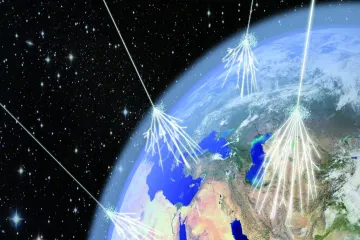
What are the three main components dividing the space radiation environment for missions near or beyond Earth?
What characterizes Galactic Cosmic Rays (GCRs) regarding their origin and persistence?
What is the typical source and timing associated with Solar Particle Events (SPEs)?
What forms the zones of trapped radiation encircling our planet near Earth?
What percentage of Galactic Cosmic Rays typically consists of protons (Hydrogen Nuclei)?
How is secondary radiation typically created in the context of space travel?
Which types of particles are often included in the shower of secondary radiation generated upon impact?
Why are materials rich in hydrogen, like polyethylene, often preferred for shielding against GCRs compared to dense materials like aluminum?
How does the intensity of a major Solar Particle Event (SPE) compare to the background flux of Galactic Cosmic Rays (GCRs)?
For missions operating in Low Earth Orbit (LEO), such as the ISS, what represents a distinct radiation concern?
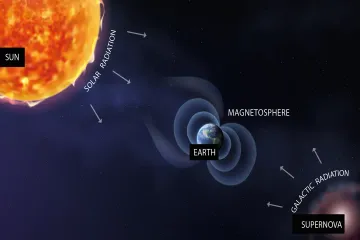
What are cosmic rays primarily composed of?
Where do the primary cosmic ray particles originate from?
What protects Earth by deflecting the majority of charged primary cosmic ray particles?
What happens when primary cosmic rays collide with the atmosphere?
If a regular, ground-level cosmic ray passes through a person, what sensation would be felt?
What causes astronauts outside a spacecraft to occasionally perceive a brief flash of light?
How much energy did the
What is the primary hazard associated with the cascade effect of an Ultra-High-Energy Cosmic Ray (UHECR) hitting tissue?
How does the radiation dose rate for an astronaut on the International Space Station compare to that on Earth's surface?