Gases articles
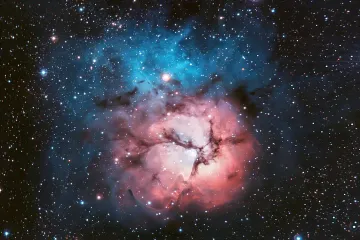
What two elements constitute nearly 99% of the gaseous content in many large, diffuse nebulae?
Which type of hydrogen region is characterized by ionized hydrogen ($ ext{H}^+$) and is often called an emission nebula?
What is the primary function of dust grains in the formation of molecular hydrogen ($ ext{H}_2$) within a nebula?
Which specific element, when ionized, often emits light in the green or blue part of the spectrum in nebulae?
What is the general upper limit for elements synthesized within the shell ejected by a dying, mid-mass star (Planetary Nebula)?
What physical phenomenon, alongside thermal motion, causes the broadening of spectral emission lines in nebulae?
What characteristic is shared by both Dark Nebulae and Molecular Clouds regarding their hydrogen state?
Which type of stellar remnant is responsible for creating and scattering elements *heavier* than iron into the interstellar medium?
Approximately what percentage of the total mass of the interstellar medium do dust grains constitute?
What specific molecule is a significant component of Integrated Flux Nebulae (IFN)?
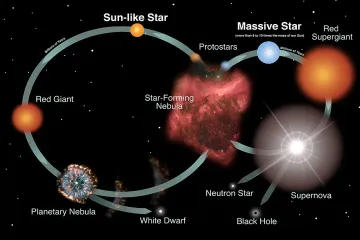
Which two elements overwhelmingly dominate the elemental composition of any given nebula by mass?
What is the typical percentage contribution of hydrogen to the total mass of a nebula?
What is the function of hydrogen gas in a star-forming region?
In a pristine nebula, where does the majority of the helium present originate from?
In which specific types of nebulae might the amount of helium be significantly elevated compared to a standard star-forming cloud?
While comprising only a small fraction of the mass, what key role do the trace heavier elements play in nebulae?
What process involving trace gases creates the distinct colors seen in emission nebulae?
When ionized, which specific element is mentioned as often emitting green or blue light?
What necessity do heavier elements provide for the potential formation of terrestrial planets like Earth?
How are nebulae chemically related to the Interstellar Medium (ISM)?