What are KBOs and TNOs?
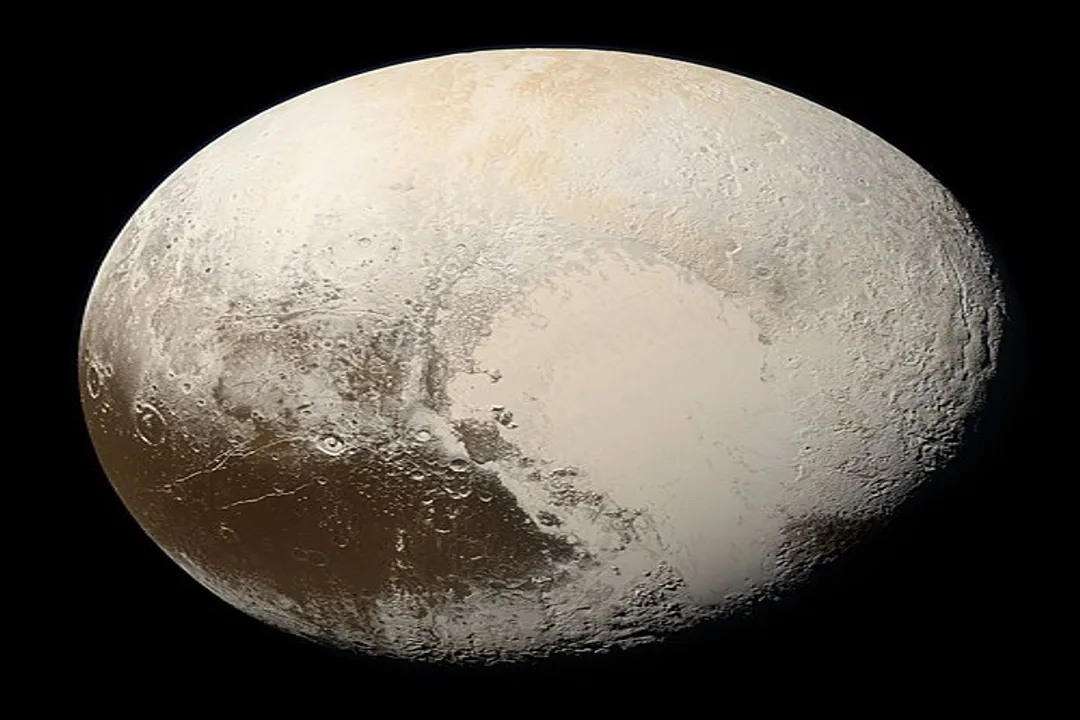
Beyond the orbit of Neptune, the solar system transitions from the familiar realm of gas giants into a vast, frigid frontier filled with remnants from the era of planetary formation. This region contains thousands of icy bodies collectively known as Trans-Neptunian Objects (TNOs). [1] While these objects are often discussed alongside the Kuiper Belt, the nomenclature can be confusing, as the terms are frequently used interchangeably despite having distinct technical meanings. [9]
Understanding this region requires shifting one’s perspective on what constitutes a planet or a minor body. In this outer expanse, the Sun appears merely as a brilliant star, and the gravitational influence of the major planets has sculpted the paths of smaller objects into complex, often chaotic orbits. [3][5] These distant worlds act as a frozen archive, preserving the chemical and physical conditions that existed billions of years ago when the solar system was still taking shape. [2]
# Defining TNOs
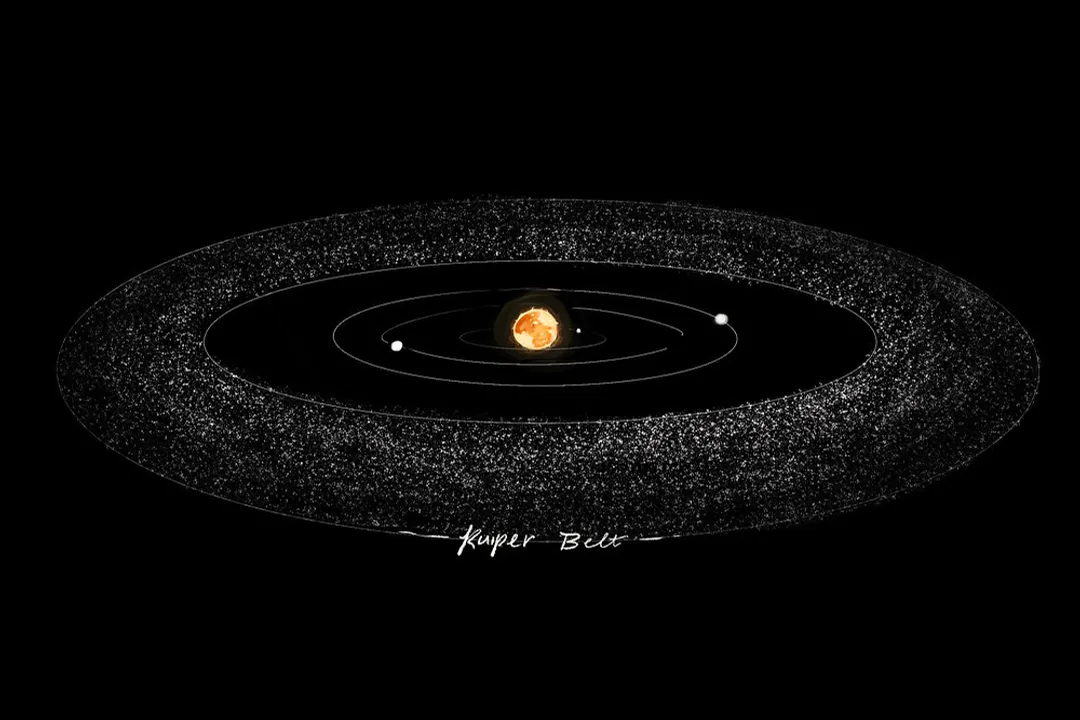
A Trans-Neptunian Object is defined primarily by its orbit. By the simplest standard, any object in the solar system with an average distance from the Sun (a semi-major axis) greater than that of Neptune is considered a TNO. [1][5] This category is broad and encompasses a diverse array of populations, including those in the Kuiper Belt, the scattered disc, and the inner Oort cloud. [1]
The distinction between a TNO and a Kuiper Belt Object (KBO) often causes confusion. Think of TNO as a parent category and KBO as a specific subset. A KBO must orbit within a specific range, typically between 30 and 50 astronomical units (AU) from the Sun, where the Kuiper Belt resides. [3][6] Therefore, all KBOs are TNOs, but not every TNO is a KBO. [9] Objects that exist far beyond the Kuiper Belt, such as those in the scattered disc, are TNOs but would not accurately be described as Kuiper Belt Objects. [1]
This classification is vital because the dynamics of these objects differ based on their location. KBOs are often categorized as "classical," meaning they occupy relatively stable, circular-like orbits that have not been significantly altered by Neptune's gravity. [6] In contrast, other TNOs, such as those in the scattered disc, move on highly elliptical and inclined paths, suggesting they were jostled out of their original positions by gravitational interactions with the gas giants during the early history of the solar system. [1]
# Kuiper Belt
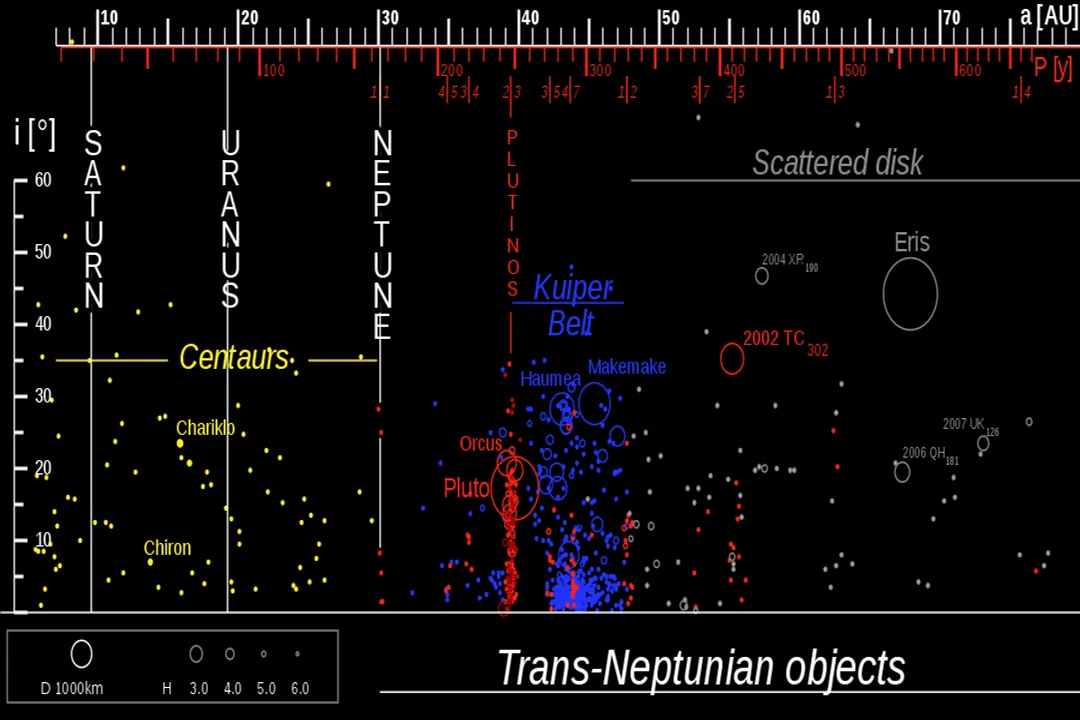
The Kuiper Belt is the most famous population of TNOs, acting as a massive, donut-shaped ring of icy debris extending from just past Neptune’s orbit. [3] It is often compared to the asteroid belt between Mars and Jupiter, though the scale difference is profound. The Kuiper Belt is much larger, contains significantly more mass, and is composed primarily of frozen volatiles like methane, ammonia, and water ice, rather than the rock and metal found in the inner solar system's asteroid belt. [3][7]
Within the Kuiper Belt, astronomers identify different classes of objects based on their orbital resonance with Neptune. [1] Resonant TNOs, such as Pluto, are locked in a rhythmic gravitational relationship with the planet. For example, Pluto completes two orbits around the Sun for every three completed by Neptune, a condition known as a 2:3 resonance. [1] This gravitational dance protects these objects from colliding with Neptune and keeps their orbits stable over billions of years. [6]
# Surface Composition
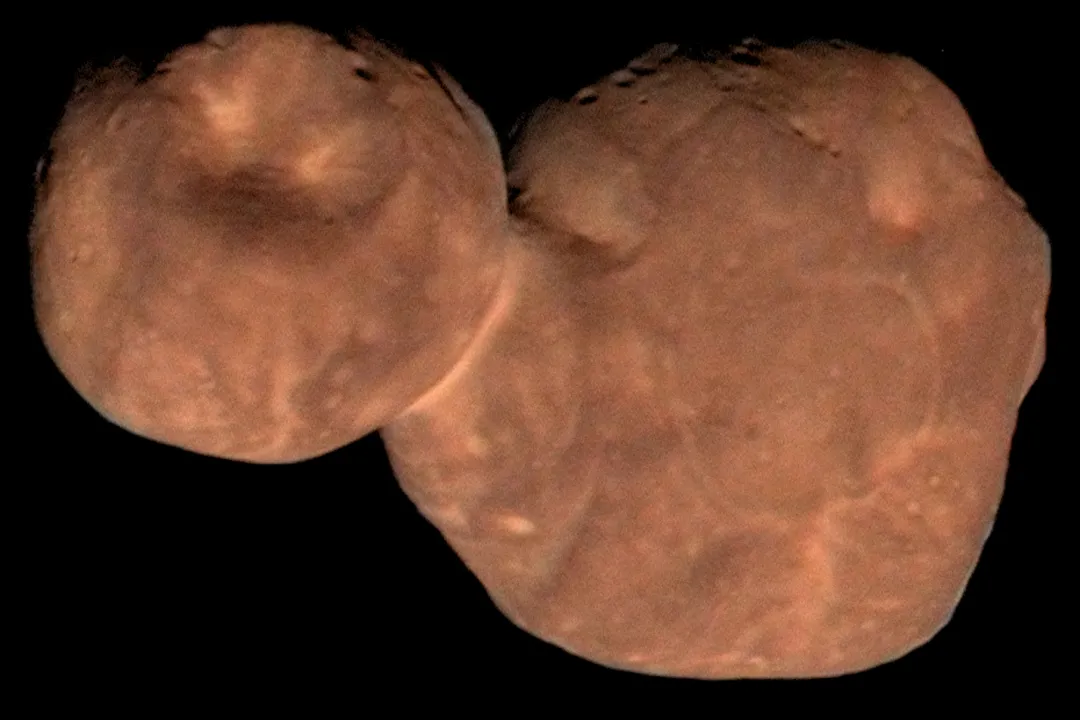
Recent advancements in observational technology, particularly from the James Webb Space Telescope, have allowed astronomers to analyze the chemical makeup of these distant bodies. [2] Surfaces of TNOs are frequently coated in complex organic compounds, often referred to as tholins, which give many of these objects a reddish hue. [2]
The composition of these surfaces provides a timeline of their evolution. Objects that appear "younger" may have undergone recent surface changes due to impacts or cryovolcanism—essentially icy volcanoes erupting beneath the surface. [2] By comparing the spectral data of various TNOs, researchers can infer whether an object has remained pristine since its formation or if it has experienced geological activity. [2] This information is crucial for understanding how planetary building blocks vary in composition depending on their distance from the Sun.
# Orbital Dynamics
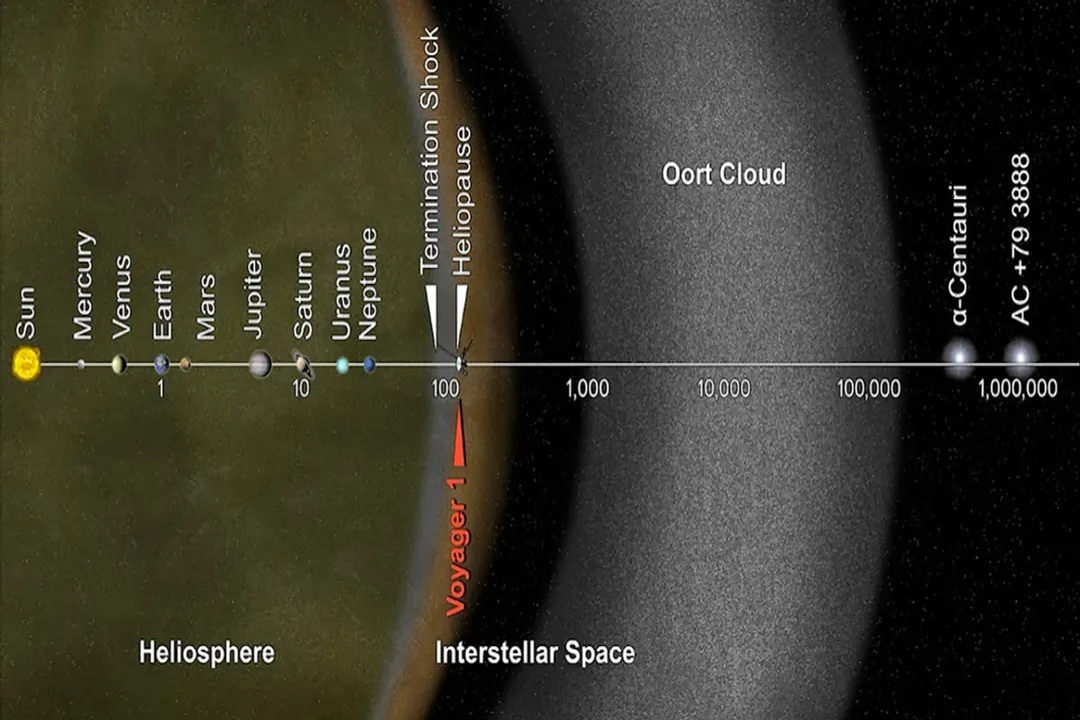
To visualize the distribution of these objects, consider a table of the primary populations found beyond Neptune:
| Population | Orbital Characteristic | Stability |
|---|---|---|
| Classical KBO | Near-circular, 30–50 AU | Generally stable |
| Resonant TNO | Integer ratio with Neptune | Stable due to gravity |
| Scattered Disc | Highly eccentric, inclined | Unstable/Transitionary |
| Detached Objects | Extreme orbits, far from Neptune | Likely perturbed by distant forces |
The scattered disc objects are particularly fascinating because their orbits often take them far beyond the main belt, yet they keep returning to the vicinity of Neptune. [1] This suggests that they are not permanently bound to the Kuiper Belt but are instead in a state of gravitational transition. [1] Some astronomers hypothesize that a massive, distant, and undiscovered planet—sometimes called "Planet Nine"—could be responsible for carving out the distinct, extreme orbits of detached TNOs like Sedna. [1]
# Detection Challenges
Observing TNOs is notoriously difficult. Because they are small, cold, and extremely far away, they reflect very little sunlight. Unlike planets, which are bright and move predictably, TNOs appear as faint, stationary pinpoints of light against a crowded background of distant stars. [7]
Astronomers often rely on a technique called stellar occultation to study them. [4] This involves monitoring a distant star and waiting for a TNO to pass directly in front of it, momentarily blocking the light. [4] By timing how long the star is hidden, researchers can calculate the precise size and shape of the object, even if it is too small to be resolved by a telescope directly. [4] This method has been essential for defining the physical characteristics of objects that are otherwise impossible to see clearly. [4]
# Historical Context
The search for these objects was a long, painstaking endeavor that began decades before the first TNO was officially confirmed in 1992. [8] For a long time, Pluto was viewed as a singular oddity, a lone planet on the edge of the system. The discovery of the first TNOs fundamentally changed this view, reclassifying Pluto not as a unique planet, but as the largest, most visible member of a vast, teeming population. [1]
This realization sparked a shift in planetary science. Instead of seeing the solar system as a rigid structure dominated by eight planets, it is now viewed as a dynamic environment where the outer regions are populated by trillions of icy bodies. [7] This transition mirrors our understanding of exoplanetary systems, where debris disks are common, suggesting that the architecture of our own solar system is typical rather than exceptional. [1]
# Original Perspective
If one were to build a mental scale model of the solar system, it helps to compress the distances. If Earth were a grape, Neptune would be about 300 meters away, and the Kuiper Belt would start just a few steps further out. Yet, the TNOs that populate the scattered disc would be kilometers away, drifting in a vast, dark expanse. This gap is not just empty space; it is a repository of history. Every crater on these objects is a record of a collision from the solar system's violent youth.
Viewing these objects as "geological archives" changes how we approach space exploration. An object in the Kuiper Belt is essentially a time capsule. Because these objects are so small, they lack the geological heat to drive the massive tectonic shifts seen on Earth or Mars. Consequently, the surface chemistry we see today is, in many ways, identical to the chemistry present 4.5 billion years ago. Analyzing a TNO is as close to traveling back in time to the early solar system as current physics allows.
The study of TNOs remains one of the most active fields in astronomy. As telescopes improve and survey techniques become more sophisticated, the count of known TNOs continues to grow. Each new discovery adds another data point to our understanding of how planets migrate, how debris is cleared from a star system, and what ingredients were available to form the planets we inhabit today. These distant, icy worlds are not merely debris; they are the keys to unlocking the origins of the solar system.
Related Questions
#Citations
Trans-Neptunian object - Wikipedia
NASA's Webb Reveals the Ancient Surfaces of Trans-Neptunian ...
The Kuiper Belt and Trans-Neptunian Objects - ScienceHolic
TNOs and Centaurs - MIT Planetary Astronomy Lab
What is a Trans Neptunian Object? - Catalina Sky Survey
Trans-Neptunian objects: Facts and Information - Solar System
Searching for Far-Flung Objects - Beyond Earthly Skies
Is it proper to refer to objects beyond Neptune as "Kuiper Belt ...