Where is the Eta Piscium?
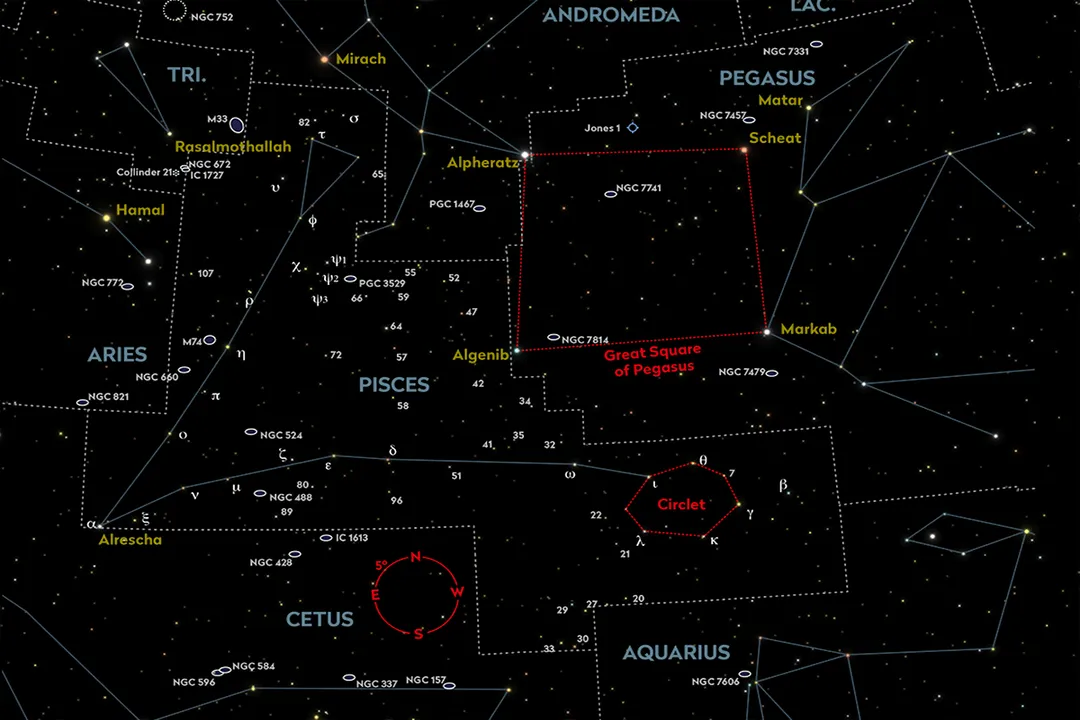
Eta Piscium, frequently identified by its traditional name Alpherg, stands as the brightest beacon within the constellation of Pisces. [1][2] While the constellation is widely recognized for housing the Vernal Equinox, this specific star occupies a position that helps observers delineate the fish-shaped pattern in the night sky. [7] Positioned as a G-type giant star, it offers a fascinating glimpse into the lifecycle of stars that are significantly more advanced in age than our own Sun. [8]
Finding this star is a rewarding exercise for those interested in celestial navigation. It does not merely sit in isolation; it functions as a primary landmark for the constellation. [2] Because the stars that make up Pisces are generally faint, the brightness of Eta Piscium provides a necessary contrast, allowing it to stand out against the backdrop of the zodiac. [3]
# Star Coordinates

The precise location of Eta Piscium is defined by its Right Ascension and Declination, which are constant values in the equatorial coordinate system. For observers tracking its path, the star is located at a Right Ascension of approximately 01h 31m and a Declination of +15° 20'. [1][3] These coordinates place it firmly within the northern celestial hemisphere, though it remains visible from a vast majority of locations on Earth. [5]
To put this location into perspective, imagine the sky as a coordinate grid. Eta Piscium resides in the eastern section of the celestial sphere. Its position is relatively close to the ecliptic, the path the Sun appears to traverse throughout the year. [6] Because of this proximity, the star is occasionally subject to lunar occultations, where the Moon passes directly in front of the star, temporarily blocking it from view. [2] Calculating the exact timing of these events requires precise tracking of the lunar orbit relative to the star’s fixed coordinates.
# Seasonal Visibility
The visibility of Eta Piscium fluctuates based on the time of year, largely influenced by the Earth’s orbit around the Sun. Being part of the Pisces constellation, it is traditionally viewed as an autumn constellation in the Northern Hemisphere. [7] During the months of late summer and early autumn, the star rises earlier in the evening, making it accessible to amateur astronomers for extended periods. [5]
For those in the Southern Hemisphere, the view is similarly accessible, though the perspective shifts. During the peak of the autumn season, the star reaches its highest point in the sky at midnight, offering the clearest opportunity for observation. [1] Because it maintains a visual magnitude of approximately 3.6, it is visible to the naked eye under clear, dark skies, even in areas with moderate light pollution. [1][8]
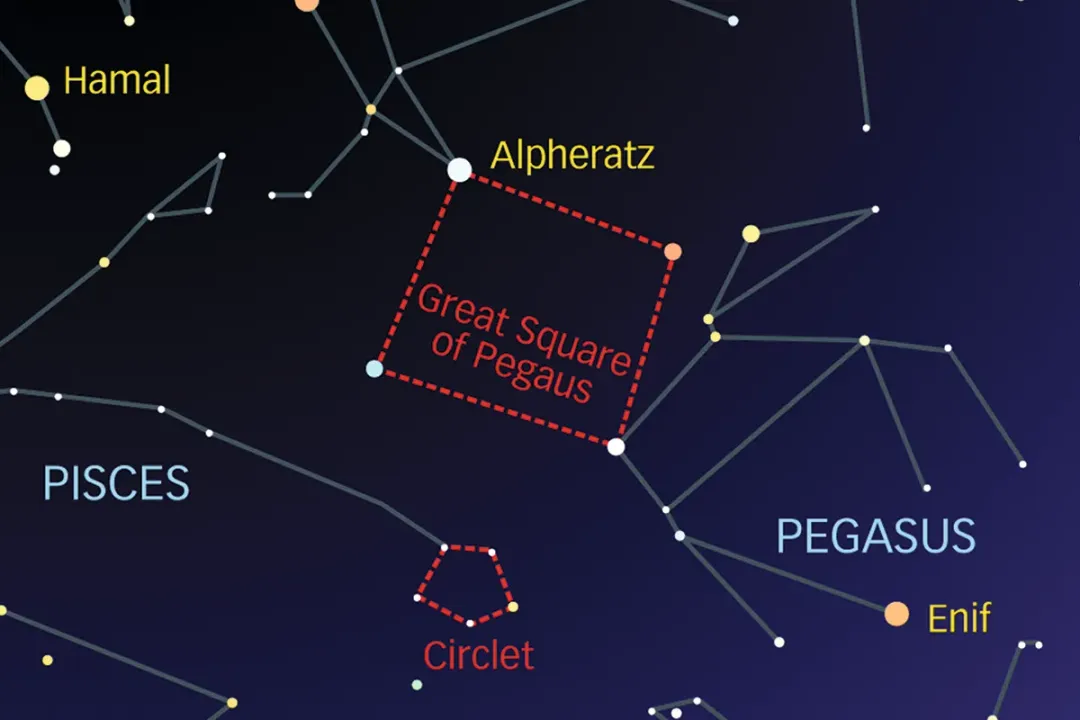
To effectively locate Eta Piscium, one can use the "Great Square" of the neighboring Pegasus constellation as a starting point. By identifying the corner of the square nearest to Pisces and shifting the gaze toward the southeast, observers can scan for the slightly brighter, distinct light of Alpherg. [7] Unlike faint cluster stars, this star holds a steady, singular presence that distinguishes it from the surrounding background clutter.
# Physical Profile

Eta Piscium is classified as a G-type bright giant, a stage in stellar evolution that occurs after a star has exhausted its hydrogen fuel in the core. [2] This classification provides significant data regarding its size and temperature. As a giant, the star has expanded significantly compared to its previous state on the main sequence. It shines with a luminosity several hundred times greater than that of our Sun, which is why it appears so bright from our distance, despite being roughly 300 light-years away. [3][8]
Its surface temperature sits in a range similar to our Sun, which results in a yellow-hued appearance. This yellow tint is a reliable marker for identification. When viewing through a telescope, the color contrast between Eta Piscium and the surrounding, often bluer or fainter stars, becomes more pronounced. [4]
To visualize the scale of this star, consider the following data points that distinguish it from similar stars in the region:
| Property | Value (Approximate) |
|---|---|
| Visual Magnitude | 3.62 |
| Distance | 300 Light-Years |
| Spectral Type | G7 III |
| Temperature | ~4,900 K |
This data confirms that while the star is bright in our sky, its brilliance is a product of its immense size rather than an extreme surface temperature. As it burns through its final stages of life, its outer layers have cooled and expanded, creating the giant classification. [8]
# Naming Paradox
The designation "Eta" typically implies the seventh star in a constellation, often ranked by brightness. However, in the case of Pisces, Eta Piscium is the brightest star, which creates an inconsistency with the standard Bayer designation system. [9] Historically, astronomers assigned Greek letters to stars within a constellation based on a combination of factors, including brightness, position, and legacy naming conventions. [2]
The name "Alpherg" originates from Arabic roots, often interpreted as "the tie" or "the fish's cord," which connects to the mythological depiction of the two fish in the constellation. [8] The disparity between its name "Eta" and its actual status as the brightest star serves as a reminder that the night sky's nomenclature is a blend of different eras and observation techniques. [9] While the Bayer system aimed for standardization, many constellations contain legacy designations that do not follow a strict brightness hierarchy. [3]
# Observation Strategy
Finding Eta Piscium involves more than just looking at a map; it requires understanding the local environment of the sky. For those looking to verify the star’s position, relying solely on electronic tools can sometimes mask the intuitive skill of star hopping.
- Locate Pegasus: Find the Great Square, a prominent asterism in the northern sky.
- Identify the Corner: Focus on the southeastern corner of the square.
- Scan Eastward: Move your field of view away from the square toward the lower arc of Pisces.
- Confirm Magnitude: Look for the singular, steady light that appears brighter than its neighbors. Its magnitude of 3.6 makes it the most reliable point in that region of the sky. [1][5]
This method reduces the reliance on coordinates and allows the observer to build a mental map of the celestial neighborhood. If the star is not visible, it may be due to the time of year or proximity to the horizon. In such cases, waiting for the star to climb higher in the meridian—the line passing directly overhead—is the most effective way to gain clarity. [7]
# Stellar Evolution
The life cycle of Eta Piscium offers insight into the future of our own solar system. As a giant star, it is in a phase where it is fusing heavier elements in its core, having moved past the stable hydrogen-burning phase that defines main-sequence stars. [2] Eventually, such stars will shed their outer layers, leaving behind a dense core that will cool over billions of years.
Understanding this trajectory helps astronomers categorize the population of the galaxy. By studying giants like Alpherg, researchers collect data on how mass influences the duration of a star's life. Stars with greater mass, like this one, burn through their fuel reserves faster than smaller, cooler stars. This pace makes them visible from great distances, even when they are not exceptionally hot. [8]
Observers who appreciate the science behind the lights in the sky often find that knowing the physical state of Eta Piscium changes the viewing experience. Instead of seeing a simple point of light, one can visualize an immense, aging furnace that has already survived for hundreds of millions of years, casting its light across the vacuum of space to reach our eyes. [4]
# Historical Context
The constellation of Pisces has long been a subject of interest due to its alignment with the Vernal Equinox. [6] While Eta Piscium is not the point of the equinox itself, it resides in the region of the sky that has carried cultural significance for millennia. Ancient skywatchers relied on these patterns to track the changing seasons, which dictated agricultural cycles and maritime navigation.
Though many modern observers focus on deep-sky objects like galaxies or nebulae, the brighter stars of Pisces, including Eta Piscium, remain essential for orientation. [7] Without these brighter anchors, mapping the fainter, more distant objects would be significantly more difficult. The star acts as a gateway, providing a starting point for anyone looking to navigate the transition between the autumn and winter skies. [5]
Whether one is a professional astronomer utilizing high-end equipment or a hobbyist identifying constellations from a backyard, this star remains a fundamental component of the night sky's structure. Its accessibility, combined with the mystery of its evolution and its misaligned naming, makes it a subject that remains relevant to the study of the stars. [8] It stands not just as a point on a map, but as a testament to the complexities of the universe we observe from Earth.
Related Questions
#Citations
Alpherg - η Piscium (eta Piscium) - Star in Pisces | TheSkyLive
Star Facts: Eta Piscium - Type, Size, Color, & Distance
Eta Piscium - The Constellations
Alpherg Eta Piscium - Star Profile - Staracle
Star Eta Piscium | Pisces Constellation - Go-Astronomy.com
Pisces | Astronomy and Astrophysics | Research Starters - EBSCO
A guide to the constellation Pisces - BBC Sky at Night Magazine
Alpherg (Eta Piscium): Star System, Name, Location, Constellation
Harford - Facebook