What is the mythology of Denebola?
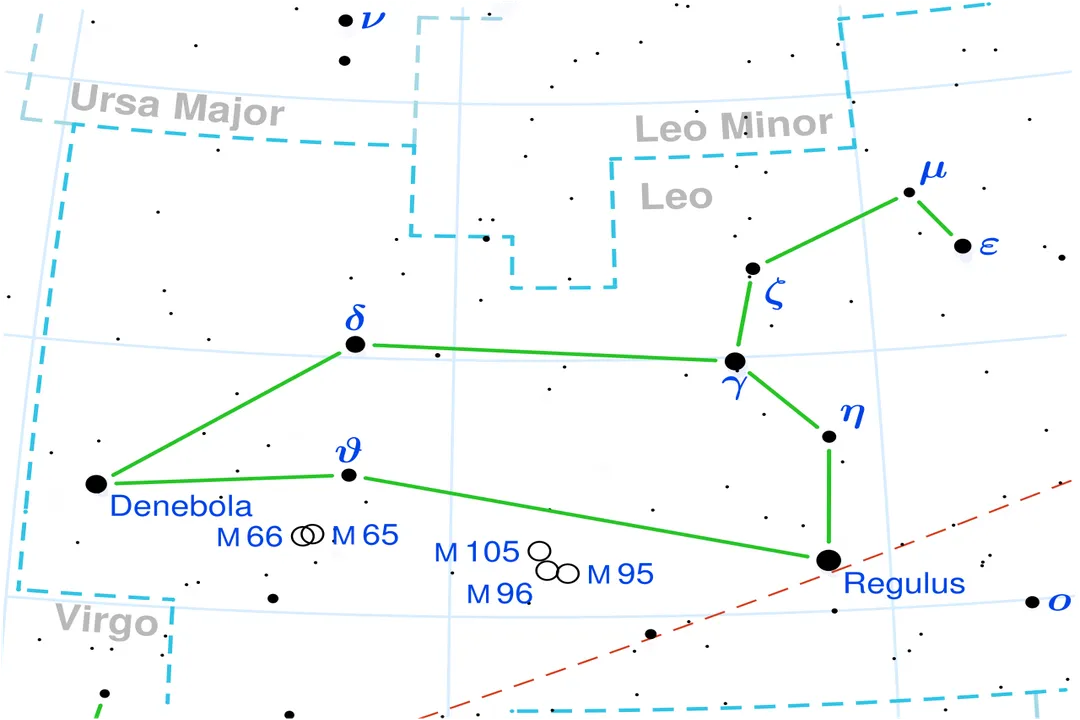
Denebola marks the tip of the tail of the constellation Leo. While many stars in the night sky gain attention for their brilliance or their position in central galactic alignments, this particular star holds a specific reputation for representing the end of a process or a sudden shift in the status quo. [2][4][9] Astronomers, astrologers, and historians have looked at this star through different lenses, creating a unique intersection of scientific data and symbolic meaning that distinguishes it from other navigational markers in the zodiac. [5][6]
# Star Etymology
The name Denebola is derived from the Arabic phrase Deneb Alased, which translates directly to "the tail of the lion". [2][6] Throughout history, astronomers across different cultures identified this star by its physical location on the celestial lion. It does not carry the same aggressive or regal connotations often associated with the heart of the constellation, Regulus, but instead defines the boundary of the figure. [4][5] This position at the very end of the constellation establishes the star as a finishing point, a tail-end of the energy that the lion represents. [9]
The naming conventions reflect a practical approach to stargazing. Ancient observers utilized the stars to map the night sky for navigation and agricultural timing. By naming the star for its anatomy within the constellation, they created a clear, mnemonic device. This nomenclature persists today, allowing amateur astronomers to quickly identify the rear of the lion by locating the star that sits furthest from the lion's head. [9]
# Mythological Context
In traditional Greek mythology, the constellation Leo represents the Nemean Lion, a beast with impenetrable hide that Hercules was tasked to slay. While the myths emphasize the struggle between the hero and the beast, the star Denebola represents the conclusion of this figure. [8] In many symbolic systems, the tail of an animal functions as the rudder or the balancer. If the lion represents power, pride, and sovereignty, the tail—where Denebola resides—represents the potential for that power to dissipate or change direction. [1][5]
Some interpretive traditions view the tail as the point of vulnerability. Unlike the main body of the lion, which stands for strength and dominance, the tail is flexible and agile. This mythic association feeds into the later astrological theories that suggest the star represents a deviation from the established norm. It is not about raw force, but rather the reaction to force. [2] When the lion’s path is blocked or the established order is challenged, the tail moves. This movement is where the narrative of Denebola shifts from one of strength to one of adaptation. [1][3]
# Astrological Interpretation
Astrologers often refer to Denebola as "the changer" or the star of unorthodoxy. [1][3] While the rest of Leo is associated with traditional leadership, confidence, and public display, Denebola acts as a counterweight. It is frequently linked to individuals who do not fit into conventional structures or who feel a drive to break away from societal expectations. [2][7]
The influence of this star is often described as swift and occasionally disruptive. It does not demand the slow, steady persistence of other celestial bodies; instead, it demands that the status quo be examined. Those who feel the influence of this star in their charts are often described as misfits or "black sheep" who find strength in their isolation rather than trying to force themselves into groups that do not value their specific perspective. [1][3]
This interpretation highlights a clear divergence from the standard Leo archetype. If Leo is the king sitting on the throne, Denebola is the advisor whispering that the throne needs to move, or the person walking away from the court entirely. This makes the star significant for understanding the pressure to conform versus the need for individual expression. [2]
# Scientific Profile
From a strictly scientific perspective, Denebola is a bright star located approximately 36 light-years from Earth. [6] It is classified as an A-type main-sequence star, meaning it is hotter and more luminous than the Sun. It appears relatively bright in the night sky, though it is significantly dimmer than the primary stars within the Leo constellation, such as Regulus or Denebola's neighbors. [9]
Because it is a main-sequence star, it is currently in a stable phase of its lifecycle, fusing hydrogen into helium in its core. Its relatively close proximity to Earth makes it an object of study for astronomers interested in debris disks. Observations have suggested the presence of dust around the star, which hints at the potential existence of planetary systems. This scientific reality offers a grounded counterpoint to the mythological and astrological weight attributed to it. While one system sees a rebel or a social outcast, the other sees a burning ball of gas likely surrounded by a ring of cold, rocky debris. [6][9]
# Comparative Analysis
The way different disciplines treat Denebola reveals much about how humanity assigns meaning to the night sky. The following table provides a breakdown of how the star is perceived across these three primary lenses:
| Perspective | Core Characteristic | Symbolic Value |
|---|---|---|
| Scientific | A-type main sequence star | Stability and stellar evolution |
| Astrological | Unorthodoxy and rebellion | Deviation from societal norms |
| Mythological | The tail of the lion | The end point of power or strength |
This table clarifies that there is no singular "truth" regarding the star, but rather a spectrum of utility. The scientific perspective allows for navigation and physical study, while the mythological and astrological perspectives allow for the projection of human social dynamics onto the cosmos.
# Practical Considerations
For those interested in the star’s symbolic influence, the focus is rarely on how to "use" the star, but rather how to integrate the energy it represents. The archetype of the "black sheep" associated with Denebola is often viewed negatively, but it can be reframed as an indicator of necessary social correction.
If an individual consistently finds themselves at odds with their environment, the folklore surrounding this star suggests the following reflective approach:
- Assess the Resistance: Determine if the friction with the status quo is based on a difference of values or simply a desire to be contrary.
- Evaluate the Objective: Ask whether the current path is one of genuine individual growth or merely a reaction to external pressure.
- Accept the Position: If the unconventional path is indeed the authentic one, acknowledge the role of the outsider. Much like the tail of the lion, the outlier provides balance and redirection to the whole. [1][3]
This practical application moves the star from an abstract point in the sky to a tool for personal introspection. It turns the "misfortune" of being an outcast into the "advantage" of having a unique perspective.
# Modern Relevance
Today, Denebola serves as a reminder of the duality inherent in celestial interpretation. It remains a physical object—a mass of plasma in the vastness of space—that scientists monitor for debris, yet it simultaneously functions as a cultural symbol for anyone who feels the urge to defy expectations. [3][6]
By balancing the scientific, mythological, and astrological views, the star becomes more than just a coordinate in the constellation Leo. It becomes a testament to how people attempt to find meaning in the patterns above. Whether viewed through a telescope or through the lens of ancient storytelling, the "Tail of the Lion" continues to occupy a space that invites inquiry and challenges the observer to think differently about their place in the order of things. [5][9]
Related Questions
#Citations
The Changer: On the Fixed Star Denebola - Recent Bedroom
Denebola - Constellations of Words
Fixed Star Denebola - Medium
Denebola is a bright fixed star located in the tail of the constellation ...
Denebola - An Interesting Tail... - Colorado Public Radio
Denebola - Wikipedia
Denebola Fixed Star Astrology, Beta (β) Leo Constellation
The Message in the Stars - Leo - Berean Insights
Meet Denebola, and Catch a Lion by the Tail - Sky & Telescope